
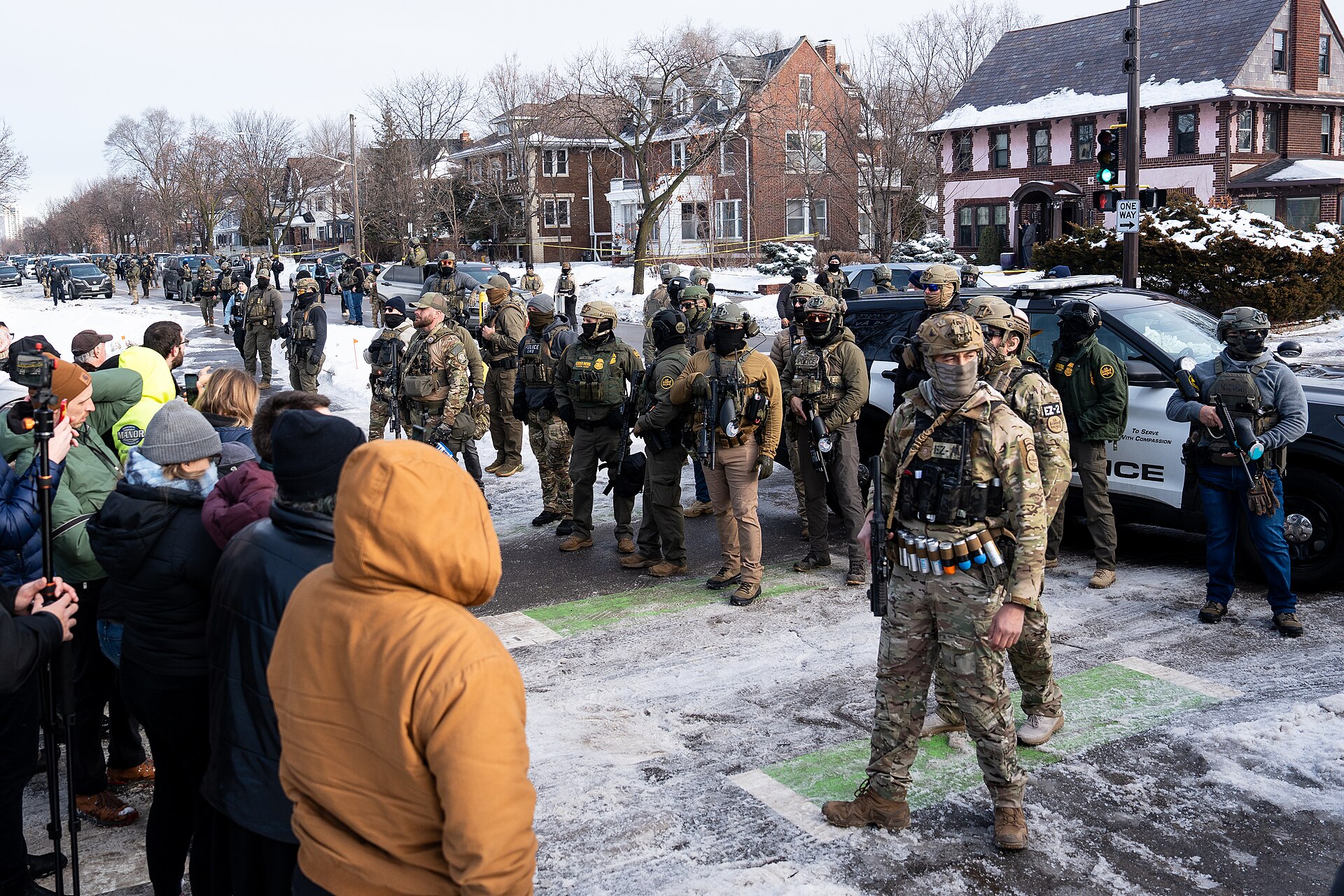
It is hard to think of a more extreme example of a federal government effort to “commandeer” state or local government action than the Department of Homeland Security’s “Operation Metro Surge” in the Twin Cities. President Trump and AG Bondi disapprove of policy decisions made by Minnesota and Minneapolis elected officials, from the way they have chosen to prosecute federal benefits fraud cases to their limitations on cooperation with immigration enforcement agencies. So in order to coerce Governor Tim Walz or Mayor Jacob Frey to comply with its preferred policies, the Trump administration has deployed thousands of ICE and CBP agents to terrorize the people who voted for them (and who largely did not vote for Trump). On this reading, Minnesota’s lawsuit alleging, among other things, that Operation Metro Surge violates the Tenth Amendment’s prohibition on commandeering should be a slam dunk for the state.
So why did Judge Katherine Menendez (a Biden appointee) deny the state’s request for a preliminary injunction kicking ICE out of its borders? As DHS has conducted its deadly operations in Minnesota, I’ve been continuing to think about the Trump 2.0 phenomenon that in a previous blog post I described as “federalism by extortion”: its preference to conduct its intergovernmental relations using threats of extraordinary punishments. Understanding the novelty of the Trump administration’s assault on state and local governments reveals some important limits of established federalism doctrine, making the prospects for judicial relief in these circumstances look more fleeting than one might have assumed.
Judge Mendendez’s January 31 opinion is a case in point. To start, she expressed some doubt that Operation Metro Surge falls within the scope of the Tenth Amendment’s anticommandeering doctrine at all. As she points out, all of the cases in which the Supreme Court has upheld this doctrine involve states’ challenges to acts of Congress. According to the Court, these statutes—as Justice Scalia wrote of the Brady Handgun Violence Prevention Act in Printz v. United States—improperly sought to “direct” state officials “to participate … in the administration of a federally enacted regulatory scheme.” Operation Metro Surge, of course, is not an act of Congress, but (ostensibly) a law enforcement action by an Executive Branch agency.
Judge Menendez did not go so far as to endorse the view that this prohibition on commandeering exempts the Executive Branch entirely. But she did conclude that applying this doctrine to an operation by a federal law enforcement agency would be “unprecedented,” and declined to extend the law in this way at the preliminary injunction stage. She also articulated various other concerns with the prospect of a judge enjoining law enforcement actions: from the worry that this might exceed her equitable authority or the state’s standing under United States v. Texas, to the possibility that scrutiny over agencies’ motivation might “venture into a uniquely controversial political question.”
A “surge” of armed federal agents might seem on its face to be far more coercive than anything at stake in the Supreme Court’s anticommandeering and related case law. Chief Justice Roberts in NFIB v. Sebelius described the Affordable Care Act’s Medicaid expansion as a “gun to the head,” but try telling that to Renee Good, Julio Sosa Celis, or Alex Pretti. But it is not obviously clear—at least not obviously enough to secure preliminary relief that could put an end to the operation—that this kind of law enforcement action falls within the scope of constitutional doctrine designed to protect states from federal coercion.
Even assuming that the anticommandeering doctrine does ultimately cover this kind of federal government behavior, this case reveals a further difficulty in applying established federalism paradigms to the Trump administration’s exercise of federal power. Although I might not be as hesitant as Judge Menendez to credit DHS’s argument that its goal was simply to enforce the law, there is an important sense in which Operation Metro Surge is also not really an attempt to commandeer state and local cooperation with immigration enforcement. Of course, this is straightforwardly what Trump administration officials such as Pam Bondi or Tom Homan have said in public. But it is hard to take seriously the notion that Governor Walz or Mayor Frey could have avoided this operation, or could even end it now, by agreeing to assist ICE. In fact, despite the administration’s characterization of Minnesota as a “sanctuary” jurisdiction, the state already has a law requiring officials to notify ICE when noncitizens with felony convictions are released, and plenty of Minnesota counties voluntarily hold noncitizens in custody at ICE’s request.
In my view, the Trump administration did not choose Minnesota or Minneapolis as a target because it wanted to “commandeer” their participation in the federal immigration enforcement scheme. Rather, it wanted to punish them not only for their pre-existing immigration policy choices, but also for unrelated political reasons: for example, because the state’s governor was Kamala Harris’s running mate, or because the city is home to a large population of Somali Americans and was the site of George Floyd’s murder. As President Trump helpfully clarified, Operation Metro Surge was meant as a “DAY OF RECKONING & RETRIBUTION” for members of a political community cast as the administration’s political enemies.
Federalism by extortion is a flexible and opportunistic mode of governance. Clearly, the administration is happy to see some local governments—such as Louisville, Baltimore, or Memphis—cave to its pressure tactics and cooperate with its aims. But practitioners of federalism by extortion do not simply target jurisdictions they believe might be unable to refuse their offers. They also go after places they expect to refuse those offers, since this provides an opportunity to demonstrate the administration’s resolve to dole out punishment. By pursuing either of these two aims (i.e. seeking concessions or publicly imposing punishments), the administration also works towards a third, which is to change the cost-benefit calculus for jurisdictions that are not direct targets. All state and local government leaders now have to account for the possibility that they might be next, and weigh the risk of punishment against the rewards of compliance.
None of this is to say that constitutional federalism protections should not apply to something like Operation Metro Surge. Courts could very well take at face value Bondi and Homan’s surface-level attempts to compel immigration cooperation using the threat of an ICE invasion. Judge Menendez certainly left herself room to conclude that this is unconstitutional commandeering—though only at a later date, after DHS may have already ended the operation of its own accord.
The point is that existing doctrine may not be up to the task of restraining the Trump administration’s federalism by extortion. This doctrine may have worked given the assumption of a federal government that is interested in building a coherent regulatory program, setting the terms on which it can seek states’ participation. A world in which federal power seeks to subjugate state and local governments as political enemies requires a new constitutional theory of federalism—if this is a world where constitutional constraints apply at all.
Cross-posted at Dorf on Law