
The Most Important Supreme Court Case in Copyright Law: Sony Corp. v. Universal City Studios (1984)

[Editors’ note: This is the fifth in our series, What Is the Most Important U.S. Supreme Court Case in Your Area of the Law? The first four installments are here, here, here, and here.]

There have been several important copyright cases before the Supreme Court since the first, Wheaton v. Peters, in 1834 (over, appropriately enough, the copyright in the Supreme Court’s reports). But the most important to me personally is Sony v. Universal, also known as “the Betamax case.” The Sony case, as is widely known, held that recording a program at home in order to watch it later—”time-shifting”—is a fair use. It also devised a very influential test for determining the liability of manufacturers and service providers for infringement committed by users, one that asked only whether the product or service was “capable of substantial noninfringing uses.” Undeniably Sony is an important case, but then so are Bleistein v. Donaldson Lithographing, Baker v. Selden, CCNV v. Reid, Burrow-Giles v. Sarony, Campbell v. Acuff-Rose and countless others. What pushes Sony over the top is the fact that the Sony case marks the boundary between two copyright worlds: a world where copyright is solely a regulation of a particular industry sector—publishing—and a world where it regulates everyone.
Continue ReadingThe Most Important Supreme Court Case in Copyright Law: Sony Corp. v. Universal City Studios (1984)

Best of the Blogs: Trivial Pursuits Edition

This week’s review of blog postings and news stories of note focuses on subjects that might seem trivial, but that interest me nonetheless.

1. Comic Books

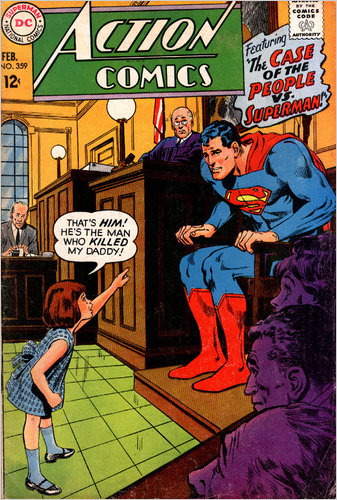
My brother and I had an extensive collection of comic books when we were growing up.  We even owned two (two!) mint editions of Conan the Barbarian number 1.  If I still owned that collection today, it would easily pay for the first year of my daughter’s college tuition.

After reaching the age of puberty, I consigned my childhood love of comic books to the “trivial” category of youthful pursuits.  Perhaps that is why I was so delighted to read about the current exhibit at the Lillian Goldman Law Library at Yale University, entitled Superheroes in Court! Lawyers, Law and Comic BooksAs described by John Schwartz in the New York Times, this exhibit includes comic books with a legal setting, contracts and correspondence relating to legal disputes over the ownership of comic book characters, and reports submitted to Congress during the 1950s seeking federal legislation to address the alleged connection between comic books and juvenile delinquency.

Continue ReadingBest of the Blogs: Trivial Pursuits Edition

“Rah-Rah-Ah-Ah-Ah, Roma-Roma-Ma-Ma, Gaga, Ooh-La-La”: Persona, Authenticity, and the Right of Publicity Now

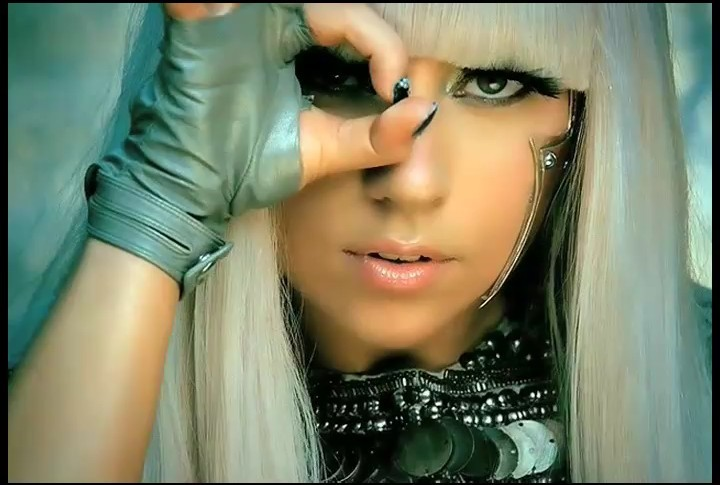
Yesterday, I posed the following questions: What is identity? As we define the right, should we only protect a person’s authentic identity (name, likeness, voice, etc.), or do we protect that constructed identity? Are Madonna’s many personas as valid as Janet’s one? These questions of authentic and constructed personas are still very much an issue in today’s video culture. Our current great video stars, Lady Gaga and Beyonce, have often played with this question of authenticity versus construction.

In fact, I would argue that Beyonce and Gaga can be seen as “baroque” versions of the authentic Janet and the constructed Madonna. Beyonce heightens the authentic tradition in her videos. For example, in the video “Crazy in Love” she sings, standing next to the man who would become her husband, Jay-Z, about how much she loves him. Like Janet, Beyonce uses her given name. Lady Gaga, very obviously, extends the constructed tradition. In the video for “Bad Romance,” Lady Gaga changes personas fourteen times in one video. Lady Gaga makes us call her Lady Gaga.

Lately, however, Beyonce and Lady Gaga themselves have sought to confuse these boundaries, between the authentic and constructed, through their two videos “Videophone” and “Telephone.” 

Continue Reading“Rah-Rah-Ah-Ah-Ah, Roma-Roma-Ma-Ma, Gaga, Ooh-La-La”: Persona, Authenticity, and the Right of Publicity Now