Milwaukee’s Safe Streets Initiative

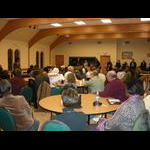
An interesting new website describes the activities of Milwaukee’s Safe Streets Initiative, an innovative antiviolence program involving Marquette Law School, local and federal law enforcement authorities, and community organizations and volunteers.  The SSI represents an effort to bring principles of restorative justice to bear in mobilizing high-crime communities against gang- and drug-related violence.  The core of the program seems to be the “call-in,” a session in which community leaders meet with known drug dealers and offer a choice: either stop dealing (in which case mentoring and community support will be made available to help the offender transition to a law-abiding life) or face swift, tough law enforcement action.  (A photograph from the first call-in in 2007 is above.) The SSI also sponsors similar meetings for offenders returning to the community from prison. 

The community involvement piece seems to me an especially welcome development.  As I discuss in a forthcoming article in the Standford Law & Policy Review, when police and prosecutors come down hard on drug offenders in poor, minority neighborhoods, it is important that their actions are seen as having legitimacy in those neighborhoods, rather than being perceived as arbitrary or racially discriminatory.  Opportunities for neighborhood residents to voice their opinions and collaborate with law enforcement in responding to crime can help build the perceived legitimacy that is necessary for long-term gains in crime reduction.

Continue ReadingMilwaukee’s Safe Streets Initiative

Is Milwaukee Mow-Town?

As long-time baseball fans know, stadium groundskeepers have been using increasingly intricate mowing patterns to create fancy visual effects in the outfield grass. What they may not know is that the trend began here in Milwaukee at the old County Stadium in 1993. The whole story is detailed in this New York Times article. I wonder if the landscaping of new Marquette Law School building will prove similarly trend-setting?

Continue ReadingIs Milwaukee Mow-Town?

Responding to Racial Disparities in the Criminal Justice System

The Sentencing Project has just published a new edition of Reducing Racial Disparity in the Criminal Justice System, a manual for policymakers that describes numerous best practices for addressing disparities.  This publication should be of particular interest in Milwaukee and Wisconsin, which have some of the worst criminal justice disparities in the nation.  As The Sentencing Project described in a May publication, blacks in Milwaukee are seven times more likely than whites to be arrested for a drug offense, the second-highest such disparity among the forty-three major American cities analyzed.  Similarly, a state-level analysis by Human Rights Watch determined that blacks in Wisconsin are forty-two times more likely than whites to receive a prison term for a drug conviction, the highest such disparity among the thirty-four states studied.

Of course, to say that there are racial disparities is not to say the disparities are necessarily unwarranted.  For instance, if it turned out that blacks committed serious drug crimes more frequently than whites, then at least some of statistical disparities might be warranted.  Still, the magnitude of the racial disparities in Milwaukee and Wisconsin is so high, particularly in comparison to national norms, that there is good reason to believe we do indeed have a serious problem.

Continue ReadingResponding to Racial Disparities in the Criminal Justice System