Twenty years ago, the movie The Devil Wears Prada entered our collective cultural consciousness. Adapted from a “fictional” book written by Lauren Weisberger, a former assistant to VOGUE’s Editor-in-Chief Anna Wintour, the movie cemented the impact of a tell-all behind the scenes reveal of perhaps the most influential fashion magazine of the 20th century and its management. As The New York Times observed in a review of the book in 2003, “does it even matter what’s actually on the page when everybody is reading between the lines?” The book had raised eyebrows (to say the least) in VOGUE circles, and, when the movie premiered it was understood that the plot was all about Anna Wintour. Despite the takedown quality of the narrative, some reviewers of the book went so far as to say the hidden hero of the book was the Anna Wintour/Miranda Priestly character. The Editor-in-Chief that has her assistants running for lattes and takes down Andrea “Andy”/Lauren with a lesson in the history of cerulean blue was every career woman’s secret idol. “Andrea’s aura of self-importance is almost enough to make you sympathize with the Prada-wearing devil herself,” said the same New York Times book review. Meryl Streep, who played Miranda Priestly in the movie, explained that she modeled the character on men in positions of power. Despite all the chatter, there was, however, no official VOGUE feature on the movie in 2006 and no dedicated article, although Anna Wintour did attend a benefit screening of the film. In other words – “no comment.”
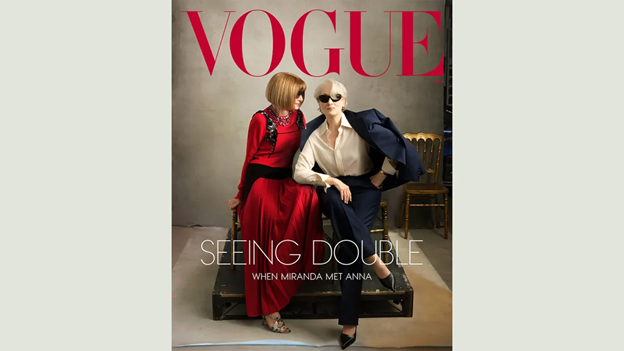
Flash forward twenty years, and how things have changed! We have a sequel, The Devil Wears Prada 2, in the vein of so many other movie franchises based on intellectual property (ask any Marvel fan). VOGUE, now managed by Editor-in-Chief Chloe Malle, put Anna Wintour (now Chief Content Officer for Condé Nast and global editorial director for VOGUE) and Meryl Streep on the magazine’s May cover. Wintour and Streep appear under the heading “Seeing Double: When Miranda Met Anna”.
Why the change in direction? Short answer: it makes legal sense. A relationship with VOGUE is good trademark sense for Disney, the parent company of 20th Century Fox, and good trademark sense for Condé Nast, VOGUE’s parent company. As films are made and valued for their intellectual property as much if not more than their plotlines, and as magazines extend their brands into services like book clubs and shopping platforms, the more “iconic” films and brands can be the better. The more “iconic” a brand – whether a film or a magazine – the more trademark rights a brand may be able to claim. In other words, the more consumers quote “The Devil Wears Prada”, see the title and quotes on t-shirts, and engage with the fictional Devil Wears Prada universe through merchandise, the more the catch-phrases and the title may function as marks of distinctiveness, and not just as creative expressions or ornamental decoration. Time and a historic appraisal of the film have been an essential element of these catch-phrases and the value of the movie as a portal to an iconic status that might lead to trademark rights. The current marketing bonanza you are seeing around The Devil Wears Prada 2 is a sign of how fashion and film partner up to make intellectual property, and not a bag or a movie, their main product.
In 2006, when The Devil Wears Prada premiered, a connection between creative content and consumers’ recognition of what company made certain products did exist. Product placement was a strategy, and could be considered part of the amount and manner of advertising that would help a brand build distinctiveness in the minds of consumers over time. Placing The Pink Panther in advertisements for your pink home insulation as part of an express collaboration, as Owens-Corning did to claim trademark rights in the color pink applied to their insulation, could help Owens-Corning argue that consumers thought that their brand produced any pink insulation a consumer saw on the market. But this use of creative content in a brand’s advertisements was far from “unsolicited media coverage of the product embodying the mark”. Unsolicited media coverage is another factor in addition to an amount of advertising that is part of the test for acquired distinctiveness (or secondary meaning). Trademark law requires designs, colors, and descriptive words to have acquired distinctiveness over time. Commentary about a brand’s product, and its more organic placement in creative content, like a movie or a film, has become a potential goldmine for brands seeking to argue that, over time, consumers recognize a design the brand creates as an indication of source (in layman’s terms, that the brand produced a bag with that design).
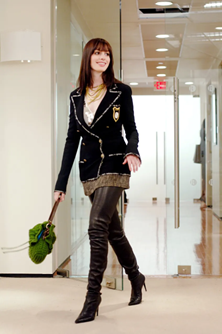
The TV show Sex and the City put this type of organic, unsolicited media coverage on the map, creating a type of feedback loop that supported brands’ interest in collaborating with costume designers in less structured ways. Because of the organic, creative role that fashion played in the show, Sex and the City (and the media coverage surrounding it) became primary source material for some fashion brands seeking to argue that consumers recognized their designs as source indicators. Before brands caught on to the opportunities organic placement in film presented, costume designers like Pat Fields (who worked on The Devil Wears Prada and was also the costume designer on Sex and the City) leaned on their own relationships with fashion designers to avoid purchasing items that would be outside the film’s budget. Fashion brands could be generous, lending “archival” items (fashion products from previous collections) before the current vintage craze, because of their relationship with a particular costume designer. These decisions to loan were not structured as product placements or made with an awareness of the impact that placement in the film could have for a designer brand’s trademark rights. So, when Andy wears “the Chanel boots” in The Devil Wears Prada, their appearance wasn’t part of a dialogue between fashion brands and creatives that understood the potential trademark value of that appearance for the distinctiveness of the boots’ design (providing, of course, that the design passed trademark’s functionality test). Of course, fast forward twenty years later and the functionality of the boots themselves may not matter if the claimed trademark isn’t the design of the boots, but their image, perhaps on a cookie (as evidenced during recent premiere parties shared on Instagram).
In 2009, shortly after the major box office success of The Devil Wears Prada, fashion brands started to fully appreciate the trademark value of the placement of their designs and other “icons” in shows like Sex and the City. As I’ve detailed in Iconic CopiesTM, Hermès cited the Birkin bag’s appearances in the show to argue the Birkin design had acquired secondary meaning. The description of fashion designs as “iconic” in third party media and in creative content (like tv shows and films) has become prevalent as marketing speak. But “iconic” is also making its way into trademark filings. Defined as “very famous or popular, especially being considered to represent particular opinions or a particular time”; “showing a relationship between the form of a sign, such as a word or a symbol, and its meaning”; and “of, relating to, or having the characteristics of an icon”), “iconic” has been used in the trademark filings of Kate Spade, Bottega Veneta, Gucci, and Hermès, to name a few. “Iconic”, as a word and concept, brings along a great ideal of information, including the origin of fashion products, the origin of ideas of and about fashion products, and a fashion brand’s heritage and wider cultural information.
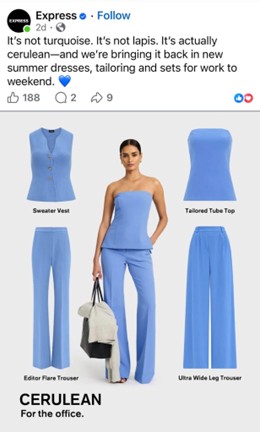
And this brings us back to the symbiotic nature of product placement, organic placement, related unsolicited media coverage, and creative content for brands in the current The Devil Wears Prada 2 universe. Put together, all of these activities are building “iconic” and then trademark status. Brands from Diet Coke to Starbucks and L’Oreal Paris have referenced copyrighted frames from The Devil Wears Prada movie and used the film’s catchphrases in their own advertisements to build recognition, fame and goodwill. The unsolicited media coverage of fashion brands and designers featured in the film has been off the charts, even before the film’s release. The film’s iconic lines and scenes are the backbones of consumers’ social media posts and mall brands’ styling suggestions. Looking for a cerulean blue outfit to wear to your local showing of The Devil Wears Prada 2? Check out Express. The brand doesn’t even need to mention the movie by name for you to know the reference.
All of these uses of The Devil Wears Prada universe are building the recognition of phrases and words from the movie in ways that might allow them to function as trademarks. While The United States Patent and Trademark Office generally refuses to register titles of single creative works as trademarks, The Devil Wears Prada 2 now symbolizes a series and is applied to a suite of goods beyond a creative work. Disclaim the word “Prada” (already registered by the eponymous fashion brand for the services of education and entertainment and accessories, among other products), and, so long as Disney doesn’t plan to create a The Devil Wears Prada band, a trademark registration may now be within the production company’s intellectual property portfolio. Fashion brands’ intellectual property portfolios are winning too. We’ll have to see what fashion turns up in the film, but we might just see future commentary on the movie in trademark filings for handbag designs.
In all of this, we might ask ourselves what has actually made The Devil Wears Prada universe iconic since 2006. It’s more than the movie’s own storyline – it’s the movie’s role in our wider culture. It’s our participation with the movie as viewers who have incorporated it into our lives. The iconic status of The Devil Wears Prada universe is also related to the evolution of the fashion industry. In the twenty years since the film’s release, the Met Gala has, under Anna Wintour’s trustee leadership, become “the Super Bowl of fashion” (held on the first Monday in May, it’s around the corner, gird your loins!). American culture has engaged in a pervasive reappraisal of women’s ambition and men’s roles in power. And social media arrived: Instagram in 2010, Twitter (now X) almost contemporaneously to the original Devil Wears Prada premiere in 2006, and more platforms. Social media has become our main vehicle for communication across tangible geographic borders (and across intangible, societal borders). Consumers are constantly watching, commenting, reappraising, explaining, recontextualizing and remembering as fashion, and the films that document the industry and our mythic views of it, evolves and meets our current cultural zeitgeist. All of this, along with the current anxiety of our contemporary times, has produced a strong sense of nostalgia. Defined as “a sad pleasure experienced in recalling what no longer exists” and as “a wistful or sentimental yearning for a return to or the return of some real or romanticized past period or some irrecoverable past condition or setting”, nostalgia has an emotional pull that leads us to recall and remember. This recalling and remembering is, increasingly, a perfect foundation on which to build trademark distinctiveness. Nostalgia is the bedrock of brands’ “icons” and “iconic” designs, and the trademark rights brands claim in them. When brands’ “iconic” symbols are mixed into creative content that builds consumer recognition of their brand after a period of time, brands can increase the strength of their mark and, perhaps, even dip their toe into trademark fame territory.
But is nostalgia a proper foundation for a trademark’s acquired distinctiveness? Does remixing creative content into advertising and unsolicited media coverage undermine the conceptual divide between copyright and trademark law? Should we allow a brand to claim a trademark in an “iconic” symbol, word, phrase, or design when we, as consumers, have helped build that “iconic” status? Miranda Priestly might ask me to bore someone else with these questions, but I hope we all entertain them as we watch The Devil Wears Prada 2 and, to quote one of Andy’s friends, contemplate how fashion “is merely a piece of iconography used to express individual identity.”