
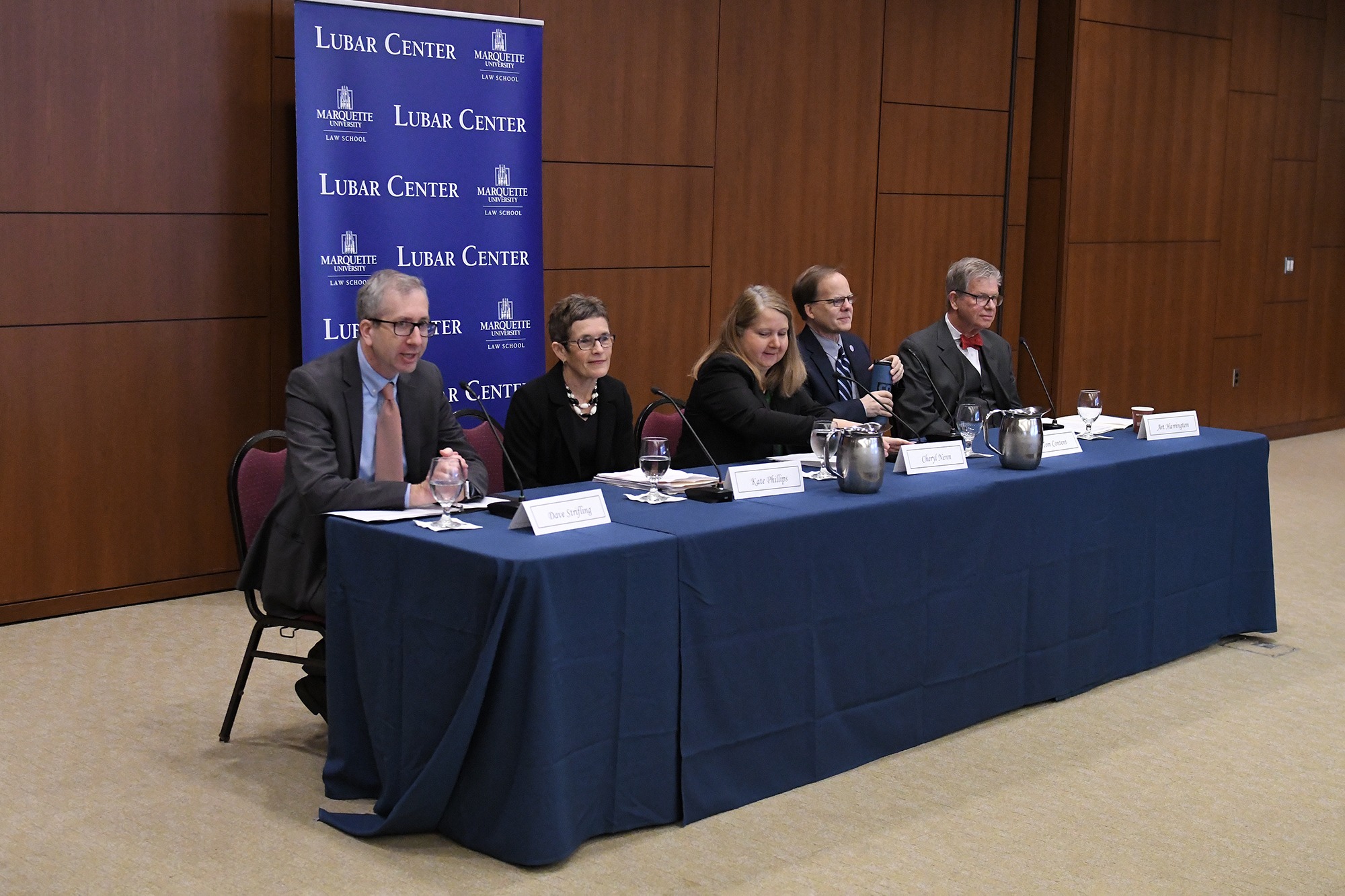
Water and energy governance regimes are under increasing pressure to manage heavy new demands from “data centers,” large physical warehouses that contain computer servers, data storage equipment, and related digital infrastructure. Data centers support a variety of evolving digital technologies upon which our society increasingly depends, from artificial intelligence to large-scale video streaming. They can be significant tools for economic development but also draw heavily on local water systems and electrical grids, straining resources and resulting in community opposition. On April 8, the Marquette Water Law and Policy Initiative (affiliated with the Law School’s broader Lubar Center for Public Policy Research and Civic Education) hosted a panel event to explore these challenges.
The issues are significant for Wisconsin, which is becoming a magnet for data centers given its plentiful water resources, stable electrical grid, and comparatively low land costs. The state already hosts over 40 data centers, and more have been proposed. Balancing the economic development potential with the environmental and energy drawbacks will not be easy. The February 2026 edition of the Marquette Law School Poll featured several questions about data centers. The results showed that 70% of Wisconsinites now believe that the costs of data centers outweigh the benefits, with water and energy use frequently cited as top concerns.
The event participants first noted the vast scale of energy and water use by data centers. Co-moderator Art Harrington pointed out that data centers already use roughly 4 to 5% of the total energy generated in the United States, with that share expected to double or more in the coming years. Wisconsin’s data centers will require continuous power at levels comparable to that required to support hundreds of thousands of homes.
Meanwhile, the implications are also significant for water resources in the state. Data centers require a great deal of water to cool the sensitive electrical components housed within. Some are estimated to use a whopping one to five million gallons of water per day, equivalent to the water demand of a town of about 50,000 people. Panelist Cheryl Nenn, of Milwaukee Riverkeeper, said that the proposed Microsoft data center in Mount Pleasant, Wisconsin (billed by the company as “the world’s most powerful AI data center”) is expected to contain about 60 miles of pipeline to circulate cooling water.
Nenn pointed out that the Great Lakes are essentially a “one-time gift from the glaciers” with less than 1% of their total water volume annually renewable via precipitation. If data centers consume more than that renewable amount, the volume of water in the Lakes would start to decline, she predicted. A related consequence: Nenn expects local water rates to rise by 50-70% or more as municipalities upgrade their treatment systems.
A further complication is that it’s difficult to be sure how much water a data center will use. Two factors contribute to a lack of transparency, Nenn said. First, most data centers draw water by connecting to local public water systems rather than through direct withdrawals from surface or groundwater resources and therefore do not have to report their usage to the state. Second, much of the water use is “indirect,” meaning that the water use happens as part of the process of generating energy to supply the center and its cooling system. Nenn’s group had to sue the City of Racine to obtain information about the Microsoft facility’s projected water use.
Turning back to energy, the panel noted that electric utilities are already planning major new investments in generating capacity to support the expected demand and are also proposing new rate structures to sort out who pays for the projects. “Energy infrastructure is built for decades,” Harrington pointed out. Panelist Tom Content observed that $2 billion worth of new power plants have recently been approved in the state, andclose to $6 billion worth of additional projects have been proposed. Much of the new capacity will accommodate data center demand. Content predicted that the projects would eventually double the state’s historical system capacity.
Content is the executive director of the Citizens Utility Board of Wisconsin, a nonprofit, nonpartisan entity tasked with representing the interests of Wisconsin citizens and small businesses. Many of his comments focused on consumer protection measures centered on protecting ratepayers from costs incurred to satisfy demand at data centers. He warned that electricity demand associated with data centers could change very quickly. If the demand doesn’t materialize at expected levels due to shifting market conditions or rapidly evolving technological change, Content explained, the state’s ratepayers could be left with stranded assets and a heavy financial burden for decades to come. Content said he favors a “show me the money” approach with explicit financial guarantees from data center operators to pay for the energy generation projects even if they are never built or close early.
Kate Phillips, senior corporate counsel for WEC Energy Group, responded that the utility had built transparent safeguards for consumers into the proposals it has sent to the Wisconsin Public Service Commission for approval. Phillips said the “core principle” of the utility’s philosophy was that “very large customers” (VLCs) with demand exceeding 500 MW, such as data centers, would pay for the generation, distribution, and transmission costs for their facilities. The utility does not expect residential customers to pick up those costs, she said. With respect to “stranded assets” specifically, Phillips said that if a VLC terminates operations early, it will be obligated to pay for the net book value of assets devoted to supplying it with energy.
Near the end of the conversation, the panelists turned to whether governments have effectively managed the data center boom. They have not, said Nenn: she believes that regulators have been caught “flat footed” when it comes to concerns over water and energy use at data centers. Conversely, they have provided significant financial incentives and support to data centers, she added.
State legislatures around the country are grappling with these issues, the panelists said, considering everything from moratoria to increased transparency. The Wisconsin legislature considered several bills in its most recent session but enacted none. For comparison, Nenn cited the recent Wisconsin compromise on PFAS remediation and funding, another complex problem which took the Legislature several years to resolve.
Effectively managing the growth of data centers will require equitable allocation of infrastructure costs, greater transparency surrounding resource use, community involvement in siting decisions, and regional coordination to address cumulative effects. The stakes are high, because decisions made today about data centers will shape Wisconsin communities for decades to come.
A video recording of the full program is available here.