 Barron’s Educational Series, a leading publisher of college guides, published its first “Guide to Law Schools” in 1967. Its profile of Marquette, one of the then 133 ABA accredited law schools, provides a picture of a law school that differs from its modern counterpart in a number of ways. The information below was provided to Barron’s by Dean Robert H. Boden.
Size and Structure: The school offered only a 3-year Day Division program, and the total enrollment at the school was only 260 students.
Make-up of the Student Body: Women made up only 3% of the student body—eight students. (While this was below the national average, significantly less than 10% of all law students in the mid-1960’s were female.) Three quarters of the student body was from Wisconsin.
Faculty: The faculty consisted of 10 full-time and seven part-time instructors. Dean Boden was in his second year as dean. Members of the faculty included current emeritus professors Jim Ghiardi and Ray Klitzke, and Wally McBain, who passed away last year.
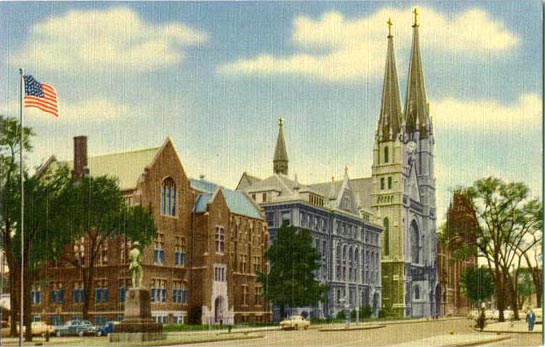
Library: The current law library had not yet been constructed, and the library was housed on the third floor of Sensenbrenner Hall. Holdings totaled 54,000 volumes.
Tuition: Tuition was $1150 per year, or $40 per credit hour.
Admissions Standards: Applicants had only to have completed three years of college. Would-be students were required to take the LSAT, but the school reported that primary emphasis was placed on college grades. Fifty percent of applicants were accepted, and applicants who ranked in the top 40% of their college classes were likely to secure admission. While applicants were encouraged to apply for admission for the fall semester, admission in the middle of the year was possible.
Placement: There was no placement director, but a member of the full-time faculty supervised a “Placement Bureau,” which assisted students in obtaining post-law school employment. The law school and the student bar association also published an annual “placement digest,” which contained photographs and profiles of all graduating students. The document was distributed to law firms in the Midwest.
Degree Awarded: The law school awarded the degree of LL.B. (bachelor of laws) to its graduates. However, Barron’s reported that the school was considering switching the title of its degree to J.D. (There was a national movement in the 1960’s from the LL.B. to the J.D.) The Marquette degree qualified its holders for automatic admission to the Wisconsin Bar under the diploma privilege, as it had since 1933. At this time, the Wisconsin Supreme Court rules required only a law degree from Marquette or the University of Wisconsin and did not stipulate any specific courses as a prerequisite for admission.
Required Courses: Ninety credits were required for graduation. In addition to the traditional first year courses, Civil Procedure, Constitutional Law, Contracts, Criminal Law, Legal Bibliography, Property, and Torts, students were required to take Advanced Contracts, Agency and Partnership, Appellate Practice, Business Organizations, Ethics, Evidence, Federal Income Taxation, Introduction to Law, Jurisprudence, Sales, Trial Practice, Trusts and Estates, and one of Administrative Law, Labor Law, or Trade Regulations. Moot Court participation was also mandatory. Grades were numerical.
Financial Aid. There were 32 full-time scholarships available each year, but this appears to have been the extent of financial aid. Only 12-15% of the student body received financial assistance.
Legal Fraternites: Chapters of Delta Theta Phi, Phi Alpha Delta, and Phi Delta Phi were active at the law school and appear to have played an important role in student life.
The Barron’s guide classified law schools as either “national,” “regional,” or “state.” These classifications were based on the origins of a school’s student body and the focus of its curriculum. Marquette was classified as a “regional” law school. By way of contrast, the University of Wisconsin was a “national” law school, while DePaul, Loyola of Chicago, and Chicago-Kent were “state” law schools.
The guide also sought to classify schools as “most selective,” “highly selective,” “selective,” and “varying standards.” Marquette fell into the latter category, but it appears that the guide relied on ambiguous, non-statistical information supplied by the school’s themselves to make these determinations. Marquette’s ranking may also have been affected by the fact that it did not require its students to have earned undergraduate degrees, although by 1967 virtually all did.