In Jan. 63% said Court should rule against Trump, including 33% of Republicans
On Feb. 20 the United State Supreme Court ruled against President Trump’s authority to impose tariffs under the International Emergency Economic Powers Act of 1977. The case is Learning Resources, Inc. v. Trump.
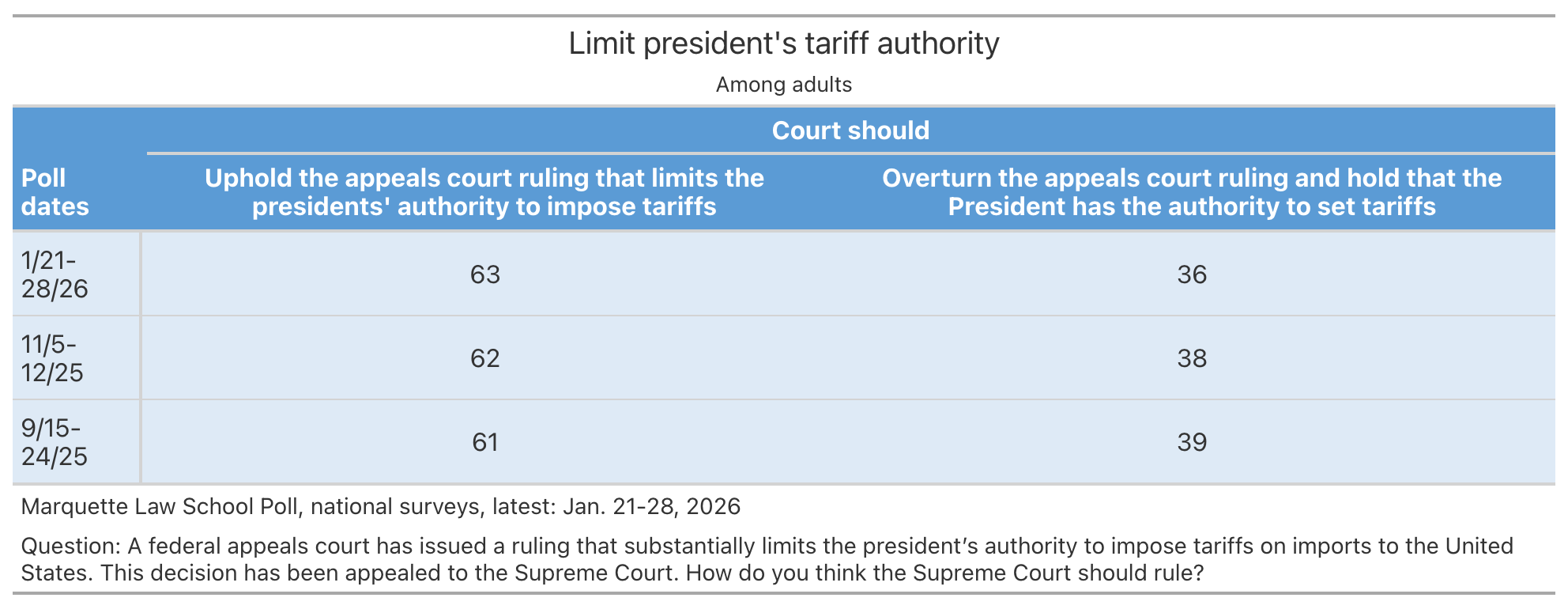
Public views of the case have been consistently in favor of upholding limits on the tariff authority since the Marquette Law School national poll first asked about this case in September. The table shows opinion over three national surveys.
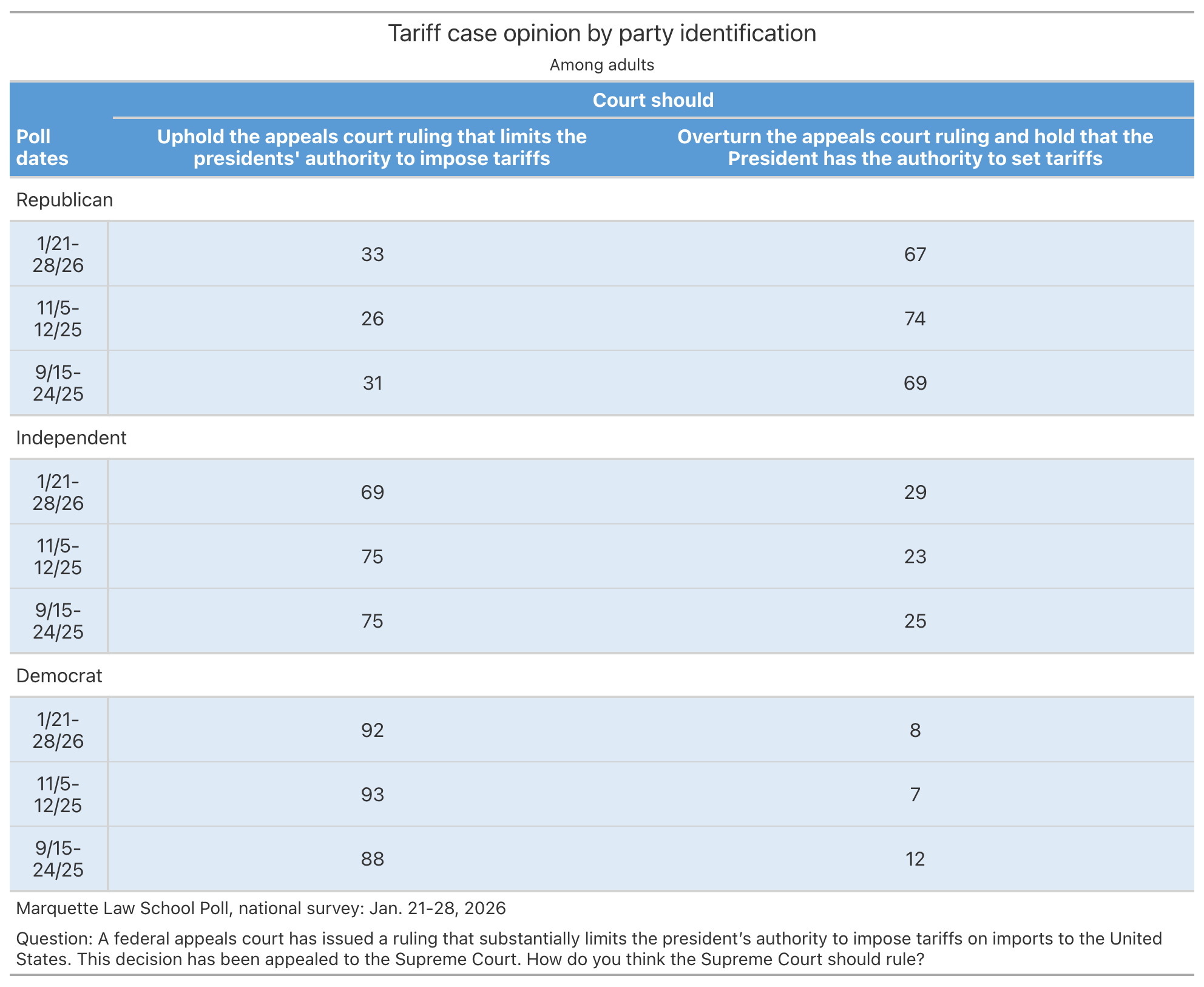
The partisan divide on the tariff case is somewhat less stark than on many issues, with a significant minority of Republicans opposing the president’s position. A third of Republicans in the January poll wanted the Court to strike down the tariffs, an increase from 26% in November. More than two-thirds of independents favored overturning Trump’s use of tariffs, as did an overwhelming 92% of Democrats.
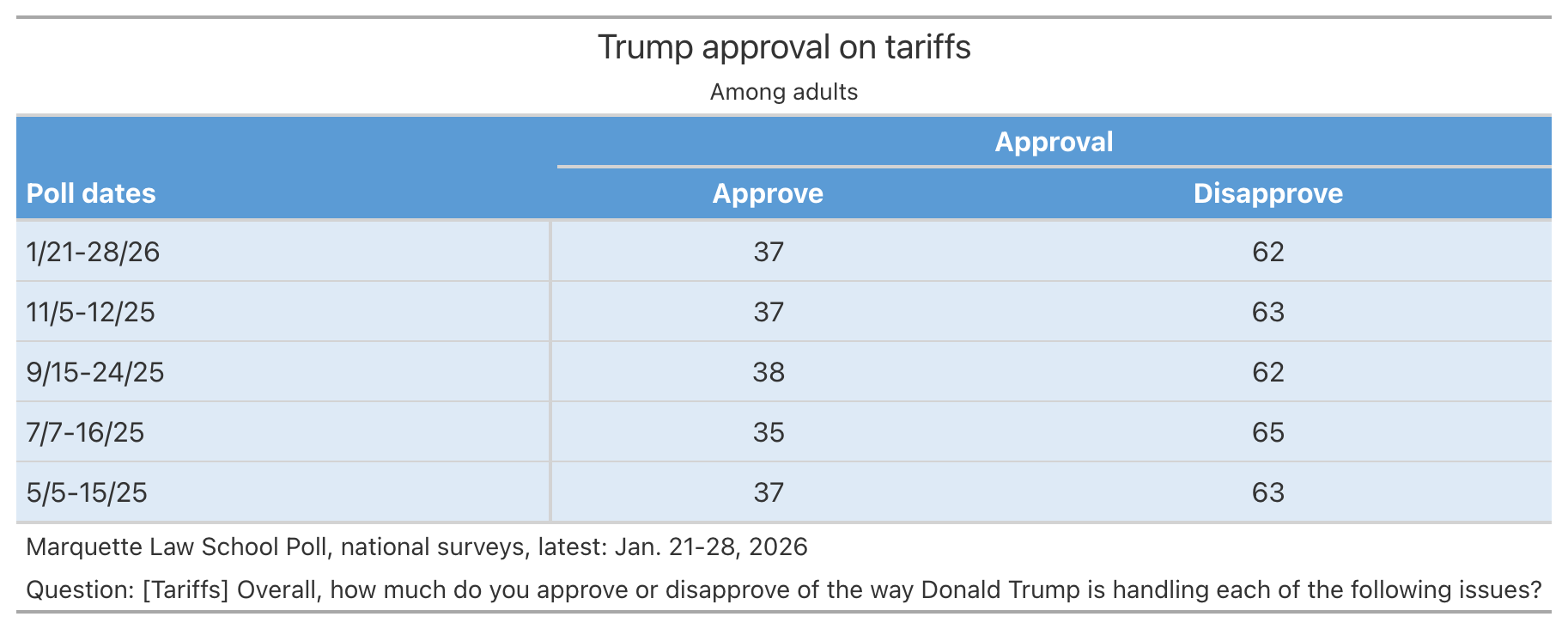
Approval of Trump’s handling of tariffs has consistently been below his overall approval rating in Marquette Law School national polls, with approval on tariffs below 40% in each of five polls since May 2025. In January, 26% of Republicans disapproved of Trump’s handling of tariffs, as did 71% of independents and 95% of Democrats.
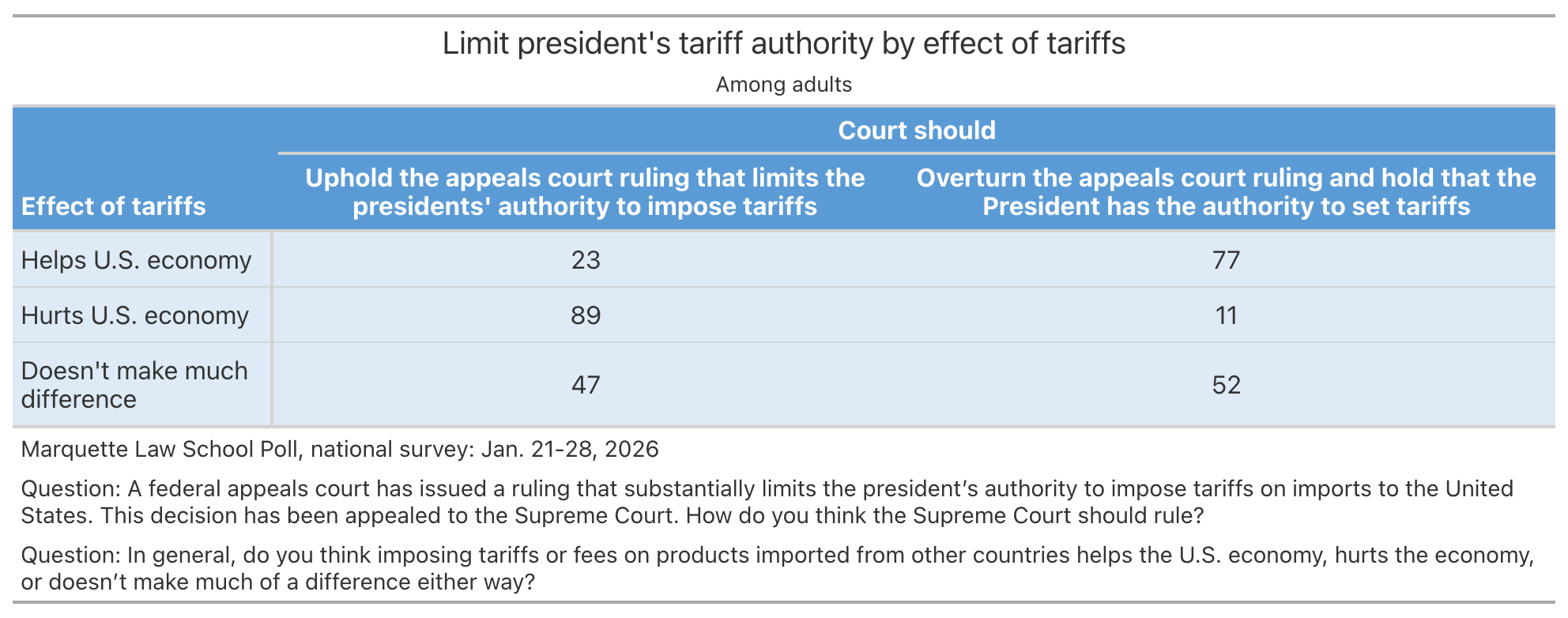
A majority of the public, 56% say that tariffs hurt the U.S. economy, while 30% think they help the economy and 14% say tariffs don’t make much difference. Views of the effect of tariffs are related to opinion of how the Court should rule, as shown in the table below. Those who think tariffs help the economy are in favor of overturning the limits on the president’s authority, 77%, though even among this group more than one-in-five think the president’s authority should be limited, 23%. Among those who say tariffs harm the economy, 89% think the Court should limit presidential authority. Opinion is evenly divided among those who say tariffs don’t make much difference.
The Court and the President
A large majority of adults believe that the president must obey a Supreme Court decision, 82% with 17% who say the president can ignore a decision with which he disagrees. These views have been quite stable in 10 Marquette polls since 2019, never dipping below 76% saying the president must obey the Court, and not below 83% since Jan. 2025.
This belief in the authority of the Court is not a partisan matter. Among Republicans 76% say the president must obey the Court, as do 79% of independents and 90% of Democrats.
In January, a majority, 57% said the Court was going out of it’s way to avoid ruling against Trump, while 43% said the Court was not doing so. Among Republicans 34% thought the Court was avoiding ruling against Trump, as did 59% of independents and 78% of Democrats.
Approval of the Supreme Court
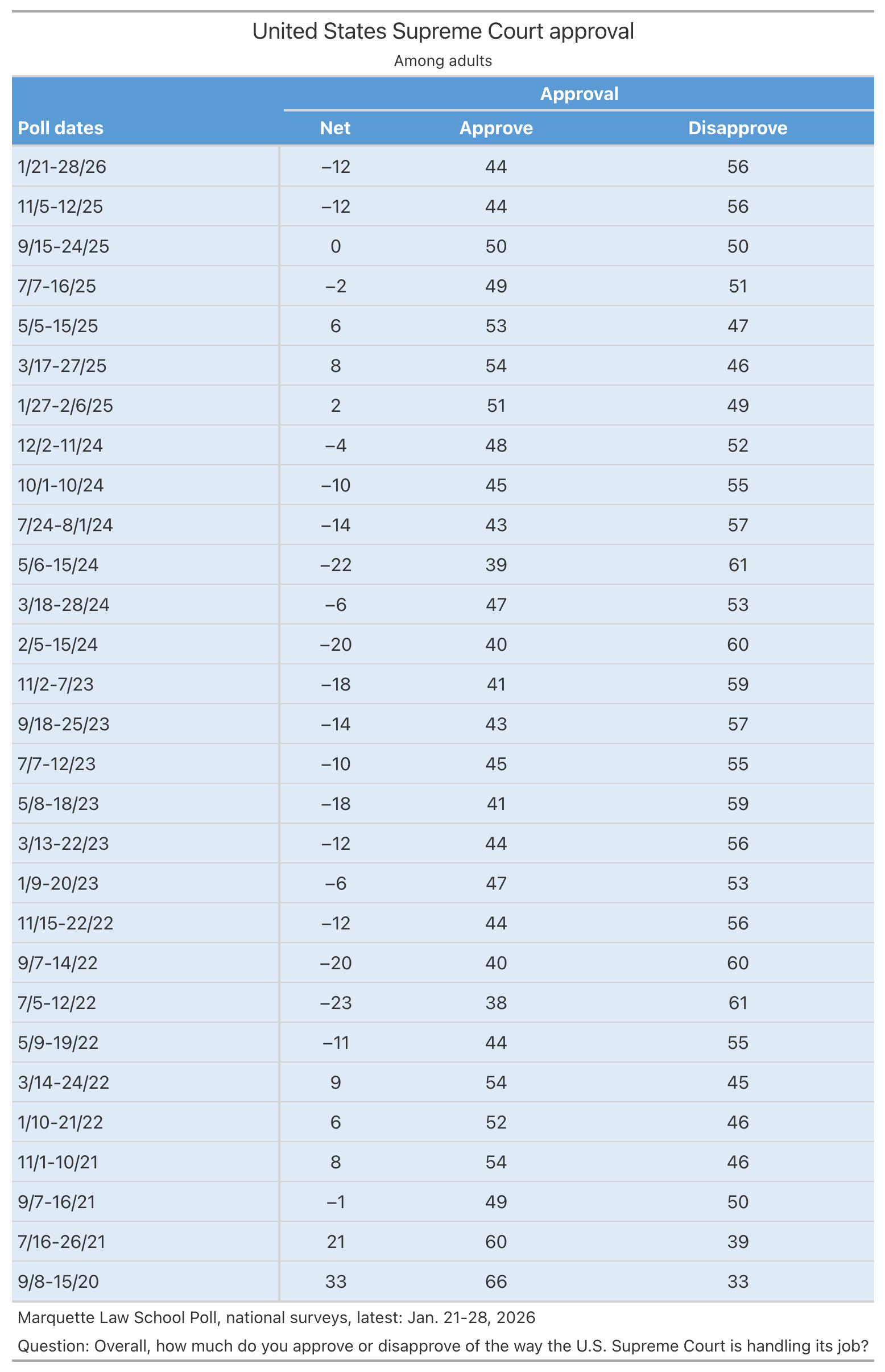
Approval of the U.S. Supreme Court has fallen since September, from 50% to 44% in January. Approval fell sharply in 2022 following the Dobbs v. Jackson Women’s Health Organizationdecision which overturned abortion rights established in Roe v. Wade. Net approval, the percentage approval minus disapproval, remained negative throughout the remainder of 2022 and through 2024. In January 2025 net approval moved up into positive territory before turning down in July. The table shows approval of the Court since September 2020.
About the Marquette Law School Poll
The survey was conducted Jan. 21-28, 2026, interviewing 1003 adults nationwide, with a margin of error of +/-3.4 percentage points.
Interviews were conducted using the SSRS Opinion Panel, a national probability sample with interviews conducted online. The detailed methodology statement, survey instrument, topline results, and crosstabs for this release are available at https://law.marquette.edu/poll/category/results-and-data/
The Marquette Law School poll has conducted multiple national polls of opinion on cases before the U.S. Supreme Court in the October 2024 term. This post shows this results for cases that have been decided or are still pending. Additional polling will be conducted in July following the end of the term.
Links to SCOTUSBlog page for each case provide more details of the cases.
Classified documents
A federal judge in Florida has dismissed the case charging Trump with illegally retaining classified documents and obstructing government efforts to recover the documents. The judge ruled that the appointment of the special counsel violated the Constitution. Do you favor or oppose this ruling?
In January the Supreme Court upheld a law requiring the social media app TikTok, which is owned by a Chinese company, to be sold or banned in the U.S. How much do you favor or oppose this decision?
In January the Supreme Court rejected Donald Trump’s request to halt his criminal sentencing in New York where he was convicted in May on 34 felony counts, allowing sentencing to proceed. How much do you favor or oppose this decision?
In January the Supreme Court heard arguments concerning a Texas law meant to prevent minors from accessing sexual materials on the internet, through a requirement that adults prove they are 18 or over by submitting government-issued IDs in order to access sexually oriented websites. Do you think the court should uphold this law or strike it down for infringing on the rights of adults?
[In March, the Supreme Court rejected President Trump’s request to freeze nearly $2 billion in foreign aid, sending the case back to a lower court for further proceedings.] How much do you favor or oppose this decision?
[In March, the Supreme Court ruled that the US Environmental Protection Agency (EPA) was entitled to impose specific requirements on permit holders to prevent pollution but not to make the permit holders responsible simply because water quality has fallen below the agency’s standards.] How much do you favor or oppose this decision?
[In April, the Supreme Court will hear arguments in a case asking whether a state that generally funds charter schools as alternatives to traditional public schools may refuse to fund a charter school simply because it is explicitly religious.] How do you think the Court should rule?
Poll dates
The state may refuse to fund the religious charter school
The state is required to fund a religious charter school
3/17-27/25
57
43
Party ID
Poll dates
The state may refuse to fund the religious charter school
The state is required to fund a religious charter school
[In December, the Supreme Court heard arguments challenging a Tennessee law that prohibits medical providers from prescribing puberty-delaying medication or performing gender transition surgery for youth under 18.] How do you think the Court should rule?
Poll dates
Uphold the Tennessee law
Overturn the law
3/17-27/25
72
27
5/5-15/25
70
30
Party ID
Poll dates
Uphold the Tennessee law
Overturn the law
Republican
3/17-27/25
90
10
Republican
5/5-15/25
92
8
Independent
3/17-27/25
79
21
Independent
5/5-15/25
73
27
Democrat
3/17-27/25
52
48
Democrat
5/5-15/25
44
56
Trump administration must facilitate return of Kilmar Abrego Garcia
In April, the Supreme Court ruled that federal law requires the Trump administration to facilitate the return of a man erroneously deported to El Salvador. How much do you favor or oppose this decision?
In April, the Supreme Court said that those the administration is seeking to deport under the Alien Enemies Act must receive notice that they are subject to deportation within a reasonable time and in such a manner as will allow them to actually seek court review before such deportation occurs. How much do you favor or oppose this decision?
In April, the Supreme Court heard arguments in a case asking whether parents of elementary school students should be able to opt their children out of reading classes concerning stories about LGBTQ+ characters, if those stories conflict with the families’ religious beliefs. How do you think the Court should rule?
Holding: The U.S. Court of Appeals for the 6th Circuit’s “background circumstances” rule — which requires members of a majority group to satisfy a heightened evidentiary standard to prevail on a Title VII discrimination claim — cannot be squared with either the text of Title VII or the Supreme Court’s precedents.
Judgment: Vacated and remanded, 9-0, in an opinion by Justice Jackson on June 5, 2025. Justice Thomas filed a concurring opinion, in which Justice Gorsuch joined.
Holding: Because Mexico’s complaint does not plausibly allege that the defendant gun manufacturers aided and abetted gun dealers’ unlawful sales of firearms to Mexican traffickers, the Protection of Lawful Commerce in Arms Act bars the lawsuit.
Judgment: Reversed, 9-0, in an opinion by Justice Kagan on June 5, 2025. Justices Thomas and Jackson filed concurring opinions.
Holding: The U.S. Court of Appeals for the 5th Circuit’s moment-of-threat rule — a framework for evaluating police shootings which requires a court to look only to the circumstances existing at the precise time an officer perceived the threat inducing him to shoot — improperly narrows the Fourth Amendment analysis of police use of force.
Judgment: Vacated and Remanded , 9-0, in an opinion by Justice Kagan on May 15, 2025. Justice Kavanaugh filed a concurring opinion, in which Justices Thomas, Alito, and Barrett joined.
Holding: The U.S. Court of Appeals for the 5th Circuit erred in setting aside as arbitrary and capricious the FDA’s orders denying respondents’ applications for authorization to market new e-cigarette products pursuant to The Family Smoking Prevention and Tobacco Control Act of 2009; the 5th Circuit also relied on an incorrect standard to reject the FDA’s claim of harmless error regarding the agency’s failure to consider marketing plans submitted by respondents.
Judgment: Vacated and remanded, 9-0, in an opinion by Justice Alito on April 2, 2025. Justice Sotomayor filed a concurring opinion.
Emergency application for stay is granted on Aug. 8, 2023. Justices Thomas, Alito, Gorsuch, and Kavanaugh would deny the application for stay.
Issue: Whether the Supreme Court should stay the judgment of the U.S. District Court for the Northern District of Texas baring the Bureau of Alcohol, Tobacco, Firearms, and Explosives from enforcing a 2022 rule regulating “ghost guns” as firearms.
Issue: Whether the Supreme Court should stay the district courts’ nationwide preliminary injunctions on the Trump administration’s Jan. 20 executive order ending birthright citizenship except as to the individual plaintiffs and identified members of the organizational plaintiffs or states.
Issue: (1) Whether the majority of the three-judge district court in this case erred in finding that race predominated in the Louisiana legislature”s enactment of S.B. 8; (2) whether the majority erred in finding that S.B. 8 fails strict scrutiny; (3) whether the majority erred in subjecting S.B. 8 to the preconditions specified in Thornburg v. Gingles; and (4) whether this action is non-justiciable.