- New Marquette Law School national survey finds Democrats expand lead on congressional ballots; Trump approval declines
Democrats open lead outside margin of error among both likely, registered voters
Also:
- On generic congressional vote, Democrats receive 54%, Republicans 41% among likely voters; Democrats 50%, Republicans 42% among registered voters
- Democrats seen as better than Republicans on economy, inflation, Medicare/Social Security, and health care; Republicans seen as better on national defense, crime, and immigration/border security
- Inflation and cost of living remains top issue concern
- Approval of Trump’s handling of inflation falls to 19%; approval on the economy at 28%, Iran war at 26%
- Majorities continue to oppose data centers and think AI will be bad for society; they also oppose Flock cameras
MILWAUKEE — A new Marquette Law School Poll national survey finds 54% of likely voters saying they will vote for a Democrat in congressional elections in November, while 41% say they will vote for a Republican. In July, the Democratic advantage was 51% to 45%. The recent results for the congressional vote among likely voters are shown in Table 1. (All results in the tables are stated as percentages.)
Table 1: Generic congressional ballot
Among likely voters
Poll dates Congressional vote Net Dem minus Rep Democratic candidate Republican candidate Neither 9/2-9/26 13 54 41 4 7/22-29/26 6 51 45 4 6/9-15/26 8 53 45 2 5/20-26/26 1 49 48 4 4/8-16/26 10 53 43 4 1/21-28/26 7 52 45 3 11/5-12/25 9 53 44 3 Marquette Law School Poll, national surveys, latest: Sept. 2-9, 2026 Question: If the election for Congress were held today, would you vote for the (Democratic) candidate in your district or the (Republican) candidate in your district? Among all registered voters, Democrats hold a 50% to 42% advantage over Republicans, a larger margin than the 46% to 44% gap in July’s Marquette Law School Poll, as shown in Table 2.
Table 2: Generic congressional ballot
Among registered voters
Poll dates Congressional vote Net Dem minus Rep Democratic candidate Republican candidate Neither 9/2-9/26 8 50 42 7 7/22-29/26 2 46 44 8 6/9-15/26 2 47 45 6 5/20-26/26 1 46 45 7 4/8-16/26 4 48 44 6 1/21-28/26 4 48 44 7 11/5-12/25 5 49 44 6 Marquette Law School Poll, national surveys, latest: Sept. 2-9, 2026 Question: If the election for Congress were held today, would you vote for the (Democratic) candidate in your district or the (Republican) candidate in your district? The survey was conducted Sept. 2-9, 2026, interviewing 1,023 adults nationwide, with a margin of error of +/-3.3 percentage points. For registered voters, the sample size is 864, with a margin of error of +/-3.6. For likely voters, the sample size is 581, with a margin of error of +/-4.3 percentage points.
The Democratic advantages among all registered voters stem in part from stronger Democratic performance among independents, including both those who lean to a party and those who say they are not closer to either party. Among independents who lean to the Democratic Party, 90% support the Democratic Party candidate, while among independents who lean to the Republican Party, 83% say they will vote for the Republican congressional candidate and 10% are reluctant to vote for either candidate. Among independents who do not lean to either party, 41% favor the Democratic candidate and 10% the Republican, but 40% say they favor neither and 8% say they won’t vote.
In contrast, both Democratic and Republican partisans support their party’s congressional candidate at least 93% of the time, with very little crossover voting and with few saying they won’t vote, as shown in Table 3.
Table 3: Generic ballot, by party identification
Among registered voters
Party ID Congressional vote Net Dem minus Rep Democratic candidate Republican candidate Neither Would not vote Republican -89 4 93 2 1 Lean Republican -80 3 83 10 4 Non-leaning Independent 31 41 10 40 8 Lean Democrat 85 90 5 4 0 Democrat 96 98 2 1 0 Marquette Law School Poll, national survey, Sept. 2-9, 2026 Question: If the election for Congress were held today, would you vote for the (Democratic) candidate in your district or the (Republican) candidate in your district? The substantial independent preference for Democratic congressional candidates is also seen when the six Marquette polls conducted in 2026 are combined, boosting the sample size and showing the September poll is in line with results all year. In the combined sample, 31% of independents favor the Democrat and 14% favor the Republican, while 46% say they prefer neither. The strong partisan loyalty seen in September is nearly the same in the combined polls, and those independents who lean to the Democratic Party report more Democratic votes than those who lean Republican favor the Republican candidate, as shown in Table 4.
Table 4: Generic ballot, by party identification, pooling all 2026 polls
Among registered voters
Party ID Congressional vote Net Dem minus Rep Democratic candidate Republican candidate Neither Would not vote Republican -90 4 94 1 1 Lean Republican -76 6 82 10 2 Non-leaning Independent 17 31 14 46 8 Lean Democrat 88 91 3 5 1 Democrat 95 97 2 1 0 Marquette Law School Poll, national surveys, latest: Sept. 2-9, 2026 Question: If the election for Congress were held today, would you vote for the (Democratic) candidate in your district or the (Republican) candidate in your district? Which party is better
The Democratic Party is seen as doing a better job on six of 10 issues. Republicans are seen as better on three issues, and there is a tie on one. Democrats hold the advantage on the federal deficit, foreign policy, the economy, inflation, Medicare & Social Security, and health care. Republicans are seen as better on national defense, crime, and immigration and border security. The two parties are tied on which would handle taxes better, as shown in Table 5.
Table 5: Which party is better handling issues
Among adults
Issue Which better Net Rep minus Dem Republican Party Democratic Party Both about the same Neither would be good National defense 15 41 26 23 10 Crime 15 38 23 26 12 Immigration and border security 11 42 31 15 12 Taxes 0 32 32 22 14 The size of the federal deficit -3 22 25 28 25 Foreign policy -5 31 36 21 12 The economy -6 30 36 19 15 Inflation and the cost of living -11 25 36 23 16 Medicare & Social Security -22 23 45 19 12 Health care -25 22 47 16 15 Marquette Law School Poll, national survey: Sept. 2-9, 2026 Question: [The economy] Do you think the (Republican) party or the (Democratic) party would do a better job handling each of the following issues? The Democratic advantage has grown across issues during 2026, while the Republican advantages have decreased. On each issue where Republicans are seen as better, the size of that advantage has declined since January, while each Democratic issue has seen a larger advantage over time. Table 6 shows the changes for each issue in 2026 polls.
Table 6: Which party is better handling issues, net Rep minus Dem
Among adults
Issue Net Rep minus Dem better by month Sept. May Jan. National defense 15 15 18 Crime 15 22 23 Immigration and border security 11 19 18 Taxes 0 2 9 The size of the federal deficit -3 4 NA Foreign policy -5 NA NA The economy -6 -3 3 Inflation and the cost of living -11 -7 -1 Medicare & Social Security -22 -16 -18 Health care -25 -20 -18 Marquette Law School Poll, national surveys, latest: Sept. 2-9, 2026 Question: [The economy] Do you think the (Republican) party or the (Democratic) party would do a better job handling each of the following issues? Approval of the parties in Congress has also shown similar trends. In September, 36% approve and 64% disapprove of how the Republican Party in Congress handles its job, and identical totals of 36% approve and of 64% disapprove of Democrats in Congress. Both parties have seen substantial majorities disapprove throughout President Donald Trump’s second term. However, there has been a change in the approval ratings of both parties. Over the term of the 119th Congress, Republican approval has fallen from 45% in March 2025 to 36% in September 2026, while Democratic approval has increased from 29% to 36%. Approval of each party is shown in Table 7.
Table 7: Approval of congressional parties
Among adults
Poll dates Approval Net approve minus disapprove Approve Disapprove Republican 9/2-9/26 -28 36 64 7/22-29/26 -26 37 63 5/20-26/26 -26 37 63 4/8-16/26 -25 37 62 1/21-28/26 -21 39 60 11/5-12/25 -20 40 60 9/15-24/25 -16 42 58 7/7-16/25 -16 42 58 5/5-15/25 -14 43 57 3/17-27/25 -10 45 55 Democratic 9/2-9/26 -28 36 64 7/22-29/26 -32 34 66 5/20-26/26 -40 30 70 4/8-16/26 -39 30 69 1/21-28/26 -42 29 71 11/5-12/25 -28 36 64 9/15-24/25 -38 31 69 7/7-16/25 -32 34 66 5/5-15/25 -42 29 71 3/17-27/25 -42 29 71 Marquette Law School Poll, national surveys, latest: Sept. 2-9, 2026 Question: Overall, how much do you approve or disapprove of the way Republicans in Congress are handling their job? Question: Overall, how much do you approve or disapprove of the way Democrats in Congress are handling their job? The Republican Party is seen as too conservative by 51% of adults, and the Democratic Party is seen as too liberal by 50%. About a quarter (28%) say the Republican Party is about right ideologically, and 22% say the Democratic Party is about right, as shown in Table 8.
Table 8: Is the Republican/Democratic Party too conservative/too liberal
Among adults
Too extreme? Too conservative/too liberal Too conservative Too moderate Too liberal About right for me Republican Party 9/2-9/26 51 11 10 28 Democratic Party 9/2-9/26 11 16 50 22 Marquette Law School Poll, national survey, Sept. 2-9, 2026 Question: As far as you are concerned, is the Republican party (too conservative), too moderate, or (too liberal) or is it about right for you? Question: As far as you are concerned, is the Democratic party (too conservative), too moderate, or (too liberal) or is it about right for you? Those who identify with the parties are more likely to say their party is about right for them, with 62% of Republicans and 40% of Democrats saying this. Those independents who lean to either party are somewhat less satisfied with the party ideologically, and a quarter or less of independents say either party is right for them. Among Democrats, 46% say the Democratic Party is too conservative or too moderate for them, while among Republicans, 23% say the Republican Party is too liberal or too moderate. This shows substantially more desire among Democrats for a leftward shift in the party than among Republicans for a rightward shift in theirs. This is shown in Table 9.
Table 9: Is each party too conservative/liberal, by party ID
Among adults
Party ID Too conservative/too liberal Too conservative Too moderate Too liberal About right for me Republican Party Republican 16 15 8 62 Lean Republican 36 19 7 39 Independent 45 12 21 21 Lean Democrat 85 4 6 4 Democrat 78 7 11 4 Democratic Party Republican 5 4 87 4 Lean Republican 4 3 88 5 Independent 18 15 41 25 Lean Democrat 15 22 29 34 Democrat 15 31 15 40 Marquette Law School Poll, national survey, Sept. 2-9, 2026 Question: As far as you are concerned, is the Republican party (too conservative), (too moderate), or (too liberal) or is it about right for you? Question: As far as you are concerned, is the Democratic party (too conservative), (too moderate), or (too liberal) or is it about right for you? The Democratic advantage in congressional vote among likely voters is aided by higher expected turnout among Democrats than among Republicans. Among registered Democrats, 77% say they are certain to vote in November, versus 69% among Republicans. Likewise, among independents who lean Democratic, 67% say they are certain to vote, compared to 60% among independents who lean Republican. Independents who don’t lean to either party are substantially less likely to say they are certain to vote, with just 41% sure they will go to the polls. This lower turnout among “pure” independents reduces their influence in elections below their size among all registered voters. These results appear in Table 10.
Table 10: Likelihood of voting in November elections
Among registered voters
Party ID Likely to vote Absolutely certain to vote Very likely to vote Chances are 50-50 Don’t think will vote Republican 69 17 11 2 Lean Republican 60 13 19 6 Independent 41 27 24 8 Lean Democrat 67 17 13 3 Democrat 77 12 9 2 Marquette Law School Poll, national survey, Sept. 2-9, 2026 Question: What are the chances that you will vote in the November 2026 general election for congressional and state offices– are you absolutely certain to vote, very likely to vote, are the chances 50-50, or don’t you think you will vote? Democrats also enjoy an enthusiasm advantage going into the fall elections. Forty-seven percent of Democrats say they are very enthusiastic about voting in the election, compared to 32% of Republicans. There is a more modest enthusiasm gap among independents who lean to a party, with a 29% to 23% advantage for Democratic leaners over Republican leaners. As with certainty of voting, pure independents are by far the least enthusiastic about voting, with just 14% very enthused, as shown in Table 11.
Table 11: Enthusiastic about voting in November elections
Among registered voters
Party ID Enthusiasm Very enthusiastic Somewhat enthusiastic Not too enthusiastic Not at all enthusiastic Republican 32 37 26 5 Lean Republican 23 24 38 15 Non-leaning Independent 14 31 44 11 Lean Democrat 29 35 31 5 Democrat 47 37 14 3 Marquette Law School Poll, national survey, Sept. 2-9, 2026 Question: How enthusiastic are you about voting in the elections this November for congressional and state offices? Among Republicans and independents who lean Republican, turnout is highest among those who are very favorable to the Make American Great Again (MAGA) movement, with 82% of them saying they are certain to vote. This falls to 64% for Republicans only somewhat favorable to MAGA and to 52% among those unfavorable to MAGA. This shows that the turnout issue among Republicans comes from those less attached to Trump’s loyal base of MAGA enthusiasts. These results are seen in Table 12.
Table 12: Likelihood of voting among Republicans, by MAGA favorability
Among Republican registered voters
MAGA favorability Likely to vote Absolutely certain to vote Very likely to vote Chances are 50-50 Don’t think will vote Very favorable 82 11 6 0 Somewhat favorable 64 17 17 2 Unfavorable 52 22 18 7 Marquette Law School Poll, national survey, Sept. 2-9, 2026 Question: What are the chances that you will vote in the November 2026 general election for congressional and state offices– are you absolutely certain to vote, very likely to vote, are the chances 50-50, or don’t you think you will vote? As with affection for MAGA, turnout among Republicans is strongly related to approval of Trump. Among those who strongly approve of the president, 81% say they are certain to vote, dropping to 61% among Republicans who somewhat approve and to 56% among those Republicans who disapprove of how Trump is handling his job. Among Republicans and independents who lean Republican, 36% strongly approve of Trump, 40% somewhat approve, and 24% disapprove (either somewhat or strongly). Turnout by approval is shown in Table 13.
Table 13: Likelihood of voting among Republicans, by Trump approval
Among Republican registered voters
Trump approval Likely to vote Absolutely certain to vote Very likely to vote Chances are 50-50 Don’t think will vote Strongly approve 81 7 9 2 Somewhat approve 61 21 15 3 Disapprove 56 22 15 7 Marquette Law School Poll, national survey, Sept. 2-9, 2026 Question: What are the chances that you will vote in the November 2026 general election for congressional and state offices– are you absolutely certain to vote, very likely to vote, are the chances 50-50, or don’t you think you will vote? The Democratic Party has seen fresh competition from democratic socialists in primaries in 2026, creating new divisions within the party. However, these divisions are not associated with differences in turnout, such as are seen among Republicans. There is very little difference in expected turnout among Democrats regardless of how favorable or unfavorable they are to democratic socialist candidates, as shown in Table 14.
Table 14: Likelihood of voting among Democrats, by democratic socialist favorability
Among Democratic registered voters
Democratic socialist favorability Likely to vote Absolutely certain to vote Very likely to vote Chances are 50-50 Don’t think will vote Very favorable 75 15 8 1 Somewhat favorable 78 11 9 2 Unfavorable 74 15 10 1 Marquette Law School Poll, national survey, Sept. 2-9, 2026 Question: What are the chances that you will vote in the November 2026 general election for congressional and state offices– are you absolutely certain to vote, very likely to vote, are the chances 50-50, or don’t you think you will vote? Trump approval in second term
Approval of how Trump is handling his job as president declined in September to 37%, with 63% who disapprove. That is down from 40% approval in July, and a percentage point below the previous low of 38% approval in May and June. The course of approval has been downward since the start of Trump’s second term, when 48% approved and 52% disapproved. This trajectory has not been marked by dramatic or sudden drops. The steadiness of the decline from poll to poll has been notable, with approval falling by 0 to 3 points across successive polls, with the exception of a 2-point increase in the July 2026 poll. While successive changes have been small, the cumulative decline is substantial, as shown in Table 15.
Table 15: Trump job approval in second term
Among adults
Poll dates Approval Net approve-disapprove Approve Disapprove 9/2-9/26 -26 37 63 7/22-29/26 -20 40 60 6/9-15/26 -24 38 62 5/20-26/26 -24 38 62 4/8-16/26 -21 39 60 1/21-28/26 -16 42 58 11/5-12/25 -14 43 57 9/15-24/25 -14 43 57 7/7-16/25 -10 45 55 5/5-15/25 -8 46 54 3/17-27/25 -8 46 54 1/27-2/6/25 -4 48 52 Marquette Law School Poll, national surveys, latest: Sept. 2-9, 2026 Question: Overall, how much do you approve or disapprove of the way Donald Trump is handling his job as president? The strength of approval of Trump has also shifted over the second term. A substantial share of adults has strongly disapproved of Trump throughout 2025 and 2026, ranging from 40% in February 2025 to the current 47%. More change is seen in the balance of those who strongly approve and those who somewhat approve. Strong approval outweighed somewhat approval by 29% to 19% in February 2025, but as of September 2026, this is reversed, with 22% somewhat approving and just 15% strongly approving. This is a drop of almost half in strong approval since February 2025. The full trend is shown in Table 16.
Table 16: Strength of Trump job approval in second term
Among adults
Poll dates Approval Net strong approve-strong disapprove Strongly approve Somewhat approve Somewhat disapprove Strongly disapprove 9/2-9/26 -32 15 22 16 47 7/22-29/26 -30 15 25 14 45 6/9-15/26 -31 16 22 15 47 5/20-26/26 -29 16 22 17 45 4/8-16/26 -31 17 22 12 48 1/21-28/26 -25 19 23 14 44 11/5-12/25 -23 21 22 13 44 9/15-24/25 -17 23 20 16 40 7/7-16/25 -21 23 22 11 44 5/5-15/25 -17 24 22 13 41 3/17-27/25 -15 26 20 13 41 1/27-2/6/25 -11 29 19 12 40 Marquette Law School Poll, national surveys, latest: Sept. 2-9, 2026 Question: Overall, how much do you approve or disapprove of the way Donald Trump is handling his job as president? Approval of Trump varies substantially across issues, with his highest approval rating, 49%, for his handling of border security, and 43% approval on the issue of immigration. Each of the other six issues measured has approval ratings below 35%, with overall approval at 37%. Approval is especially low for the economy, war with Iran, gas prices, and inflation and the cost of living, each of which has approval below 30%. While approval on border security and on immigration each has remained relatively stable, approval on other issues has seen significant decline over time. Approval of the war with Iran has declined from 32% in April to 26% now. These trends are shown in Figure 1 and Table 17.
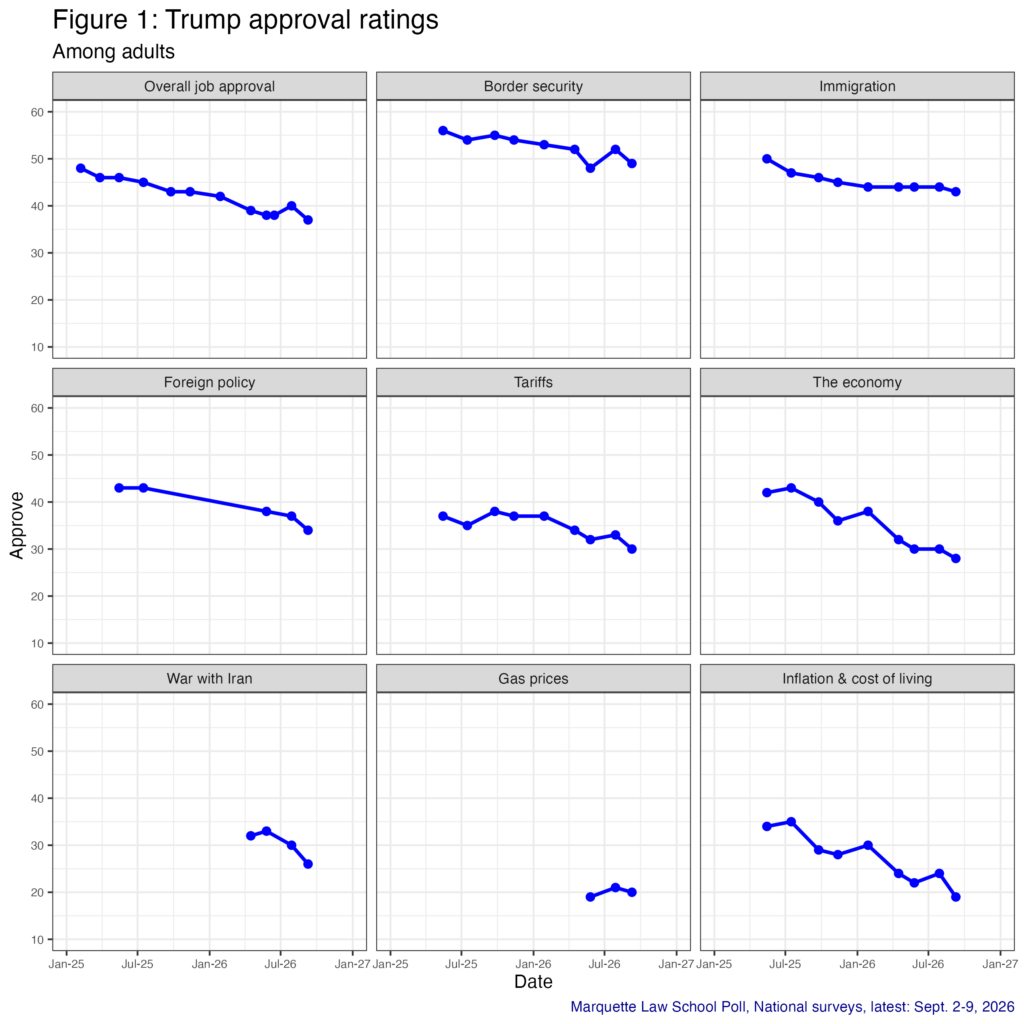
Table 17: Trump approval ratings
Among adults
Date Approval percentage Overall job approval Border security Immigration Foreign policy Tariffs The economy War with Iran Gas prices Inflation & cost of living 9/2-9/26 37 49 43 34 30 28 26 20 19 7/22-29/26 40 52 44 37 33 30 30 21 24 6/9-15/26 38 NA NA NA NA NA NA NA NA 5/20-26/26 38 48 44 38 32 30 33 19 22 4/8-16/26 39 52 44 NA 34 32 32 NA 24 1/21-28/26 42 53 44 NA 37 38 NA NA 30 11/5-12/25 43 54 45 NA 37 36 NA NA 28 9/15-24/25 43 55 46 NA 38 40 NA NA 29 7/7-16/25 45 54 47 43 35 43 NA NA 35 5/5-15/25 46 56 50 43 37 42 NA NA 34 3/17-27/25 46 NA NA NA NA NA NA NA NA 1/27-2/6/25 48 NA NA NA NA NA NA NA NA Marquette Law School Poll, National surveys, latest: Sept. 2-9, 2026 Question: Overall, how much do you approve or disapprove of the way Donald Trump is handling his job as president? Question: Overall, how much do you approve or disapprove of the way Donald Trump is handling each of the following issues? Americans are especially negative on Trump’s handling of inflation and the cost of living, with just 19% approving. A substantial 64% say his policies are increasing inflation, while only 18% think they are decreasing it. An additional 18% think Trump’s policies are not affecting inflation. This represents a sharp downturn in public opinion from the beginning of the second term, when twice as many, 36%, thought his policies would lower inflation, though 49% said he would increase inflation, as shown in Table 18.
Table 18: Effect of Trump policies on inflation
Among adults
Poll dates Effect on inflation Decrease inflation Increase inflation Have no effect on inflation 9/2-9/26 18 64 18 7/22-29/26 21 61 18 5/20-26/26 22 61 18 4/8-16/26 23 62 15 1/21-28/26 25 60 15 11/5-12/25 27 60 13 9/15-24/25 25 60 15 7/7-16/25 28 60 12 5/5-15/25 28 61 10 3/17-27/25 30 58 12 1/27-2/6/25 36 49 15 Marquette Law School Poll, national surveys, latest: Sept. 2-9, 2026 Question: Do you think Trump’s policy proposals will decrease inflation, increase inflation, or have no effect on inflation? There has been an especially striking change over the second term among Republicans in their belief whether Trump’s policies will decrease inflation. In December 2024, shortly after his reelection and before taking office, 76% of Republicans thought Trump’s policies would lower inflation. That percentage has fallen by more than half, to just 37% of Republicans who now think the president’s policies are reducing inflation. Among independents, only 28% thought Trump would lower inflation just after his election, but that, too, has fallen to 9% as of September. Democrats scarcely expected Trump to decrease inflation, declining from 8% to 3% now. These changes are shown in Table 19.
Table 19: Trump policies decrease inflation, by party identification
Among adults
Poll dates Policies decrease inflation Republican Independent Democrat 9/2-9/26 37 9 3 7/22-29/26 43 9 2 5/20-26/26 44 9 4 4/8-16/26 50 5 2 1/21-28/26 54 11 3 11/5-12/25 55 14 3 9/15-24/25 51 7 5 7/7-16/25 55 17 4 5/5-15/25 55 18 5 3/17-27/25 62 16 4 1/27-2/6/25 70 26 5 12/2-11/24 76 28 8 Marquette Law School Poll, Wisconsin surveys, latest: Sept. 2-9, 2026 Question: Do you think Trump’s policy proposals will decrease inflation, increase inflation, or have no effect on inflation? Most important issues
Inflation remains by far the most important issue for Americans, with 37% ranking it first among 10 issues considered in the September poll. The second-highest-rated issue is the economy, at 16%, followed by the war with Iran at 10%. The high ranking of inflation has been steady throughout the year, and by a large margin in each survey. Concern over the war with Iran has declined from 24% in April to 10% as of September, while the importance of most other issues has remained relatively stable. The importance of issues, and the changes over the year, are shown in Table 20.
Table 20: Most important issue, throughout 2026
Among adults
Issue Sept. July May April Jan. Inflation and the cost of living 37 35 37 30 38 The economy 16 15 19 15 17 The war between Iran, Israel and the United States 10 10 16 24 NA Medicare & Social Security 9 9 7 6 9 Health care 7 5 5 5 8 Immigration and border security 6 5 6 7 14 Affordability of housing 4 5 NA NA NA Crime 3 2 2 3 2 Abortion policy 2 1 2 2 3 The war between Russia and Ukraine 1 NA NA NA 1 The proposed SAVE America Act NA 9 NA NA NA The size of the federal deficit NA NA 2 3 3 Marquette Law School Poll, national surveys, latest: Sept. 2-9, 2026 Question: Which one of the following issues matters MOST to you right now? Gasoline prices rose sharply with the start of the Iran war, and Americans are vividly aware of the change. In January, prior to the war beginning on Feb. 28, half of adults said gas prices had declined at least a little over the previous six months, a bright spot for the cost of living. In contrast, in May, 80% had said gas prices were up lot, and 95% said up a little or a lot. That sense of substantial increases has lessened somewhat as of September, with 15% saying prices have been about the same over the last six months, and 5% saying they have gone down a little. Yet 80% say gas prices have risen over the last six months since the start of the Iran war.
Grocery prices are also seen as rising, but more consistently over the year than for gas prices. As of September, 81% say their bill at the checkout counter is higher than six months ago, up from 70% in January. This consistent pressure on grocery prices is a clear source of concern over the cost of living, beyond the recent surge in gas prices. These trends are shown in Table 21.
Table 21: Change in price of gasoline and groceries
Among adults
Poll dates Price change Gone down a lot Gone down a little Stayed about the same Gone up a little Gone up a lot Gasoline 9/2-9/26 0 5 15 25 55 7/22-29/26 1 7 11 24 57 5/20-26/26 1 1 3 15 80 4/8-16/26 1 1 5 18 75 1/21-28/26 14 36 29 14 7 Groceries 9/2-9/26 0 4 15 30 51 7/22-29/26 1 5 15 31 48 5/20-26/26 1 3 11 32 53 4/8-16/26 1 3 14 32 50 1/21-28/26 2 9 19 30 40 Marquette Law School Poll, national surveys, latest: Sept. 2-9, 2026 Question: How has the price you pay for gasoline changed over the last six months? Question: How has the price you pay for groceries changed over the last six months? Adults are also pessimistic about the course of inflation over the next 12 months, as 68% say inflation will increase in the next year. Only 12% are expecting a decrease, and 20% are expecting to see no change. This is a somewhat more negative outlook than in January, when 61% thought inflation would increase over the year, as shown in Table 22.
Table 22: Outlook for inflation in next 12 months
Among adults
Poll dates Change in inflation Increase Stay about the same Decrease 9/2-9/26 68 20 12 7/22-29/26 69 19 13 5/20-26/26 71 16 13 4/8-16/26 70 18 13 1/21-28/26 61 19 19 Marquette Law School Poll, national surveys, latest: Sept. 2-9, 2026 Question: Over the next 12 months do you think inflation and the cost of living will increase, decrease or stay about the same? More people say they are worse off than a year ago, 38%, than say they are better off, 19%, while 43% say they are about the same as a year ago. This two-to-one ratio of worse-to-better is a considerable shift from January, when 28% said they were better off and 34% said worse off, as shown in Table 23.
Table 23: Better or worse off than a year ago
Among adults
Poll dates Better or worse Better About the same Worse 9/2-9/26 19 43 38 7/22-29/26 19 44 37 5/20-26/26 19 39 41 4/8-16/26 20 42 38 1/21-28/26 28 37 34 Marquette Law School Poll, national surveys, latest: Sept. 2-9, 2026 Question: Would you say you personally are better off, about the same, or worse off than you were a year ago? Iran war and foreign affairs
The public remains very doubtful that the United States has achieved its goals in the Iran war, with just 13% saying the goals have been reached and 87% saying they have not been achieved. This is down from 21% in April who thought the goals had been achieved, as shown in Table 24.
Table 24: Has U.S. achieved its goals in Iran war
Among adults
Poll dates Achieved goals Has achieved its goals Has not achieved its goals 9/2-9/26 13 87 7/22-29/26 12 88 5/20-26/26 18 81 4/8-16/26 21 78 Marquette Law School Poll, national surveys, latest: Sept. 2-9, 2026 Question: Has the U.S. achieved its goals in the Iran war? One in five, 21%, say the Iran war has been worth the cost, down from 28% who said so in May. This is seen in Table 25.
Table 25: Has Iran war been worth the cost
Among adults
Poll dates Worth cost Worth the cost Not worth the cost 9/2-9/26 21 79 7/22-29/26 25 75 5/20-26/26 28 72 Marquette Law School Poll, national surveys, latest: Sept. 2-9, 2026 Question: Has the Iran war been worth the cost? Favorability toward Israel has declined sharply since March 2025, when 43% were favorable and an equal 43% unfavorable. As of September, only 29% are favorable to Israel and 59% are unfavorable. This movement has been steady over the last 20 months, as shown in Table 26.
Table 26: Favorability to Israel
Among adults
Poll dates Favorability Net favorable minus unfavorable Favorable Unfavorable Haven’t heard enough 9/2-9/26 -30 29 59 12 7/22-29/26 -24 31 55 14 4/8-16/26 -21 33 54 14 11/5-12/25 -13 35 48 17 9/15-24/25 -13 36 49 15 3/17-27/25 0 43 43 14 Marquette Law School Poll, national surveys, latest: Sept. 2-9, 2026 Question: [Israel] Do you have a favorable or an unfavorable opinion of the following or haven’t you heard enough yet to have an opinion? More say the United States is providing too much aid to Israel rather than not enough, as shown by two somewhat different questions asked since November 2023.
- From 2023 through 2025, respondents were asked about U.S. support for Israel in its war with Hamas in Gaza. Those saying the U.S. was giving too much support remained in the 37%-42% range in 2024 and 2025, with between 17% and 24% saying not enough support and 34%-41% saying about the right amount.
- In 2026 a different question has asked about military aid to Israel, with 55% saying the U.S. is providing too much, 12% saying not enough, and 33% about the right amount. There was a slight increase in those saying too much from July to September, and a decrease in those saying not enough.
These results are shown in Table 27.
Table 27: Military aid to Israel
Among adults
Poll dates Aid amount Too much Not enough About the right amount Military aid to Israel 9/2-9/26 55 12 33 7/22-29/26 52 16 32 Support for war with Hamas in Gaza 11/5-12/25 41 17 41 9/15-24/25 42 23 34 12/2-11/24 40 24 36 5/6-15/24 41 24 35 3/18-28/24 37 24 39 2/5-15/24 42 21 38 Marquette Law School Poll, national surveys, latest: Sept. 2-9, 2026 Question: Do you think the United States is providing too much military aid to Israel, not enough aid to Israel, or about the right amount of aid to Israel? Question: When it comes to Israel’s war with Hamas in Gaza, do you think the United States is providing too much support to Israel, not enough support to Israel, or about the right amount of support to Israel? Favorability to Ukraine has declined since March 2025 from 59% to 51%, with unfavorable views increasing from 31% to 36%, though on balance more remain favorable than unfavorable. This is shown in Table 28.
Table 28: Favorability to Ukraine
Among adults
Poll dates Favorability Net favorable minus unfavorable Favorable Unfavorable Haven’t heard enough 9/2-9/26 15 51 36 13 7/22-29/26 17 51 34 15 9/15-24/25 33 60 27 13 3/17-27/25 28 59 31 10 Marquette Law School Poll, national surveys, latest: Sept. 2-9, 2026 Question: [Ukraine] Do you have a favorable or an unfavorable opinion of the following or haven’t you heard enough yet to have an opinion? Views on U.S. aid to Ukraine has varied over the course of the war since Russia invaded in February 2022. In each poll from November 2022 through March 2025, more said the U.S. was providing too much support to Ukraine than said not enough support. In September and November 2025 this reversed with more saying there was not enough aid. In September 2026, a slightly different wording asked about military aid to Ukraine, with 35% saying not enough and 33% saying too much military aid was going to Ukraine. Often the largest group said about the right amount of support was being given, in the 40%-46% range in 2022 and 2023, though this declined in 2024 and since. These trends are shown in Table 29.
Table 29: Military aid to Ukraine
Among adults
Poll dates Aid amount Too much Not enough About the right amount Military aid to Ukraine 9/2-9/26 33 35 32 Support for Ukraine in war with Russia 11/5-12/25 26 37 36 9/15-24/25 28 38 34 3/17-27/25 37 33 29 1/27-2/6/25 41 22 37 12/2-11/24 42 25 34 10/1-10/24 38 22 40 5/6-15/24 39 25 36 3/18-28/24 36 31 33 2/5-15/24 38 25 37 11/2-7/23 38 21 40 9/18-25/23 37 22 41 7/7-12/23 34 22 44 5/8-18/23 34 23 43 3/13-22/23 34 24 41 1/9-20/23 29 24 46 11/15-22/22 32 23 45 Marquette Law School Poll, national surveys, latest: Sept. 2-9, 2026 Question: Do you think the United States is providing too much military aid to Ukraine, not enough aid to Ukraine, or about the right amount of aid to Ukraine? Question: When it comes to Russia’s invasion of Ukraine, do you think the United States is providing too much support to Ukraine, not enough support to Ukraine, or about the right amount of support to Ukraine? The wars between Russia and Ukraine, and between the United States and Iran, have demonstrated the importance of drone aircraft in both conflicts. The U.S. has been slower to develop low-cost drones than these other countries, relying instead on more expensive munitions. With the Iran war draining supplies of U.S. armaments and the apparent success of Ukraine’s low-cost drones in their war with Russia, Americans were asked if the U.S. should ask Ukraine for assistance in developing cheaper but effective drones. A majority, 57%, say the U.S. does not need Ukraine’s assistance, while 43% says the U.S. should ask for Ukraine’s aid. Larger majorities of Republicans and independents say the U.S. does not need help, with a slight majority of Democrats say the U.S. could use the help, as shown in Table 30.
Table 30: Ask Ukraine for aid building drones, by party identification
Among adults
Party ID Aid with drones Should ask Ukraine for assistance The U.S. does not need assistance developing drones Among all adults 43 57 Republican 38 62 Independent 30 69 Democrat 52 48 Marquette Law School Poll, national survey, Sept. 2-9, 2026 Question: Do you think the U.S. should ask Ukraine for its assistance in developing effective military drones at affordable prices, or do you think the U.S. does not need assistance in developing drones? News attention
The death of Dolly Parton gained the most attention to news stories this month, with 78% saying they heard a lot about it, while just 5% heard nothing at all. Attention was also widespread with only small differences by party, age, education, or source of news. In contrast, the pennant races in Major League Baseball received the least attention of nine topics, with just 7% hearing a lot and 69% nothing at all. Substantially more, 31%, heard a lot about the start of the NFL season.
Other topics receiving substantial attention include the war with Iran, with 67% hearing a lot; new tariffs on Canada, 51% hearing a lot; and Trump announcing he was renaming Lake Ontario, 50% hearing a lot. Less visible topics include the national debt reaching $40 trillion, 35% hearing a lot, and the projected depletion of the Social Security trust fund by 2032, 22% hearing a lot. Less attention was paid to the announcement by Alexandria Ocasio-Cortez that she would freeze her eggs. Attention to these topics is shown in Table 31.
Table 31: Attention to topics in the news
Among adults
Item Heard or read A lot A little Nothing at all The death of Dolly Parton 78 17 5 The U.S. war with Iran 67 28 5 Trump imposing new tariffs on Canada 51 35 14 Rename Lake Ontario 50 35 15 The national debt reached $40 trillion 35 38 27 The start of the NFL football season 31 38 32 Social Security’s retirement trust fund reserves are projected to be depleted in late 2032, which could force an estimated 22% across-the-board benefit reduction 22 42 37 Representative Alexandria Ocasio-Cortez announced that she would be freezing her eggs 11 32 57 The pennant races in Major League Baseball 7 24 69 Marquette Law School Poll, national survey: Sept. 2-9, 2026 Question: Here are some recent topics in the news. How much have you heard or read about each of these? Attention to events varies across sources of news and across topics. Parton’s death was quite visible regardless of news source, ranging from 74% to 89% hearing a lot. Attention to news about the war with Iran varied more, from 92% of MS Now viewers hearing a lot to 73% of Fox News viewers and 69% of those who rely on social media for news. Similar variation is seen for news of tariffs on Canada and renaming Lake Ontario. And news of the national debt passing $40 trillion was heard a lot by 66% of MS Now viewers but only by 34% of the Fox News audience. These comparisons are shown in Table 32.
Table 32: Heard a lot about news topics, by news source
Among adults. Lighter colors indicate heard more, darker heard less
News source Heard a lot Dolly Parton death Iran war Canada tariffs Rename Lake Ontario $40T national debt Start of NFL Social Security trust fund AOC freezes eggs Pennant races MS Now (MSNBC) 83 92 87 78 66 30 44 17 10 Newsmax 83 88 72 66 48 38 37 32 17 BBC 81 85 70 75 57 21 35 17 7 National newspapers 87 84 67 67 50 26 35 17 7 Podcasts 74 81 59 53 43 21 29 24 7 CNN 85 81 67 66 46 35 28 13 9 NPR/PBS 86 79 68 67 53 26 33 18 8 Local newspaper 89 78 66 65 46 37 35 12 10 NBC news 86 78 70 66 50 39 34 15 12 ABC news 88 77 67 65 49 38 30 13 10 CBS news 87 75 64 59 44 35 31 13 10 Local radio 84 75 58 58 40 35 27 11 9 Local TV news 86 74 60 59 42 37 26 10 9 Fox news 84 73 57 51 34 38 27 14 11 Social media 82 69 52 55 35 33 22 12 5 Marquette Law School Poll, national survey Sept. 2-9, 2026 Question: Here are some recent topics in the news. How much have you heard or read about each of these? Question: Which of the following, if any, have you read, watched, or listened to in the past month for information about political news and current affairs? Data centers and industrial development
The public remains strongly skeptical of the building of data centers, with 71% saying the costs outweigh the benefits and 29% saying benefits outweigh the costs. In January, 62% said the costs were higher than benefits, as shown in Table 33.
Table 33: Benefits and costs of data centers
Among adults
Poll dates Benefits or costs greater Benefits outweigh costs Costs outweigh benefits 9/2-9/26 29 71 7/22-29/26 27 73 5/20-26/26 29 71 4/8-16/26 30 69 1/21-28/26 37 62 Marquette Law School Poll, national surveys, latest: Sept. 2-9, 2026 Question: Companies are investing billions of dollars around the country in construction of data centers to run artificial intelligence and other applications. Which comes closer to your opinion, even if neither is exactly right: Views as to whether artificial intelligence is good or bad for society have fluctuated slightly since April, with 64% in September saying AI is bad for society and 36% saying it is a good thing. This trend is shown in Table 34.
Table 34: Is AI a good or bad thing for society
Among adults
Poll dates Good or bad A good thing A bad thing 9/2-9/26 36 64 7/22-29/26 30 70 5/20-26/26 35 65 4/8-16/26 30 70 Marquette Law School Poll, national surveys, latest: Sept. 2-9, 2026 Question: Do you think the development of artificial intelligence (AI) is a good thing for society or a bad thing? Despite the skepticism about AI, a growing majority of the public says they have used an AI app in the last month, with 69% in September saying they are users—up from 61% in April. Table 35 shows this change.
Table 35: Does respondent use AI
Among adults
Poll dates Uses or not Doesn’t use any AI Uses AI 9/2-9/26 31 69 7/22-29/26 36 64 5/20-26/26 36 64 4/8-16/26 39 61 Marquette Law School Poll, national surveys, latest: Sept. 2-9, 2026 Question: Which of the following artificial intelligence (AI) apps have you used in the past month? Users of AI are considerably more likely to say AI will be a good thing for society, but, even among users, more say AI is a bad thing, 56%, than a good thing, 44%. Non-AI users are especially negative about AI’s impact, with 81% saying it will be bad for society, as shown in Table 36.
Table 36: Is AI good or bad for society, by use of AI
Among adults
Poll dates Good or bad A good thing A bad thing Uses AI 44 56 Doesn’t use any AI 18 81 Marquette Law School Poll, national survey, Sept. 2-9, 2026 Question: Do you think the development of artificial intelligence (AI) is a good thing for society or a bad thing? Question: Which of the following artificial intelligence (AI) apps have you used in the past month? The public is also strongly opposed to Flock cameras, which record license plates from passing cars and are used by police agencies across the country. Thirty-nine percent say these cameras are an important tool for police investigations, while 61% say they are unacceptable violations of privacy rights.
The public sees relatively limited benefits from data centers. Asked which two of six possible benefits were most important, 33% said maintaining U.S. leadership in AI, and 30% said the digital economy relies on data centers. Fewer, 29%, selected the creation of permanent jobs at data centers, and 19% said construction jobs were an important benefit. Least-mentioned benefits were local tax revenue at 15% and the establishment of new industry in their state, at 14%. A substantial 23% said none of these six considerations were benefits of data centers. These opinions are shown in Table 37.
Table 37: Benefits of data centers
Among adults
Benefit Selected as a benefit Selected Maintain US leadership in AI 33 Digital economy relies on data centers 30 New permanent jobs 29 Provide construction jobs 19 Tax revenue for community 15 New industry in the state 14 Marquette Law School Poll, national survey: Sept. 2-9, 2026 Question: Which TWO of the following do you think are the most important benefits of data centers? As for the costs of data centers, the most frequently cited aspect was high water use by 54%, followed by driving up electricity costs, with 51%. Less often cited was replacing rural or agricultural land, selected by 30%. Least-mentioned were tax subsidies, 14%, the creation of few permanent jobs, 14%, and noise from data centers, 13%. Given this list of potential costs, 7% said none of these six were important costs of data centers. The perceived costs of data centers are shown in Table 38.
Table 38: Costs of data centers
Among adults
Cost Selected as a cost Selected High water use 54 Drives up electricity costs 51 Replace rural or agricultural land 30 Tax subsidies not worth it 14 Create few permanent jobs 14 Noise 13 Marquette Law School Poll, national survey: Sept. 2-9, 2026 Question: Which TWO of the following do you think are the most important costs of data centers? Data centers are not the only potential industrial developments opposed by a majority of American adults. The survey asked about five possible large industrial or commerce developments: chip fabrication plant, automobile manufacturing plant, e-commerce fulfillment center, steel or aluminum mill, or a data center. Each development consumes substantial land and resources while providing jobs and economic development. Respondents could select none, some, or all of the developments for what they would like to see in their area.
Of the five development options, no particular one was supported by even 33%, while 44% said they would not like any of these developed. Fifty-six percent selected at least one of the five options.
The most preferred development is computer chip fabrication plants, with 31% selecting that option, while 26% would like an automobile manufacturing plant and 26% favored development of an e-commerce fulfillment center. Less popular was a steel or aluminum mill, selected by 16%. The least popular option was data centers, at 12%. These choices are shown in Table 39.
Table 39: New industrial developments in area
Among adults
Development Like to see developed Selected None of these 44 Chip fabrication plant 31 Automobile manufacturing plant 26 E-commerce fulfillment center 26 Steel or aluminum mill 16 Data center 12 Marquette Law School Poll, national survey: Sept. 2-9, 2026 Question: Which of the following, if any, large manufacturing and commerce developments would you like to see developed in your area? Select as many as you would like to see in your area. Industry or manufacturing has been a backbone of American blue-collar employment for decades, and it is striking that there is very little difference in preference for these five operations between those polled who have or do not have college educations. An identical 44% of non-college and college-educated adults say they would want none of these developments in their area. College graduates are somewhat more in favor of chip fabrication plants than are non-college graduates, while non-graduates are bit more favorable to auto manufacturing or steel and aluminum mills. Neither group likes data centers, as shown in Table 40.
Table 40: Favored industrial developments, by education
Among adults
Development Favor development Non-college College None of these 44 44 Chip fabrication plant 28 37 Automobile manufacturing plant 29 23 E-commerce fulfillment center 25 27 Steel or aluminum mill 18 11 Data center 11 13 Marquette Law School Poll, national survey Sept. 2-9, 2026 Question: Which of the following, if any, large manufacturing and commerce developments would you like to see developed in your area? Select as many as you would like to see in your area. About the Marquette Law School Poll
The survey was conducted Sept. 2-9, 2026, interviewing 1,023 adults nationwide, with a margin of error of +/-3.3 percentage points. For registered voters, the sample size is 864, with a margin of error of +/-3.6. For likely voters, the sample size is 581 with a margin of error of +/-4.3 percentage points.
Interviews were conducted using the SSRS Opinion Panel, a national probability sample with interviews conducted online. Certain other data from this survey (focusing on those about public views of the Supreme Court) are held for release on Sept. 17. The detailed methodology statement, survey instrument, topline results, and crosstabs for this release are available on the Marquette Law Poll website.
- Marquette Law Poll finds Crowley leading Tiffany among likely voters, tied among all registered voters
Also:
- Democrats more likely to vote, more Republicans enthusiastic to vote
- Democrats feature greater party loyalty with 98% likely voters supporting Crowley, although enthusiasm is low among Hong supporters
- Most voters see themselves as more moderate than either candidate
- Inflation, cost of living, and negative views of the economy are dominant issues for voters
- Opposition to data centers remains high; 67% would ban data centers for at least a year
- Views are mixed on the job that public schools are doing, with a downward trend over the past dozen-plus years
- Views also mixed on how to pay for schools
Please note: Complete Poll results and methodology information can be found online at law.marquette.edu/poll
MILWAUKEE — A new Marquette Law School Poll of Wisconsin finds Democrat David Crowley leading Republican Tom Tiffany among likely voters by 49% to 44%, with 7% undecided. The race for governor, which will come to a head with the election on Nov. 3, is tied among all registered voters at 44% each, with 12% undecided.
This is Marquette’s first survey following the primary elections on Aug. 11.
Some of the gap between the results for likely and registered voters is due to a slight Democratic advantage in commitment to voting in November, with 84% of Democrats saying they are certain to vote. Among Republicans, 82% are certain they will vote, while 59% of independents say the same. (The group of “likely voters” in this release, as traditionally in the Marquette Law School Poll, consists of those who say they are certain to vote.)
At this stage of the campaign, an additional Democratic advantage among likely voters is greater Democratic party loyalty in supporting the party’s nominee for governor, as well as support for Crowley among independents who are likely to vote. Likely voters among independents favor Crowley more than does the full registered-voter sample.
Among likely Democratic voters, 98% say they will vote for Crowley, while 91% of likely Republican voters say they will vote for Tiffany. Likely independent voters prefer Crowley by 55% to 16% for Tiffany. In comparison, among all registered voters, Crowley wins 93% from Democrats, Tiffany wins 90% of Republicans, and Crowley leads among independents, 35% to 18% for Tiffany.
Considerably more independents say they are undecided than within either partisan camp. These comparisons are shown in Table 1. (All results in the tables are stated as percentages.)
Table 1: Vote for governor, by party identification
Among likely voters and registered voters
Party ID Vote choice Tom Tiffany David Crowley Haven’t decided Likely voters Among all likely voters 44 49 7 Republican 91 3 6 Independent 16 55 30 Democrat 0 98 2 Registered voters Among all registered voters 44 44 12 Republican 90 3 7 Independent 18 35 47 Democrat 1 93 6 Marquette Law School Poll, Wisconsin survey, Aug. 12-20, 2026 Question: If the election for governor were held today between (Tom Tiffany, the Republican), and (David Crowley, the Democrat), would you vote for (Tom Tiffany) or for (David Crowley) or haven’t you decided? The survey was conducted Aug. 12-20, 2026, interviewing 891 Wisconsin registered voters, with a margin of error of +/- 4 percentage points. For likely voters, the sample size is 738 with a margin of error of +/- 4.5 percentage points.
Despite the Democratic advantage in reported likelihood of voting, more Republicans say they are very enthusiastic about voting, 55%, than Democrats, 49%, among registered voters. This margin is higher among likely voters, with 66% of Republicans enthusiastic as opposed to 58% among Democrats.
This gap in Democratic enthusiasm may reflect less enthusiasm among supporters of State Rep. Francesca Hong, who narrowly lost the primary race for the Democratic nomination to Crowley. Among Democratic registered voters with a favorable opinion of Hong, 52% are very enthusiastic about voting, while among those favorable to Crowley, 63% are very enthusiastic. Similarly, among Democrats favorable to former Lt. Gov. Mandela Barnes, who dropped out of the race before the primary, 61% are very enthusiastic. This lessened enthusiasm among those favorable to Hong does not result in more support for Tiffany in the governor’s race, with 98% of Democrats favorable to Hong voting for Crowley and none crossing over to vote for Tiffany.
In the legislative races for state Senate and Assembly, 48% of likely voters say they will vote for the Democratic candidate, while 45% say they will vote for the Republican. As with the vote for governor, this legislative vote is tied at 44% each among all registered voters.
Views of candidates
Crowley is viewed favorably by 33% and unfavorably by 29%, while a substantial 38% say they haven’t heard enough about him. Tiffany is seen favorably by 39% and unfavorably by 42%, with 18% unable to say.
The candidates for attorney general are far less well known than either of the candidates for governor, with 61% saying they haven’t heard enough about Democratic incumbent Josh Kaul and 80% unable to give an opinion of Republican challenger Eric Toney. Among those with opinions, both candidates are viewed a bit more favorably than unfavorably.
These favorability opinions are shown, along with views of Hong and Barnes, in Table 2.
Table 2: Favorability of gubernatorial and Attorney General candidates
Among registered voters
Candidate Name ID Net Fav Favorable Unfavorable Haven’t heard enough David Crowley 62 4 33 29 38 Tom Tiffany 81 -3 39 42 18 Francesca Hong 79 -27 26 53 21 Mandela Barnes 61 -19 21 40 37 Josh Kaul 36 4 20 16 61 Eric Toney 18 2 10 8 80 Marquette Law School Poll, Wisconsin survey Aug. 12-20, 2026 Question: Do you have a favorable or unfavorable opinion of [INSERT NAME] or haven’t you heard enough about them yet?) Note: Name ID is the percentage that have either a favorable or unfavorable opinion of the candidate. Net favorable is the percentage favorable minus the percentage unfavorable. Most registered voters see themselves toward the center of the political spectrum rather than at either ideological extreme. Equal numbers say they are either very conservative, 10%, or very liberal, 10%. Thirty-one percent say they are conservative, and 15% say they are liberal. Just over a third, 34%, describe themselves as moderate.
In contrast to how voters see themselves, they place Tiffany well to the right ideologically and Crowley somewhat less far to the left. More are unable to place Crowley than are unable to place Tiffany.
Tiffany is described as very conservative by 37%, conservative by 39%, and moderate by 5%. Very few say he is liberal, while 15% say they haven’t heard enough to place him ideologically.
For Crowley, 16% say he is very liberal, with 32% calling him liberal and 23% saying he is moderate. Few consider him conservative, but 26% say they haven’t heard enough. These results are shown in Table 3.
Table 3: Ideology of respondent and of candidates
Among registered voters
Who Ideology Very conservative Conservative Moderate Liberal Very liberal Haven’t heard enough Self-placement 10 31 34 15 10 NA Tiffany 37 39 5 2 0 15 Crowley 1 2 23 32 16 26 Marquette Law School Poll, Wisconsin survey, Aug. 12-20, 2026 Question: In general, would you describe your political views as… Question: In general, would you describe [candidate name] as…? Tiffany is described as a MAGA Republican by 69% and as not a MAGA Republican by 28%, with 2% who don’t know. Among those who think of themselves as a member of the MAGA movement, 72% say Tiffany is also a MAGA Republican. That is only slightly more than the 69% of non-MAGA Republicans who see Tiffany as a MAGA Republican. Among all registered voters, 24% say they are members of the MAGA movement.
Hong is seen as a democratic socialist by 84% of registered voters, and as a socialist by 91% of those who describe themselves as democratic socialists. Those who do not identify themselves as socialists are less inclined to describe Hong as a socialist, with 82% of these respondents saying Hong is a democratic socialist. Among all registered voters, 19% think of themselves as democratic socialists.
Views of the parties
The Republican Party is seen more favorably than the Democratic Party by registered voters, with 42% favorable to Republicans and 35% favorable to Democrats. There is a difference in favorability within the parties that accounts for much of this gap. Among Republicans, 85% are favorable to their party, while 74% of Democrats feel favorable to their party. Each is extremely negative toward the other party, while independents are slightly more favorable to the Democratic than the Republican party. This unease within the Democratic party has accounted for much of the overall worse opinion of the Democratic Party throughout polling this year. The favorability ratings by party are shown in Table 4.
Table 4: Favorability to political parties
Among registered voters
Party ID Favorability Net Fav Favorable Unfavorable Haven’t heard enough The Republican Party Among all registered voters -11 42 53 5 Republican 73 85 12 2 Independent -39 18 57 22 Democrat -96 1 97 2 The Democratic Party Among all registered voters -24 35 59 6 Republican -95 2 97 1 Independent -31 22 53 24 Democrat 53 74 21 5 Marquette Law School Poll, Wisconsin survey Aug. 12-20, 2026 Question: Do you have a favorable or unfavorable opinion of [INSERT NAME] or haven’t you heard enough about them yet? Note: Net favorable is the percentage favorable minus the percentage unfavorable. Among registered voters, 49% say the Republican party in Wisconsin is too conservative, while 33% say it is about right. For the Democratic party, 52% say it is too liberal, with 26% saying it is about right. Among Republicans, 58% say the Republican party is about right for them, while 47% of Democrats say their party is about right.
Table 5 shows how partisans feel about the ideological lean of each party, with more Democrats saying their party is too moderate or too conservative, 40%, than Republicans saying their party is too moderate or liberal, 25%.
Table 5: Perception of party ideology, by party identification
Among registered voters
Party ID Party ideology Too conservative Too moderate Too liberal About right for me Republican party Among all registered voters 49 10 7 33 Republican 16 16 9 58 Independent 47 9 6 34 Democrat 87 4 4 6 Democratic party Among all registered voters 7 12 52 26 Republican 1 1 93 4 Independent 5 10 40 37 Democrat 14 26 12 47 Marquette Law School Poll, Wisconsin survey, Aug. 12-20, 2026 Question: As far as you are concerned, is the Republican party in Wisconsin (too conservative), (too moderate), or (too liberal) or is it about right for you? Question: As far as you are concerned, is the Democratic party in Wisconsin (too conservative), (too moderate), or (too liberal) or is it about right for you? Wisconsinites see the parties as helping the working class and the middle class about equally, but a substantial majority say the Republicans are doing more for the upper class. About a third say neither party does much for either the working class or the middle class.
Among partisans, around two-thirds of registered voters say their own party does more for the working and middle classes, while seeing the other party as doing little. Among independents, more than two-thirds say neither party does much to help the working or middle class.
As for helping the upper class, more people of each party see this as something the Republican party does more.
These results are shown in Table 6.
Table 6: Which party helps working, middle, and upper classes, by party identification
Among registered voters
Party ID Which party helps Democratic Party Republican Party Neither does much Helps working class Among all registered voters 34 31 34 Republican 4 66 28 Independent 24 3 70 Democrat 70 1 29 Helps middle class Among all registered voters 31 30 38 Republican 4 63 31 Independent 26 4 69 Democrat 62 1 37 Helps upper class Among all registered voters 11 62 24 Republican 22 39 37 Independent 6 48 40 Democrat 2 92 6 Marquette Law School Poll, Wisconsin survey, Aug. 12-20, 2026 Question: Does the (Democratic party) or the (Republican party) do more to help working-class people, or does neither party do much to help working-class people? Question: Does the (Democratic party) or the (Republican party) do more to help middle-class people, or does neither party do much to help middle-class people? Question: Does the (Democratic party) or the (Republican party) do more to help upper-class people, or does neither party do much to help upper-class people? Most important issues
Inflation and the cost of living remains by far the most frequently cited problem facing voters, with 43% saying it is most important to them. Immigration and border security is a distant second at 12%. The next four issues are each related to the cost of living, including health insurance, jobs and the economy, property taxes, and the affordability of housing. Ranking the lowest are data centers, abortion policy, public schools, and crime in the respondent’s community.
When asked which is the second-most important issue, inflation and the cost of living remains at the top, followed by jobs and the economy, health insurance, immigration and border security, and property taxes, again demonstrating the salience of issues related to expenses and financial issues. These ratings are shown in Table 7.
Table 7: Most important issue
Among registered voters
Issue Percent most important Percent 2nd most important Inflation and the cost of living 43 19 Illegal immigration and border security 12 11 Health insurance 10 13 Jobs and the economy 7 17 Property taxes 6 9 Affordability of housing 6 8 Data centers 5 7 Abortion policy 4 5 Public schools 3 5 Crime in your community 1 5 Marquette Law School Poll, Wisconsin survey, Aug. 12-20, 2026 Question: Which one of the following issues matters MOST to you right now? Question: And which is the second most important issue to you right now? Specific economic concerns echo the general concern about economic circumstances. During the second term of President Donald Trump, the percentage of Wisconsin voters saying they are better off—rather than worse off—improved from February 2025 to February 2026 but has taken a downward turn since then. In this poll, 20% say they are better off than a year ago, while 38% say they are worse off. This is slightly improved from July, but notably worse than in February 2026. The changes in this condition are shown in Table 8.
Table 8: Better or worse off than a year ago
Among registered voters
Poll dates Better or worse off Net better-worse Better About the same Worse 8/12-20/26 -17 20 42 38 7/8-16/26 -21 18 43 39 3/11-18/26 -6 26 43 32 2/11-19/26 3 32 38 30 10/15-22/25 -3 28 42 30 2/19-26/25 -10 21 49 31 Marquette Law School Poll, Wisconsin surveys, latest: Aug. 12-20, 2026 Question: Would you say you personally are better off, about the same, or worse off than you were a year ago? A large majority, 69%, think inflation will increase over the next 12 months. Just 9% think it will decrease, and 21% think it will remain the same. Republicans are more optimistic than independents or Democrats, but even 43% of Republicans think inflation will rise, with only 19% saying it will decline. These expectations by party identification are shown in Table 9.
Table 9: Inflation expectation over next 12 months, by party identification
Among registered voters
Party ID Inflation expectation Net increase-decrease Increase Decrease Stay about the same Among all registered voters 60 69 9 21 Republican 24 43 19 38 Independent 80 83 3 14 Democrat 93 94 1 5 Marquette Law School Poll, Wisconsin survey, Aug. 12-20, 2026 Question: Over the next 12 months do you think inflation and the cost of living will increase, decrease or stay about the same? More than half of registered voters in each Marquette Law School Poll since June 2025 have said they think Trump’s policies will increase inflation, but this perception has grown over time as the number of those saying his policies will decrease inflation has declined. A brief increase in optimism about Trump’s influence on inflation was seen in February, days before the start of the war with Iran, with steady decline since then, as shown in Table 10.
Table 10: Effect of Trump policies on inflation
Among registered voters
Poll dates Trump policy effect Net increase-decrease Decrease inflation Increase inflation Have no effect on inflation 8/12-20/26 37 23 60 16 7/8-16/26 33 26 59 14 3/11-18/26 31 28 59 12 2/11-19/26 18 35 53 11 10/15-22/25 27 30 57 12 6/13-19/25 24 31 55 12 Marquette Law School Poll, Wisconsin surveys, latest: Aug. 12-20, 2026 Question: Do you think Trump’s policy proposals will decrease inflation, increase inflation, or have no effect on inflation? Views of the price of gasoline during the six months before each poll have dramatically changed from before the Iran war began to the present. In February, before the war started, 50% said the price they paid for gas had gone down and only 18% said the price had increased. In August, that is dramatically different, with 81% saying the price has gone up and just 7% saying it has gone down. What had been a bright spot in contributions to the cost of living in February is now one of the worst perceptions in views of the cost of living, as shown in Table 11.
Table 11: Change in gasoline prices
Among registered voters
Poll dates Gas prices Net gone up-gone down Gone down Stayed about the same Gone up 8/12-20/26 74 7 11 81 2/11-19/26 -32 50 31 18 Marquette Law School Poll, Wisconsin surveys, latest: Aug. 12-20, 2026 Question: How has the price you pay for gasoline changed over the last six months? Perception of the cost of groceries during the six months before each poll has changed less than that of gas prices but has also shown a growing sense of increased prices. After a small improvement from October 2025 to February 2026, in August the percentage saying grocery prices have gone up has reached 81%, matching the view of gas prices. This trend is shown in Table 12.
Table 12: Change in grocery prices
Among registered voters
Poll dates Grocery prices Net gone up-gone down Gone down Stayed about the same Gone up 8/12-20/26 77 4 15 81 2/11-19/26 57 11 21 68 10/15-22/25 65 11 13 76 Marquette Law School Poll, Wisconsin surveys, latest: Aug. 12-20, 2026 Question: How has the price you pay for groceries changed over the last six months? National issues
Trump’s job approval in August stands at 40%, while disapproval is at 59%. This is the same approval level as in July, while disapproval has increased one percentage point, from 58%. This ties the record low of approval in either Trump’s first or second terms, and is a new record low for his net approval, at -19 percentage points. The trend in the second term is shown in Table 13.
Table 13: Trump job approval in second term
Among registered voters
Poll dates Job approval Net Approve Disapprove 8/12-20/26 -19 40 59 7/8-16/26 -18 40 58 3/11-18/26 -14 42 56 2/11-19/26 -10 44 54 10/15-22/25 -7 46 53 6/13-19/25 -5 47 52 2/19-26/25 -3 48 51 Marquette Law School Poll, Wisconsin surveys, latest: Aug. 12-20, 2026 Question: Overall, do you approve or disapprove of the way Donald Trump is handling his job as president? The war with Iran is seen quite negatively, as 14% say the United States has achieved its goals in the war and 86% say it has not achieved those goals. In July, 14% said the goals had been achieved and 85% said they had not been.
A somewhat larger minority, 30%, say the war has been worth the cost, while 70% say it has not been. In July, 29% said the war was worth the cost and 71% said it was not.
Opinion about how Immigration and Customs Enforcement (ICE) is enforcing immigration laws has hardly changed since February, with 43% approving and 57% disapproving. In February, 44% approved and 56% disapproved.
State issues
Data centers
Opposition to data centers inched up further from July to August, with 78% now saying the costs outweigh the benefits, slightly up from 76% in July. The trend in views of data centers since October 2025 is shown in Table 14.
Table 14: Benefits vs costs of data centers
Among registered voters
Poll dates Benefits vs costs The benefits of the data centers outweigh the costs The costs of the data centers outweigh the benefits 8/12-20/26 21 78 7/8-16/26 22 76 3/11-18/26 30 69 2/11-19/26 29 70 10/15-22/25 44 55 Marquette Law School Poll, Wisconsin surveys, latest: Aug. 12-20, 2026 Question: There are several large data centers being proposed or under construction in Wisconsin. Which comes closer to your opinion, even if neither is exactly right: Oct. Question: There are several large data centers being proposed or under construction in Wisconsin, though Microsoft recently announced it would not build one after facing community opposition. Which comes closer to your opinion, even if neither is exactly right: Majorities of Republicans, independents, and Democrats all say the costs outweigh the benefits of data centers. Opposition has increased among independents and Democrats since July, with only a slight decline in opposition among Republicans, as shown in Table 15.
Table 15: Costs and benefits of data centers, by party identification
Among registered voters
Poll dates Costs outweigh benefits of data centers Republican Independent Democrat 8/12-20/26 64 80 94 7/8-16/26 67 71 88 3/11-18/26 62 69 77 2/11-19/26 55 76 85 10/15-22/25 53 55 56 Marquette Law School Poll, Wisconsin surveys, latest: Aug. 12-20, 2026 Question: There are several large data centers being proposed or under construction in Wisconsin. Which comes closer to your opinion, even if neither is exactly right: Question: October wording: There are several large data centers being proposed or under construction in Wisconsin, though Microsoft recently announced it would not build one after facing community opposition. Which comes closer to your opinion, even if neither is exactly right: A majority, 67%, favor a ban on data center construction for at least one year, and 33% oppose this. Republicans are almost evenly split on a pause in construction, while substantial majorities of independents and Democrats favor halting construction of data centers, as shown in Table 16.
Table 16: Ban data center construction for a year, by party identification
Among registered voters
Party ID Ban construction Favor Oppose Among all registered voters 67 33 Republican 53 46 Independent 67 33 Democrat 83 17 Marquette Law School Poll, Wisconsin survey, Aug. 12-20, 2026 Question: Do you favor or oppose a ban on data center construction for at least a year? School funding and property taxes
A majority (58%) says that it is more important to reduce property taxes than to increase funding for K-12 schools (42%). Between 50% and 60% have said property taxes are more important in 11 Marquette Law School Poll surveys since June 2023. Prior to that, a majority said that school funding was more important in 16 polls from April 2015 through October 2022.
While voters think reducing property taxes should be a priority, 47% say schools are getting too little funding from the state, 39% say there is enough state funding, and 14% say schools are getting more than is needed.
Opinion is divided on Gov. Tony Evers’ 2024 partial veto which required increases in per-pupil spending limits for the next 400 years. Forty-eight percent say this was necessary to support schools, while 51% say this will mean tax increases for centuries. Partisans are sharply divided on this, with 86% of Republicans saying this will require continuing tax increases and 89% of Democrats saying it was necessary to support schools. Independents are evenly divided, with 46% saying it is necessary and 46% saying it requires ongoing tax increases.
Among registered voters, 53% say they are very or somewhat satisfied with the job their local public schools are doing, while 46% are very or somewhat dissatisfied. Satisfaction declined from a high of 81% in March 2013 to a stable range of 60% to 69% from 2021 to February 2026. Satisfaction has declined from 64% in February this year to 59% in March, to 55% in July, and to 53% in August.
Sixty percent say public schools need to be held more accountable for student performance, while 40% say the schools are doing the best they can with the resources they have.
Opinion is close to evenly divided on the school voucher program that provides state funding for students to attend private or religious schools, as 48% would like to see the voucher program eliminated and 51% want to see it continued. Partisan differences are substantial, but not as large on this issue as on some others, with 68% of Republicans favoring continuing the voucher program and 68% of Democrats wanting the program eliminated. Independents are nearly evenly divided, with 49% favoring continuation and 50% favoring elimination of vouchers.
- Budget surplus: The public is about evenly divided over whether to return the entire state budget surplus to taxpayers, supported by 46%, or whether to use the surplus to pay for state and local services, favored by 53%. A majority of Republicans, 69%, favor returning the surplus to taxpayers, while majorities of independents, 60%, and Democrats, 77%, prefer to see the money spent for state and local services.
- Millionaire tax: A special additional tax on millionaires is favored by 59%, with 41% opposed. Among Republicans, 72% oppose such a tax, while 71% of independents and 92% of Democrats favor an additional tax on the wealthy.
- Parental leave: A sizable majority, 78%, favor requiring businesses to provide paid family leave for new mothers and fathers, while 22% are opposed. Opinion on this has been stable across four polls since 2022, with between 73% and 78% in favor in each poll. Majorities in each partisan group favor requiring a paid-leave policy, with 64% of Republicans, 79% of independents, and 93% of Democrats in favor.
- Act 10: A slim majority, 54%, favor returning collective bargaining for public employees to what it was before Act 10, the 2011 law that eliminated most such collective bargaining, while 43% want to keep the law as it is now. A large majority of Democrats, 84%, want to see Act 10 repealed, while 65% of Republicans want to keep the law. Independents are divided with 50% in favor of keeping the law and 46% favoring repeal.
Crime and policing
A large majority (86%) say they feel safe going about their daily activities, while 14% say they worry about their safety. There is little partisan difference in feeling safe, with 86% of Republicans, 89% of Democrats, and 79% of independents saying they feel safe. There is some variation by type of place, with 79% of residents of the principal cities of urban areas, 87% of those in suburbs, 94% of those in exurbs and large towns, and 87% of those living in small towns or rural areas feeling safe.
There is a strong majority (84%) in favor of policies to require greater accountability for police misconduct, with 16% opposed. This opinion crosses party lines, with 72% of Republicans, 93% of independents, and 94% of Democrats favoring greater accountability.
In Madison on July 22, Corey Ruiz was fatally shot by Madison police officers during an attempted arrest. This shooting is seen by 33% as justified by the circumstances and not justified by 25%, while 41% say they haven’t heard enough to say. In the Madison media market, 37% say the shooting was justified, 32% say it was not justified and 30% haven’t heard enough to say. Across the rest of the state, a greater number (44%) have not heard enough to say, while 32% say the shooting was justified and 23% say not justified.
Social issues
In the August poll, 28% say abortion should be legal in all cases, 35% say legal in most cases, 29% say illegal in most cases, and 7% say illegal in all cases. The percentage saying legal in all or most cases has ranged from 62% to 68% in 11 Marquette Law School Poll surveys taken since Roe v. Wade was overturned by the United States Supreme Court in June 2022.
In 2015, the U.S. Supreme Court ruled that the Constitution guarantees a right to same-sex marriage. This ruling is favored by 71% and opposed by 27% of registered voters. Republicans are closely divided on this, with 50% in favor of the ruling and 48% opposed. The ruling is favored by 79% of independents and 91% of Democrats, while there is opposition to same-sex marriage from 16% of independents and 9% of Democrats.
Seventy-six percent say that transgender athletes should be allowed to play only on teams that match their gender at birth, while 22% say they should play on the team that matches their current gender identity. On this question, 99% of Republicans and 82% of independents say transgender athletes should play on teams that match their birth gender. Democrats are closely divided, with 50% saying teams should match birth gender and 47% saying teams should match current gender identity.
Election administration
Asked whether proof of citizenship, such as a birth certificate or passport, should be required in order to register to vote, 69% are in favor, while 31% are opposed. Among Republicans, 96% favor requiring proof of citizenship, as do 73% of independents, while 60% of Democrats are opposed.
Confidence in the accuracy of the 2020 presidential election in Wisconsin has changed only slightly since 2021. The number of those not at all confident had risen from 16% in August 2021 to 23% in April 2022, but has since declined to 12% in the current poll. There has been an increase in those not too confident, from 15% in August 2021 to 21% in the current poll. Those very confident in the accuracy of the election have declined from 48% to 41% over that interval, while those somewhat confident has increased from 19% to 27%. Combining “very” and “somewhat” confident, on the one hand, and “not too” or “not at all” confident, on the other, there has been little change. Thus combined, in the current survey, 68% are confident and 32% are not confident, while 67% were confident and 31% were not confident in August 2021.
Approval of governor, legislature, and Wisconsin Supreme Court
Approval of the job Evers is doing as governor declined by one point, to 50%, from 51% in July, with disapproval rising to 45% from 44%. Evers’ approval since February 2025 is shown in Table 17.
Table 17: Evers job approval
Among registered voters
Poll dates Approval Net Approve Disapprove Don’t know 8/12-20/26 5 50 45 5 7/8-16/26 7 51 44 5 3/11-18/26 0 47 47 6 2/11-19/26 4 49 45 6 10/15-22/25 5 50 45 5 6/13-19/25 2 48 46 5 2/19-26/25 5 49 44 6 Marquette Law School Poll, Wisconsin surveys, latest: Aug. 12-20, 2026 Question: Overall, do you approve or disapprove of the way Tony Evers is handling his job as Governor of Wisconsin? Approval of how the Wisconsin legislature is handling its job rose to 37% from 36% in July, with disapproval declining to 50% from 53%. The trend since February 2025 for approval of the legislature is in Table 18.
Table 18: Legislature job approval
Among registered voters
Poll dates Approval Net Approve Disapprove Don’t know 8/12-20/26 -13 37 50 13 7/8-16/26 -17 36 53 11 3/11-18/26 -9 39 48 13 2/11-19/26 -3 41 44 15 10/15-22/25 -11 39 50 11 6/13-19/25 -9 41 50 10 2/19-26/25 -11 38 49 13 Marquette Law School Poll, Wisconsin surveys, latest: Aug. 12-20, 2026 Question: Overall, do you approve or disapprove of the way the Wisconsin legislature is handling its job? The Wisconsin Supreme Court has held a net positive approval rating in polling since 2023, with approval at 47% and disapproval at 36% in August. That is a decline in approval from 50% in July, while disapproval also declined from 38%. In August, more said they don’t know about the court (17%) than in July (12%). The full trend is shown in Table 19.
Table 19: Wisconsin Supreme Court job approval
Among registered voters
Poll dates Approval Net Approve Disapprove Don’t know 8/12-20/26 11 47 36 17 7/8-16/26 12 50 38 12 3/11-18/26 9 46 37 17 2/11-19/26 15 49 34 16 10/15-22/25 6 45 39 15 6/13-19/25 11 49 38 13 2/19-26/25 9 46 37 16 Marquette Law School Poll, Wisconsin surveys, latest: Aug. 12-20, 2026 Question: Overall, do you approve or disapprove of the way the Wisconsin state Supreme Court is handling its job? Favorability of political figures
Evers is seen favorably by 47% and unfavorably by 46%. Sen. Tammy Baldwin is seen more unfavorably, with 40% favorable and 48% unfavorable, as is Sen. Ron Johnson, with 38% favorable and 47% unfavorable.
Among national figures, Vice President JD Vance and Secretary of State Marco Rubio have similar net negative favorability, though Rubio is considerably less well known. Trump has the most negative net favorability rating.
The full set of favorability ratings is shown in Table 20.
Table 20: Favorability to state and national political figures
Among registered voters
Political figure Favorability Net Fav Favorable Unfavorable Haven’t heard enough Tony Evers 1 47 46 7 Tammy Baldwin -8 40 48 12 Ron Johnson -9 38 47 14 Marco Rubio -9 35 44 20 JD Vance -10 41 51 7 Donald Trump -19 40 59 1 Marquette Law School Poll, Wisconsin survey Aug. 12-20, 2026 Note: Net favorable is the percentage favorable minus the percentage unfavorable. About the Marquette Law School Poll
The Marquette Law School Poll is the most extensive statewide polling project in Wisconsin history. This survey was conducted Aug. 12-20, 2026, interviewing 891 Wisconsin registered voters, with a margin of error of +/-4 percentage points. For likely voters, the sample size is 738, with a margin of error of +/-4.5 percentage points. To cover more subjects, some items were asked of random half-samples of 445 and 446 registered voters, with a margin of error of +/-5.7 percentage points.
Half-sample items:
- Data centers — benefits vs. costs
- Favor/oppose a moratorium on data center construction
- Favor/oppose mandatory paid family leave
- Satisfaction with local public schools
- Reduce property taxes vs. increase school spending
- Adequacy of state school funding
- Opinion of Evers’ 400-year school-funding veto
- Return budget surplus to taxpayers vs. fund services
- Favor/oppose a millionaire’s tax
- Act 10 — restore or keep current collective bargaining limits
- Eliminate or continue the private-school voucher program
- School accountability vs. schools doing their best with resources
- Support/oppose greater police accountability
- Feel safe from crime vs. worried
- Opinion on the fatal police shooting of Corey Ruiz in Madison
- Abortion legality (4-point scale)
- Favor/oppose the Obergefell same-sex marriage ruling
- Transgender athletes — play by gender identity or birth gender
- Favor/oppose proof-of-citizenship voter registration requirement
- Confidence in 2020 Wisconsin vote count accuracy
- Approval of ICE immigration enforcement
- Effect of Trump policies on inflation
- U.S. goals achieved / worth the cost in the Iran war
The survey was conducted with a hybrid sample of 664 respondents selected from the Wisconsin voter registration list and 227 selected from the SSRS Opinion Panel, a sample drawn from postal addresses across the state and invited to take part in surveys online. The interview was conducted online with 797 respondents and with 94 by telephone with a live interviewer. Full details of the methodology are contained in the methodology statement at the link below.
The partisan makeup of the sample is 36% Republican, 32% Democratic, and 32% independent. When independents who lean to a party are counted as partisans the sample is 46% Republican, 42% Democratic, and 13% independent. In all polls conducted in 2025 and 2026, the combined samples were 36% Republican, 32% Democratic, and 32% independent. Counting independents who lean to a party as partisans, the 2025-26 samples were 46% Republican, 42% Democratic, and 13% independent.
The entire questionnaire, methodology statement, full results and breakdowns by demographic groups are available on the Marquette Law School Poll website.