
-
Recent Posts
-
Recent Comments
- Matthew Fernholz on Google Law
- Melissa Greipp on Lessons from my Grandmother
- michael waxman on Mainstreaming International Law in Legal Education
- Richard M. Esenberg on Lessons from my Grandmother
- Stacie Rosenzweig on Lessons from my Grandmother
Categories
- Business Regulation
- Circuit Splits
- Civil Rights
- Computer Law
- Congress
- Constitutional Interpretation
- Corporate Law
- Criminal Law & Process
- Eastern District of Wisconsin
- Education & Law
- Environmental Law
- Evidence
- Family Law
- Federal Civil Litigation
- Federal Criminal Law & Process
- Federal Law & Legal System
- Federal Sentencing
- Federalism
- Feminism
- First Amendment
- Health Care
- Higher Education
- Human Rights
- Immigration Law
- Insurance
- Intellectual Property Law
- International Law & Diplomacy
- Judges & Judicial Process
- Labor & Employment Law
- Legacies of Lincoln
- Legal Education
- Legal Ethics
- Legal History
- Legal Practice
- Legal Research
- Legal Scholarship
- Legal Writing
- Literature & Law
- Marquette Law School
- Media & Journalism
- Mediation
- Milwaukee
- Negotiation
- Political Processes & Rhetoric
- Popular Culture & Law
- President & Executive Branch
- Privacy Rights
- Prosecutorial Misconduct
- Question of the Month
- Race & Law
- Religion & Law
- Restorative Justice
- Seventh Circuit
- Speakers at Marquette
- Sports & Law
- Tax Law
- Tort Law
- Trusts and Estates
- U.S. Supreme Court
- Uncategorized
- Western District of Wisconsin
- Wisconsin Civil Litigation
- Wisconsin Court System
- Wisconsin Criminal Law & Process
- Wisconsin Law & Legal System
- Wisconsin Supreme Court
Links
Marquette Law Professor Blogs
Other Legal & Academic Blogs
- Concurring Opinions
- Conglomerate
- Empirical Legal Studies
- Georgetown University Faculty Blog
- Goldman’s Observations
- Marquette Educator
- PrawfsBlawg
- Technology and Marketing Law Blog
- University of Chicago Faculty Blog
- University of Houston Faculty Blog
- University of Pittsburgh Faculty Blog
- University of Toronto Faculty Blog
- Voir Dire
Archives
Meta
Subscribe
Document Design for Lawyers
November 18, 2008 | Posted by: Jessica E. Slavin
Category: Legal Writing | 4 Comments
Well, Typography for Lawyers, anyway. An interesting website with lots of information about typography (basic, intermediate, and advanced) and an appendix listing typography rules for various courts. That appendix links to a good essay on the Seventh Circuit Court of Appeals website, “Requirements and Suggestions for Typography in Briefs and Other Papers.”
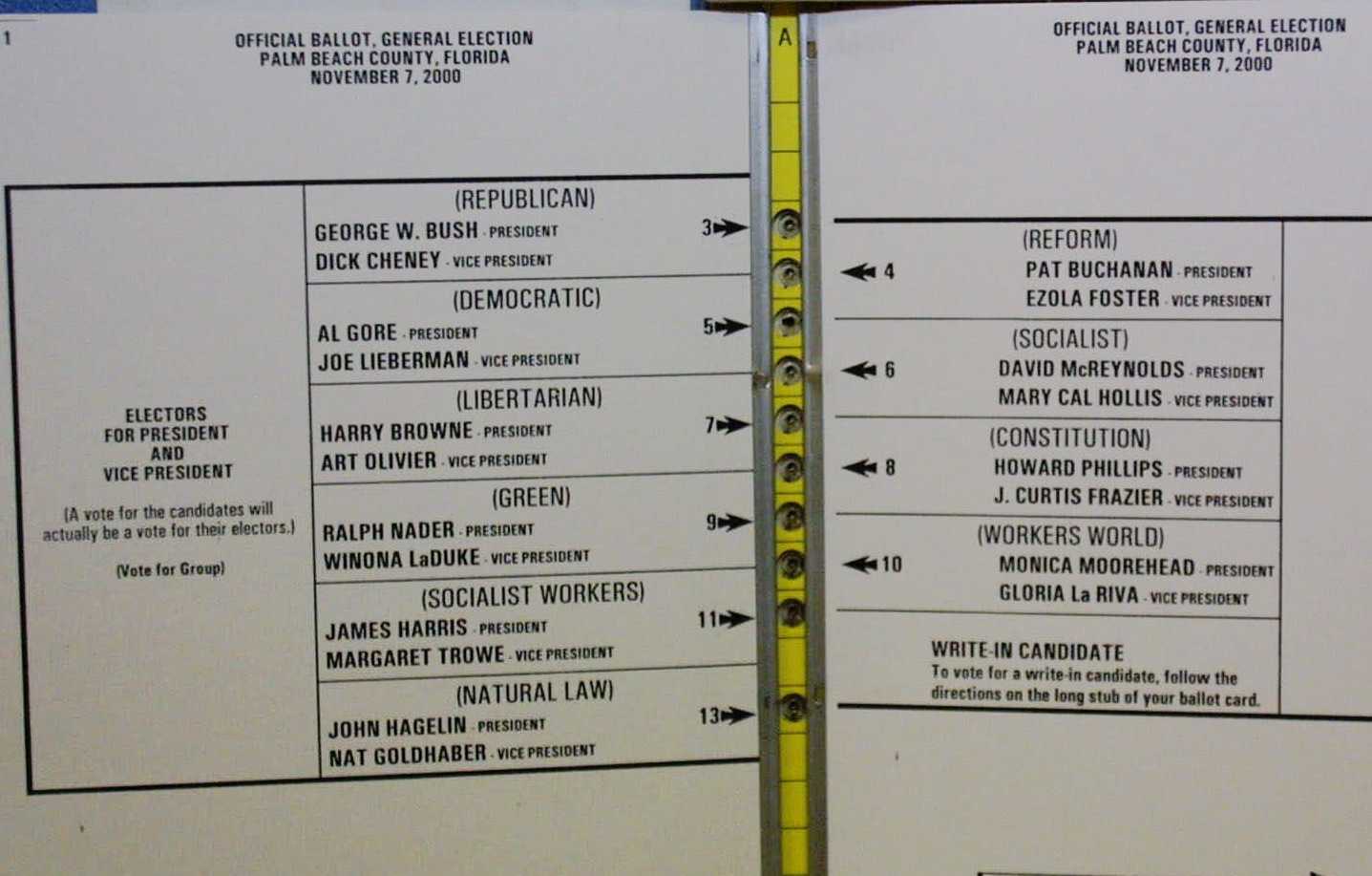
Why care about typography and document design? Well, as the site points out, citing the example of the infamous Palm Beach County butterfly ballot, the consequences of poor design and typography go beyond the “aesthetic.”
Hat tip to the Legal Writing Prof Blog (hat tipping Ruth Anne Robbins, author of a fantastic article on typography and document design, also available on the Seventh Circuit website).
Comments
4 Comments so far
- Bruce E. Boyden
- Richard M. Esenberg
- Edward A. Fallone
- Michael M. O'Hear
- Jessica E. Slavin
- Alison Barnes
- Leslie Behroozi
- Rebecca K. Blemberg
- Daniel D. Blinka
- Irene Calboli
- Janine P. Geske
- Melissa L. Greipp
- Nadelle E. Grossman
- J. Gordon Hylton
- Alison E. Julien
- Joseph D. Kearney
- John J. Kircher
- Julian R. Kossow
- Lisa J. Laplante
- Vada W. Lindsey
- Alan R. Madry
- Lisa Mazzie
- Michael K. McChrystal
- Judith G. McMullen
- Matthew J. Mitten
- Kali N. Murray
- Julie A. Norton
- Megan A. O'Brien
- Chad M. Oldfather
- David R. Papke
- Matthew J. Parlow
- Peter K. Rofes
- Paul M. Secunda
- Andrea K. Schneider
- Keith Sharfman
- Michael P. Waxman
- Tim Casey
- Charles Clausen
- Julie Darnieder
- Jon Deitrich
- Chris Donovan
- Andrew Hitt
- Eric Lalor
- Michael Morse
- Daniel Suhr
- Rachel Monaco Wilcox
- Michael Zimmer
- Theresa Fallon
- Jessica Franklin
- Andrew Golden
- Peter Heyne
- Thomas Kamenick
- Christopher King
- Nathan Petrashek
- Joshua Pollack
- Jay Rabideaux
- Sean Samis
- Brent Simerson
- Tiffany Winter
The opinions expressed here are those of the individual authors and do not represent the views of Marquette University or its Law School.
Blog Editors
Faculty Blogger of the Month
Alum Blogger of the Month
Faculty Blog Contributors
Alumni Blog Contributors
Student Blog Contributors
Other Blog Contributors
The opinions expressed here are those of the individual authors and do not represent the views of Marquette University or its Law School.
Technorati Profile


That Seventh Circuit essay changed my life! Well, not really, but it did get me to question my unthinking acceptance of the default font choice in Microsoft Word, Times New Roman. The essay convinced me that TNR is a bad choice for standard 8.5 x 11 pages; the default on my computers is now set to Palatino Linotype, which is what I used for the last dozen or so briefs I filed in practice. It’s a wider font, so it uses more paper (and for some reason when “double-spaced” is way more than double-spaced; you may need to manually adjust the line spacing). But that’s the point — it’s easier to read because there are fewer characters per line. With many courts adopting word limits, not page limits, there’s no reason to adopt a narrow font. Except for those few misguided courts that require briefs to be in GIGANTO 14-point font, and double-spaced to boot.
I likewise had a “lightning bolt” moment when I first read that piece on the Seventh Circuit website. And more such moments when I read Ruth Anne Robbins’s article
But I had not yet considered the Palatino Linotype font, and it does look like a good one, so thanks for mentioning it.
Pretty good, but much of it seemed like an advertisement for non-standard font types.
And I will still double-space after my sentences as long as I live.
Well, Tom, I swear, I have no stock in other font types. And I double-space after my sentences, except, I guess, in that comment!