
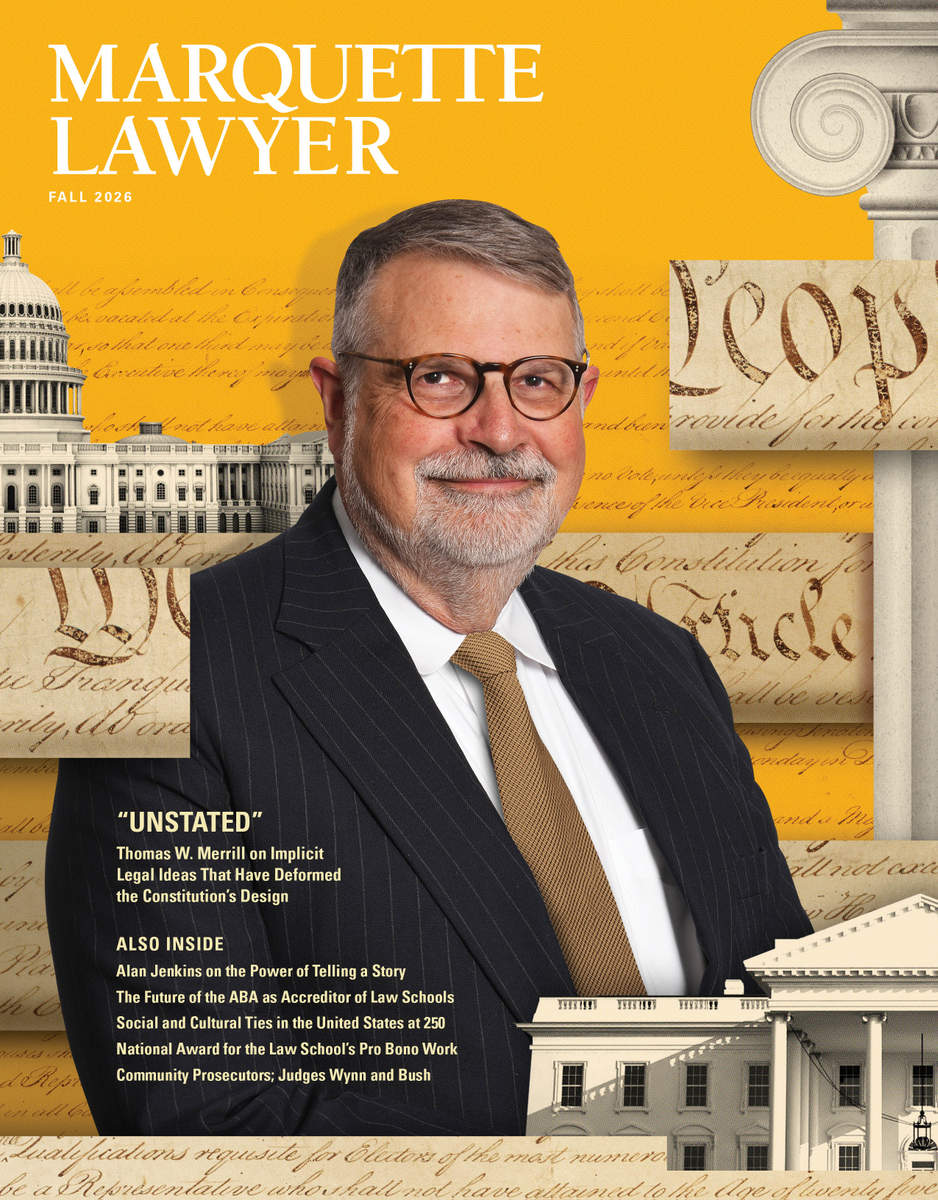
 It is a longstanding tradition that the president of the United States gives a State of the Union address each year. Consider the Fall 2026 issue of Marquette Lawyer magazine a “state of the union” report issuing from Marquette Law School as Americans mark the 250th anniversary of the Declaration of Independence. But the magazine’s approach, a bit different from that in D.C., offers nonpartisan insights into the content of the Declaration itself, the dynamic realities of the American legal system, and the lives of the people of the union.
It may seem initially curious that the most prominent part of this “state of the union” report is titled “Unstated.” In the magazine’s cover story, Thomas W. Merrill, the Charles Evans Hughes Professor of Law at Columbia University, analyzes how three “implicit ideas” have reshaped the way the federal government operates—to put it more specifically and critically, how these unstated precepts have sidelined Congress and empowered the president and the courts. Merrill, an unusually well-respected figure in the legal world, calls the changes “a fundamental deformation of the Constitution.” The article, which is a lightly edited version of the E. Harold Hallows Lecture delivered by Merrill at Marquette Law School on March 2, 2026, may be read by clicking here. A piece profiling Merrill, titled “‘A Centrist Kind of Guy,’ with Impact,” accompanies the text and may be read by clicking here.
Law School Dean Joseph D. Kearney offered insights into the content and context of the Declaration of Independence in an address to the Milwaukee Rotary Club on July 14, 2026. Kearney called the Declaration “an intensely practical document” that sets out basic principles for the new nation while providing good legal and political arguments for why independence from Great Britain was necessary. The text of his remarks, “Some Reflections on the Declaration of Independence,” may be found by clicking here.
Paired with this analysis of the Declaration is an article focused on the United States today: “The State of the People of the Union.” The Marquette Law School Poll conducted a special nationwide survey to mark the 250th anniversary of independence. More than 1,500 people were asked about their thoughts on American society and for insights into their own lives. How much do you trust other people? How do you connect with other people? How active is your religious life? How close-knit are American families across several generations? Those questions and more were probed, and the survey results are described in the article, which may be read by clicking here.
In addition to the “state of the union” articles, the new magazine offers other valuable reading, especially for lawyers.
“The Essential Power of Storytelling” provides insights from Alan Jenkins, professor of practice at Harvard Law School, who has a wide-ranging history of involvement in legal advocacy, communications, and philanthropy. “In my experience, narrative is often the ‘secret sauce’ to effective brief-writing and oral argument,” Jenkins writes. The article is based on the Robert F. Boden Lecture delivered by Jenkins at Marquette Law School on May 12, 2026. It may be read by clicking here.
For more than 25 years, the Milwaukee County District Attorney’s office has placed prosecutors in city of Milwaukee police districts to help people deal with issues in their communities. Marquette Law School graduates have played key roles in the success of the community prosecutor program, which is described in an article titled “Always Be a Problem Solver.” It may be read by clicking here.
“What is the future of law school accreditation?” This important question in the world of the legal academy and the legal profession is addressed in an interview with Daniel R. Thies, who recently completed a term as chair of the Council of the American Bar Association’s Section of Legal Education and Admissions to the Bar. Thies, an attorney in Champaign–Urbana, Ill., was interviewed by Marquette Law School Dean Kearney and Professor James B. Speta, the Elizabeth Froehling Horner Professor at Northwestern University Pritzker School of Law. An edited text of the interview may be read by clicking here.
The Law School News section of the magazine offers two articles about developments in the life of Marquette Law School.
The first reports on a seven-figure gift from the Ray & Kay Eckstein Charitable Trust to support the Law School’s Office of Public Service and, in particular, the Marquette Volunteer Legal Clinics. The gift includes a challenge to Marquette to raise additional funds—which, if met, will bring the total endowment to $7 million. The article also spotlights the American Bar Association’s recognizing the Law School’s programs with a Pro Bono Publico award, only the fourth such recognition of a law school since the award was created in 1984. And the piece announces that Joshua Hernandez, L’22, has joined the public service office as assistant director of the MVLCs.
The second Law School News article welcomes three new faculty members: Aaron Hernandez, L’13, who was named associate professor of practice and director of the National Sports Law Institute, which is part of the Law School; José Girón, an assistant professor of law with a focus on teaching criminal law and procedure; and Eric Liberatore, an assisting teaching professor and assistant director of student success.
The Law School News pieces may be read by clicking here.
The “From the Podium” section has four entries:
- Addressing the Marquette Law School graduation ceremony on May 16, 2026, Judge John K. Bush of the U.S. Court of Appeals for the Sixth Circuit called for defending constitutional principles no matter who holds public office; his remarks are excerpted here.
- As he received an honorary Doctor of Letters degree from Marquette University on May 9, 2026, Mike Gousha, now a senior advisor at the Law School, told Marquette University graduates that the world around them “doesn’t have to be this way” and they should aim to make it better; excerpts are here.
- Judge James A. Wynn, L’79, of the U.S. Court of Appeals for the Fourth Circuit, reflected on how judges should weigh history in making decisions; the reflection can be read here.
- And Professor Judith McMullen, who moved to emerita status in May 2026, is saluted by two colleagues, Professor Melissa Love Koenig, L’99, and Professor Kali Murray; the salutes can be read here.
Four distinguished Marquette lawyers were recognized at the annual alumni awards ceremony on April 23, 2026, in Eckstein Hall: Judge M. Joseph Donald, L’88, chief judge of the Wisconsin Court of Appeals, was presented with the Alumnus of the Year Award; Kathy Nusslock, L’85, an attorney in private practice, was recognized with the Lifetime Achievement Award; Richard Esparza, L’21, an in-house counsel in the Milwaukee area, received the Howard B. Eisenberg Service Award; and John G. Long, L’09, in private practice in Texas, was named the Charles W. Mentkowski Sports Law Alumnus of the Year. An article about the ceremony and the award recipients may be read by clicking here.
Almost finally (though at the beginning of the issue), “Legal Education and Mary Poppins” is the title of a column by Dean Kearney. “Well begun is half done” is the phrase from Mary Poppins that draws attention from the dean, who maintains that “a good foundation is essential to permanence and to solid further construction” and explains the precept’s pertinence to the magazine issue and the Law School more generally. The column may be read by clicking here.
The issue ends with a photo of the ABA’s Pro Bono Publico Award to the Law School.
The magazine may be read in full by clicking here.