 Time was, a “multiple-of-25” anniversary of the Interstate Commerce Act would have been an event. Law review symposia and even a speech by U.S. Supreme Court Justice Felix Frankfurter variously marked the 50th, 75th, and 100th anniversaries of the passage, on February 4, 1887, of “An Act to Regulate Commerce,” as the Interstate Commerce Act was denominated. Such celebrations (as these events substantially were) and studies seemed entirely appropriate, not simply on account of the Act’s introduction of federal entry-and-exit and rate regulation into the world of interstate railroads, but also for its status as the harbinger of the administrative state.
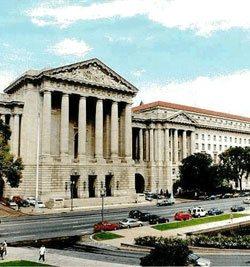
How times have changed. Insofar as I have been able to tell, this past Saturday—February 4, 2012—seems to have come and gone without any public notice of its being the 125th anniversary of the Interstate Commerce Act. That, too, is logical enough: after all, the Interstate Commerce Commission (ICC) created by the Act was abolished by Congress in 1995, and the landmark building along Constitution Avenue (pictured here) has been rededicated to other purposes of the federal government. At the same time, the Act lingers: there is no sign of the coming abolition of most of the ICC’s various descendants (grandchildren, I suppose they must be, if the ICC is the “granddaddy of them all,” as we are sometimes told), such as the Federal Communications Commission and the Federal Energy Regulatory Commission. And no one would suggest that the now larger administrative state is in danger of passing away anytime soon.
In all events, whether for its lasting effects or for itself in its time, the Interstate Commerce Act is worth remembering. So we will fill the void, as it seems. I will be joined by six distinguished scholars of regulated-industries law in writing short remembrances of the Interstate Commerce Act:
- Richard D. Cudahy, Senior Judge, United States Court of Appeals for the Seventh Circuit
- Paul Stephen Dempsey, Tomlinson Chair in Global Governance in Air and Space Law, McGill University
- James W. Ely, Jr., Milton R. Underwood Professor of Law Emeritus and Professor of History Emeritus, Vanderbilt University
- Thomas W. Merrill, Charles Evans Hughes Professor of Law, Columbia University
- Randall C. Picker, Paul H. and Theo Leffmann Professor of Commercial Law, University of Chicago
- James B. Speta, Professor of Law, Northwestern University
Prof. Speta and I will edit these essays for a future issue of the Marquette Law Review; we may find a spot for them on this blog during the next several months.

 Marquette University Law School and the Milwaukee Journal Sentinel will host a conference next week. The conference title—“Milwaukee’s Future in the Chicago Megacity”—reflects that Chicago is one of the world’s emerging “megacities”; for example, it is ranked No. 6 in Foreign Policy magazine’s Global Cities Index (behind only New York, London, Tokyo, Paris, and Hong Kong). An expansive new report by the international Organization for Economic Co-operation and Development argues that closer ties between the Milwaukee region and Chicagoland are of singular importance. At our conference, various panels, involving business leaders, elected officials, and public policy analysts, will assess that argument, with a general eye to these central questions: how closely should the Milwaukee region connect its future to Chicago, and how might that be accomplished through public policy and business might?
 Marquette University Law School is fortunate to welcome this week the Hon. Jeffrey S. Sutton of the U.S. Court of Appeals for the Sixth Circuit. Judge Sutton will deliver our annual Hallows Lecture on Tuesday, February 28, at 4:30 p.m. in the Appellate Courtroom of Eckstein Hall. His lecture, titled “Barnette, the Roosevelt Appointees, and the Progressive Embrace of Judicial Review,” focuses on Board of Education v. Barnette, the U.S. Supreme Court’s 1943 decision holding that the First Amendment protected students unwilling on religious grounds to salute the American flag. The 6-3 decision overturned Minersville School District v. Gobitis, a 7-2 decision only three years earlier. Appointees of Franklin D. Roosevelt were central in this drama: Robert H. Jackson wrote for the Court in Barnette, over the dissent of Felix Frankfurter, who had authored Gobitis but found himself abandoned by William O. Douglas and Hugo L. Black. Judge Sutton will discuss how this reversal of course happened so quickly and why it marked a turning point away from the progressive opposition to many forms of judicial review. The lecture is free and open to the public (