Taking Oaths Seriously
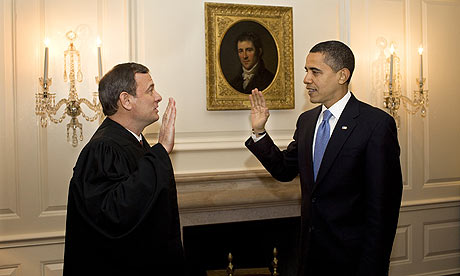 Most presidents take the oath of office twice in their lives only if reelected. Yesterday night, Barack Obama took the oath – again – from Chief Justice John Roberts because of the miscues during the inauguration ceremony the day before. The media’s take, thus far, is to poke fun at what is called the “do over,” the “flub heard around the world,” (MSNBC) and the “oaf of office” (courtesy of the New York Post). Yet at the same time, we are assured that Obama’s first oath was essentially good enough or perhaps even unnecessary for him to assume the presidency because the new term began at noon on January 20, 2009 regardless. Yale’s Akhil Amar obligingly opined on NBC that the second oath was akin to “wearing both a belt and suspenders.”
Personally, I’d find it somewhat unsettling if Obama began wearing a belt along with suspenders, so I think it is worth our time to take seriously an event that obviously the President and the Chief Justice took quite seriously. I am very much impressed that Obama and Roberts thought the oath significant enough to warrant the second ceremony. Clearly it was not done to deflect the embarrassment of the day before; indeed, the second oath only underscored their abject failure to recite correctly the 35 word oath – hardly a pas de deux. I also doubt that either Obama or Roberts fretted about the legality of the inauguration ceremony; the second oath was not intended to avoid crack pot law suits.