The Obama “Hope” Poster Case — AP Strikes Back

(This is the fifth in a series of posts on Fairey v. Associated Press. See below for other posts in the series.)

Today, the AP filed its response to the Fairey complaint—and as I predicted, the AP is asserting counterclaims for copyright infringement. Like Fairey’s complaint, the AP’s counterclaims go well beyond merely stating a cause of action, and attempt to win the battle for positive publicity as well. (Note to my Civ Pro students: Take a look at these pleadings if you want to see skillful examples of what I was talking about when I mentioned complaints that go beyond a “short and plain statement.”) Both sides in this case have their eye not just on the law, but on the ordinary, nonlegal intuitions of the press, the judge, the jury, scholars, and bloggers such as myself. (Indeed, I got a copy of AP’s press release by email. To Fairey’s attorneys: Feel free to reciprocate!)

I have a few quick observations.

Continue ReadingThe Obama “Hope” Poster Case — AP Strikes Back

The Obama “Hope” Poster Case — How Was the Poster Created?

(This is the fourth in a series of posts on Fairey v. Associated Press. See below for other posts in the series.)

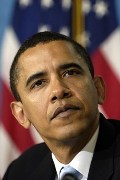
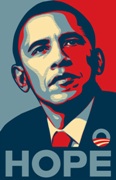
There are two intriguing mysteries in the Shepard Fairey case related to how the Obama Hope poster (above right) was created. First, while Fairey’s poster looks pretty similar to Mannie Garcia’s photograph at left, Fairey actually claims he based his poster on a very different photograph, albeit one taken at the same event, with Obama looking in the same direction. Second, the complaint is fairly cagey about the actual creation process behind the poster. In particular, it’s not clear from the complaint whether Fairey simply photoshopped the Garcia photo, or rather created the poster by hand.

Why do either of these things matter? The first issue matters doctrinally; the amount of the copyrighted work that was taken helps to determine both infringement liability and counts in evaluating any fair use defense. The second issue matters more atmospherically; it just seems easier to credit a claim of substantial similarity, or conversely harder to credit a claim of fair use, if Fairey copied the original and altered it down, rather than creating a similar-looking version from the bottom up. I’d venture that that may be true even if the two processes led to exactly the same end product, although that might not make much sense as a theoretical matter.

So what’s the truth? Which image did Fairey use, and what did he do to it?

Continue ReadingThe Obama “Hope” Poster Case — How Was the Poster Created?

Litman on the Prospect of Copyright Reform

Jessica Litman, the John F. Nickoll Professor of Law and Professor of Information at the
University of Michigan, delivered the Twelfth Annual Honorable Helen Wilson Nies Memorial Lecture yesterday at the Law School. (Audio available here; a print version will be forthcoming in the Marquette Intellectual Property Law Review.) The subject of Litman’s fascinating lecture was “Real Copyright Reform” — the word “real” referring not to what is likely to actually occur, but rather what sort of changes would truly reform the Copyright Act.

Litman believes that yet another wholesale revision of the Copyright Act, akin to those in 1831, 1870, 1909, and 1976, is in the offing. The warning signs are all there — practitioners are arguing that different meanings should be given to the same terms in different contexts, industry players are opting out of the Act’s provisions in private agreements, and the current Act no longer serves any of its constituencies very well. Those constituencies include not only creators and distributors, the primary movers behind previous reform efforts, but now also device makers and, increasingly, ordinary users of copyrighted works, who in the past were treated by copyright law with benign neglect. Now, as evidenced by the RIAA lawsuits and YouTube notice and takedowns, consumers are no longer below the fray; they are getting drawn into the battles between distributors and device makers.

What can legal scholars offer the copyright revision process? Litman was not optimistic that the legislative process would produce a worthy reform, or that scholars would get to play much of a role in it, but she offered three goals the ideal “Copyright Act of 2026” should meet.

Continue ReadingLitman on the Prospect of Copyright Reform