
Wisconsin School Vaccination Rates: an interactive map

The Washington Post recently published an interactive article which shared kindergarten immunization data collected from public schools in 34 states. The data shows plunging vaccine rates across the country.

I was shocked by how low some of the numbers were, and I wanted to understand how they compared to school numbers as a whole. It’s possible than some kindergartners haven’t yet received all of the vaccination they will receive.

For example, Neeskara Elementary had an MMR vaccination rate of 12% and an overall compliance rate of 7%. Fortunately, the schoolwide numbers for Neeskara, according to WI DHS, are an MMR rate of 60% and an overall rate of 50%. Given that herd immunity against measles requires “about 95% of a population to be vaccinated,” Neeskara is still disturbingly low, but there is a world of difference between 7% and 60%. Most of the children attending Neeskara have received this vaccine–just not most kindergartners at the beginning of the year.

At MacDowell Montessori, kindergartners reported an MMR rate of 26% and an overall rate of 26%. The schoolwide numbers are 92% for MMR and 62% overall. Likewise, kindergartners at Hayes Bilingual School were at 33% for MMR and 27% overall. The schoolwide numbers are 76% MMR and 61% overall.

More details from WI DHS

Besides listing the MMR and overall vaccine compliance rates for each school, the WI DHS data also provides information about why students aren’t vaccine compliant. In most Milwaukee schools with low vaccination rates, the cause isn’t that parents have filled out vaccine waivers. According to the DHS statistics, it’s more common for students who are out-of-compliance to be classified as “in process,” “behind schedule,” or just “no record” rather than having explicitly opted-out of vaccinations by completing a waiver.

At Neeskara, for example, 20% are “behind schedule” and 28% have “no record.” Scarcely any students actually have a vaccine waiver on file. Similarly, Riverside High School has truly dismal 12% vaccine compliance rate. Eighty percent of its students are “behind schedule” and 7% are “no record.” Few, if any, have waived vaccine requirements.

Schools where many students have waived vaccines are uncommon, but they do exist. At Tamarack Waldorf, on Milwaukee’s East Side, 67% of students have met minimum vaccination requirements. Sixteen percent have “waived all vaccines” and 24% have completed a “personal conviction waiver.” The distinction between these classifications is unclear to me. So is the distinction between students who are listed as “in progress” vs. “behind schedule.”

In general, the quality of the school-level data provided by WI DHS raises as many questions as it answers. At North Division, for instance, 65% of students were classified as “met minimum requirements” in 2024, with just 5% having “no record.” The next year, in 2025, fewer than 5% “met minimum requirements” and 80% had “no record.” Absent some extraordinary turnover over students between those two years, I struggle to imagine how this could be possible. More likely: the data was reported incorrectly in one or both of the years.

Many schools also fail to submit their reports every year. In 2025, 377 schools statewide (13% of the total) failed to submit a report. But 197 of those schools had submitted a report the previous year, in 2024.

The current self-reported school vaccination data collected by WI DHS is incomplete and inconsistent where available. The failure to report this data accurately (or at all) poses real challenges to public health efforts. A health department might want to plan its vaccine outreach campaigns around those schools where children are unvaccinated, not because their parents have opted them out of immunizations, but simply because those children are apparently not receiving medical care. Better data would improve this kind of targeting.

I’ve built an interactive map showing the available data for every school in the state. Click the image below to open it. Mousing over each school will reveal its name and 2025 overall vaccine compliance rate. Click the school to display a table showing more detailed vaccine statistics for each year from 2022 through 2025. If the school failed to submit a report in any of those years, all values for the year will be NA.
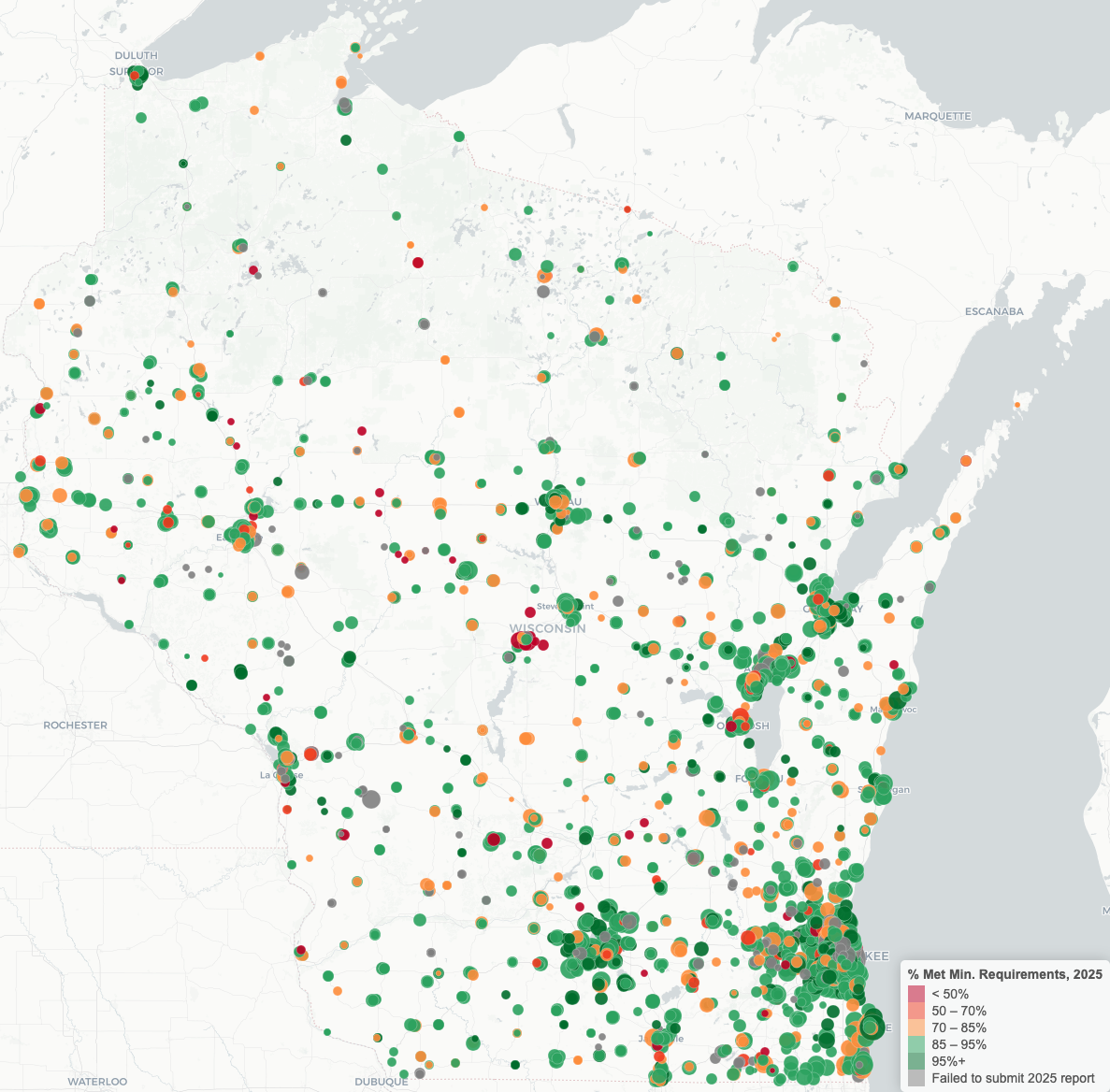
Updated 2/25 to correctly identify that the Washington Post story uses kindergarten vaccination rates, not schoolwide rates.

Continue ReadingWisconsin School Vaccination Rates: an interactive map

Eleven Thoughts on Making the Work of K–12 Teachers More Successful

People Falling with Hand outreachedThe Fall 2024 Marquette Lawyer magazine included essays looking at the broad question of why so much K–12 education reform brings so little progress. If I do say so myself (and I was much involved), it was a provocative and thoughtful discussion.
In the end, one sentence stood out to me and others involved in planning programs at Marquette Law School’s Lubar Center for Public Policy Research and Civic Education. Robert Pondiscio, a senior fellow at the American Enterprise Institute, wrote, “What if, instead of pulling policy levers, we redirected the reform movement’s energy and enthusiasm toward improving classroom practice?”

Well, what if? Pondiscio argued that better training of teachers and steps to lighten the workload of teachers would open paths to better results. He said too much is being expected of many teachers now. He advocated particularly for providing teachers in many subjects high-quality curricular materials so they don’t have to spend large amount of time developing lessons plans and can focus on actual teaching and connecting with students.

To advance the conversation, Marquette Law School, teaming with the Marquette College of Education, hosted an in-person forum on May 8, 2025, titled “Focusing K–12 Education Reform on Teaching Efforts.” Before an audience in the Lubar Center of more than 100, including a number of leaders in Wisconsin education, Pondiscio expanded on his thinking; Sarah Almy, chief of external affairs for the National Council on Teacher Quality, offered additional perspective; and a panel of Wisconsin educators offered their thoughts.

We intend to pursue this important conversation in further events and in the Marquette Lawyer magazine. For the moment, let me offer a set of thoughts from the conference’s speakers.

Pondiscio on the teaching workforce overall: With about 3.7 million K–12 teachers nationwide, it is unrealistic to expect the large majority to be “saints and superstars.” The large majority, he said, are people who want to be good teachers but are, for one reason or another, more middle-of-the-pack in their work. But, he said, they could become more successful. “That’s why I come back to raising not the level of teacher quality, but of quality teaching—making this job doable by the teachers we have and not by the teachers we wish we had.”

Pondiscio on reducing the burden on teachers who often must deal with duties that go beyond actual teaching: “Something’s got to come off the teacher’s plate. And the most obvious thing to me is curriculum. . . . Somebody else can write the curriculum. Nobody else can give feedback, get to know the kids, etc. So that one basic shift alone would probably make a difference.”

Pondiscio, when asked who will do all the non-teaching things teachers do now: “I don’t know what the answer is, but I know what the answer is not. It’s not asking Miss Jones to do it. . . . This is about making teaching easier and doable.”

Pondiscio on the education reform movement in recent years: Some reformers wanted to “beat teachers up—you know, ‘look at these terrible teachers, they’re lazy.’ A lot of us in education reform said, ‘just fire bad teachers and all will be well.’” In fact, he said, teachers were not “the sinners,” but “the sinned against,” by being put in positions where they faced unreasonable demands and were not trained well. “The teachers are not the bad guys here. When teachers know what to do, they’re not that bad.”

Almy on the gap between policy and practice in education: “I think a lot of times we really fall down on translating policy into implementation and practice. . . . I think we put a lot of energy, whether it’s at the state level or the district level, into getting the policy passed and the political pieces of that. And then everyone takes a sigh of relief and sort of assumes a lot of this will translate at the classroom level.” But pushing waves of reform onto teachers and local school leaders often means that things don’t change “because the classroom door closes and the teacher does whatever the teacher’s going to do.”

Almy on teacher-training programs, a major focus of her organization: “We need to stop putting all of the onus on training teachers on the districts, and we need to ensure that we’re holding our teacher-prep programs to really high expectations.”

Taylor Thompson, a first-year first-grade teacher from Oshkosh who has used a literacy curriculum called Core Knowledge Language Arts: “CKLA has actually given me a clear, structured path that supports my teaching and my students’ learning . . . . That structure has allowed me to focus on how we are teaching things, rather than spending hours worrying and figuring out what we are teaching.”

Maggy Olson, director of equity and instruction for the Greendale School District in suburban Milwaukee, on those who say education is not succeeding: “I think so often in education that is the narrative: ‘It’s impossible.’ It is, ‘teachers are failing, kids are failing, our schools are failing, it’s a mess.’ I want to say that is absolutely false. . . . Our schools are not failing. They’re doing more than they’ve ever done before.”

Kanika Burks, chief schools officer for Howard Fuller Collegiate Academy, a Milwaukee charter school, on the obligation of administrators to support teachers: Administrators need to “pay attention to the heart of the people that are in front of you. . . . If the person who is in front of our young people is not healthy, if their heart is breaking, if they are breaking down, they are not going to be the most effective person regardless of the curriculum and the faith in them.”

Cynthia Ellwood, a Marquette University College of Education faculty member, on striking a balance between curriculum and teacher presentation: “It’s not just a matter of going out there and finding the perfect material. I don’t think it boils down to a single approach to curriculum [or other factors]. . . . We must know that every single one of our students is capable of high intellectual thought, that they are capable of seeing themselves as intellectuals. And what we’re doing right now is not building pathways so that every child is offered this incredible challenging curriculum and the appropriate supports that make it possible for them to succeed.”

Olson on the future: “Is there hope? Yes, there is so much hope in our children and our educators. Right now, we are in a very dark place. I would argue that we are not in a tomb, we are in a womb, and we’re ready to be reborn. . . . . Hope is in the work that we have moving forward.”

The in-print symposium in the fall 2024 Marquette Lawyer magazine may be read by clicking here (online version) or here (PDF).

Video of the May 8 program at Eckstein Hall may be viewed by clicking here.

Continue ReadingEleven Thoughts on Making the Work of K–12 Teachers More Successful

Why Report on K–12 Education in Wisconsin? Listen to Alan Borsuk.

Alan BorsukAlan J. Borsuk has been the Law School’s senior fellow in law and public policy since fall 2009—call it 14 years. So, for a not wholly impertinent point, he has some time to go before replicating his 37 preceding years as a reporter and editor at the Milwaukee Journal and Milwaukee Journal Sentinel. In any event, during his time with us, he has kept his hand in the newspaper with the occasional—nay, frequent—column on K–12 education policy and practice in this region. Why?

Borsuk’s recent piece in The Grade, a nationwide online platform focused on journalism about education, will tell you. Here’s a flavor (the introduction):

I crossed paths with a former member of the Milwaukee school board a while ago.

He had moved on from the school scene, but I was still writing about K-12 education, as I had across more than 50 years.

“Do you feel like you’re living ‘Groundhog Day’?” he asked me, referring to the movie in which the protagonist repeats the same day over and over.

“Yes. All the time,” I told him.

At that time, I often felt like I was writing pieces I’d written so many times before.

But I was still doing it.

Why? Because damn it, it’s important.

That’s why I’m still at it all these years later — and why I decided to make what might be my last big project as a journalist a multipart series on longstanding problems in how most schools teach kids to read.

Education coverage should be energetic and powerful. I hope that showed in the recent pieces I wrote about literacy. But I also know there is more I could and should do.

There is more all of us in education journalism could and should do.

As with Borsuk’s work more generally, the whole thing is well worth a read. Find it here.

Continue ReadingWhy Report on K–12 Education in Wisconsin? Listen to Alan Borsuk.