
Merit Selection Amendment Introduced

Yesterday, State Representative Mark Gottlieb (R-Port Washington) announced that he is drafting a constitutional amendment to replace Wisconsin’s current method of judicial elections with “merit selection.” Rep. Gottlieb is a former speaker pro tem of the Assembly, and he is widely regarded as one of the top policy gurus within the Republican caucus.

Currently, the legislature is seriously considering public financing
of judicial elections (a topic on which Prof. Esenberg has written
extensively
).  Rep. Gottlieb is offering his amendment as an alternative to public financing as it comes to the floor in the near future. Rep. Fred Kessler (D-Milwaukee) offered his own judicial selection amendment earlier this session. Both Gottlieb and Kessler differ from the typical “Missouri Plan” merit selection system. Under Kessler’s plan, the governor would appoint a justice with the “advice and consent” of a majority of the State Senate for a ten-year term. As that term is coming up for expiration, a justice who wishes to continue may do so unless at least thirteen senators reject the proposed renewal. Under Gottlieb’s plan, the governor must select his nominee from current circuit court and appellate judges who have served at least eight years on the bench. The nominee would then need to be confirmed to the ten-year term by a twenty-vote (3/5) majority in the state senate.  At the end of the ten-year term, and each subsequent ten-year term he or she desires, the justice would have to run in a retention election.  Neither the Kessler nor the Gottlieb plan would change judicial selection for the court of appeals or circuit courts.

Let’s start by stating what’s good about both of these proposals.
Continue ReadingMerit Selection Amendment Introduced

Chief Justice Shirley Abrahamson Greets Chilean Delegation

chileYesterday was another full day for the Chilean students visiting from Hurtado University Law School.  In the morning, alumn Reyna Morales gave a talk in Spanish on criminal procedure and law.  Afterwards,  MULS Professors Tom Hammer, Michael O’Hear, Chad Oldfather, Dan Blinka, and Greg O’Meara, S.J., participated in a Q&A panel.  The Chilean students came prepared with a range of questions dealing with the types of legal defenses available to defendants, the rights of juveniles, and issues of due process in Guantanamo, among other topics.

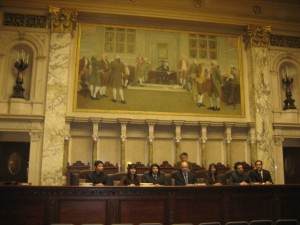
In the afternoon, we drove to Madison to visit Chief Justice Shirley Abrahamson at the State Capitol, accompanied by former Supreme Court Justice and MULS professor Janine Geske.  The Chief Justice greeted the delegation in the hallways of the Capitol, and then invited the members to sit in the Supreme Court Hearing Room to offer an overview of the Wisconsin Supreme Court’s work.  With warm humor, the Chief Justice then answered the many questions that the Chilean students posed.

One student asked if the justices are ever influenced by their political affiliations when they write their decisions.  The Chief explained that they do not work as Democrats or Republicans, but rather as “reasonable” people.  That said, the students were curious about the election process and how judges are selected.  The Chief Justice noted that she has sat on the bench for more than 30 years and joked that she plans on running in 2019, but unopposed.  She clarified that, unlike other political campaigners, the judicial candidates only promise to uphold the law.  She then turned to point to the mural above the bench of the founding fathers signing our national Constitution.  The image is there to remind us that the justices take an “oath of office” to uphold the highest law.  The Chief escorted the group to the conference room, where she shared the process for selecting who would write the majority opinion:  chess pieces!

The Wisconsin Law Journal covered the event, so stay tuned for pictures.

Continue ReadingChief Justice Shirley Abrahamson Greets Chilean Delegation

Gableman Prognostication

Yesterday a three judge panel heard oral arguments on the disciplinary complaint against Justice Michael Gablemen. You can review the offending ad here and my recent discussion of it on Prawfsblawg there.

There are two rules that are pertinent. The first sentence of 60.06(3)(c) provides “[a] candidate for a judicial office shall not knowingly or with reckless disregard for the statement’s truth or falsity misrepresent the identity, qualifications, present position, or other fact concerning the candidate or an opponent.” This is the proscription that the Judicial Commission says was violated by the Mitchell ad.

But there is a second sentence. It states that “[a] candidate for judicial office should not knowingly make representations that, although true, are misleading, or knowingly make statements that are likely to confuse the public with respect to the proper role of judges and lawyers in the American adversary system.”

The difference between “shall” and “should” is significant. The preamble to the Judicial Code states that “[t]he use of “should” or “should not” in the rules is intended to encourage or discourage specific conduct and as a statement of what is or is not appropriate conduct but not as a binding rule under which a judge may be disciplined.” (emphasis supplied)

Continue ReadingGableman Prognostication