
Almost twenty years ago, the eight Great Lakes states agreed “to act together to protect, conserve, restore, improve, and effectively manage the waters” of the Great Lakes basin. On November 3, the Law School’s Lubar Center for Public Policy Research and Civic Education and its student-led Environmental Law Society joined forces to host a special student-only event examining how the Great Lakes Compact has fared and considering its future prospects. The event featured Peter Johnson, the deputy director of an organization created by the Great Lakes St. Lawrence Governors and Premiers (GSGP) to support regional initiatives such as the Compact. Over more than a quarter century with GSGP and its predecessor organizations, Johnson has dedicated his career to protecting and improving the Great Lakes. As one of the architects and drafters of the Compact, he helped shape the contours of the agreement. Today, as part of his work, Johnson serves as the secretary of the Compact Council and the Regional Body, which together form much of the infrastructure for information exchange, joint management, and decision making under the Compact. In matters involving the Compact, it would be difficult to find a more respected and knowledgeable commentator.
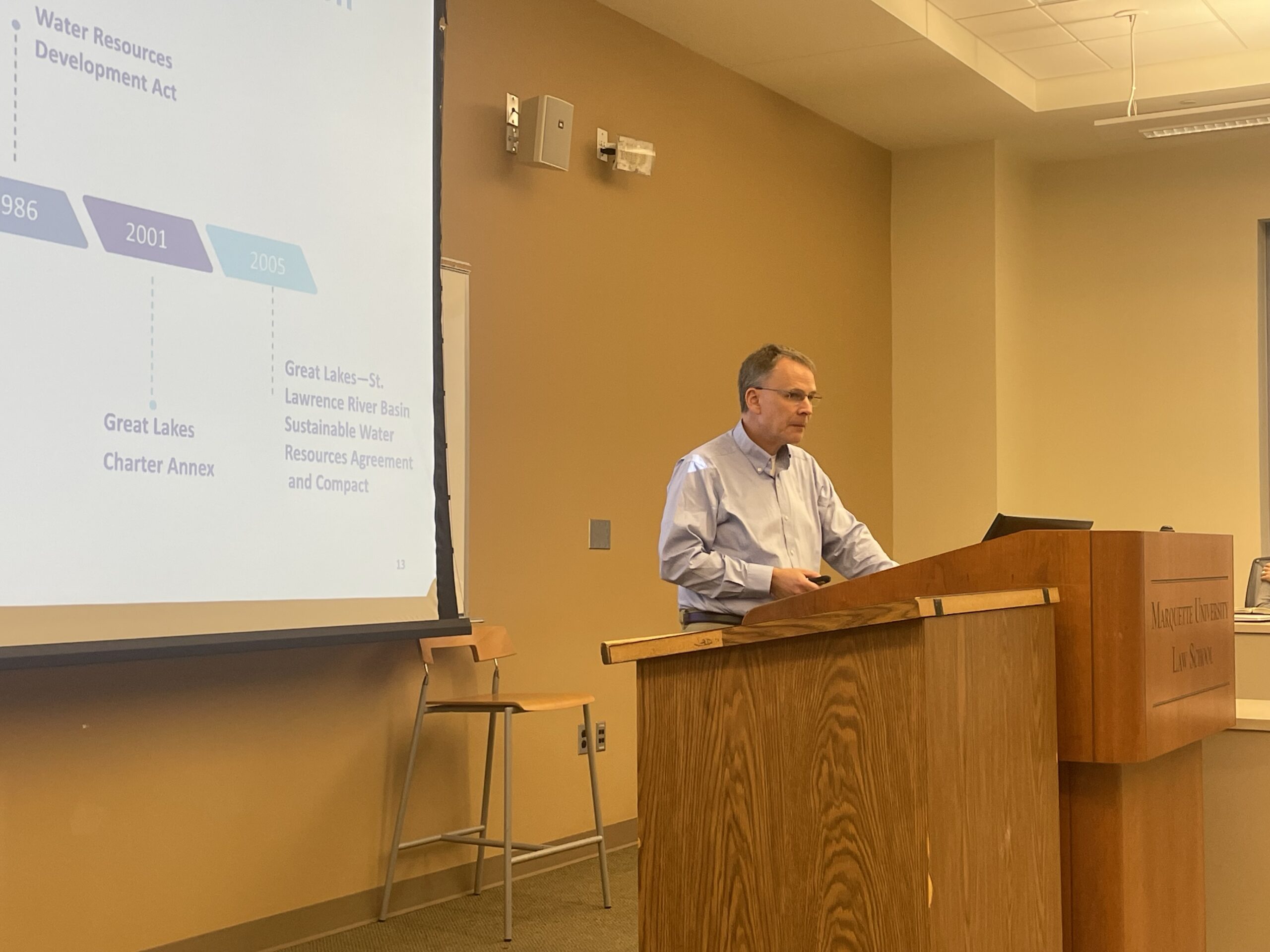
Lately, Johnson and the GSGP organization have been pondering what’s next for the Compact. In late 2025, the GSGP announced a new initiative to “Future Proof” the Compact, by “preserving long-term continuity, preparing the next generation of leaders, and building capacity to meet future water management challenges.” In furtherance of that goal, GSGP representatives – Johnson himself, in this case – hit the road to connect with future Great Lakes leaders around the region, participating in events at the University of Michigan, the University of Illinois, and most recently, here at Marquette Law School.
At the event, Johnson first highlighted the vast scale and importance of the Lakes: they contain 21% of the world’s surface freshwater, 84% of North America’s surface freshwater, and provide drinking water to over 40 million people. He acknowledged that the thing most people remember about the Compact is that it bans diversions of Great Lakes water to destinations outside the Great Lakes Basin, with a few rarely used exceptions (municipal supply for communities that straddle the basin line or that lie in a straddling county, humanitarian purposes, and exporting products containing Great Lakes water).
But Johnson elected to instead focus most of his remarks on the many other pioneering features of the Compact. Consider, for example, that the Compact required every Great Lakes state to implement a water management system, set thresholds for in-basin withdrawals, and create water conservation and efficiency programs. Similarly, the Compact was the impetus for regional protocols to collect and report water use data. In turn, that led to a first of its kind cumulative impact assessment measuring the effects of human water use on the Great Lakes. These and other innovations flowed from the parties’ express commitment to “strengthen the scientific basis for sound water management decision making” and to “guide the collection and application of scientific information” to support water policy in the Great Lakes region.
Perhaps all this helps explain the overwhelming and bipartisan support the Compact received as it came into force, with over 95% of state legislators voting to enshrine it in the law of the respective Great Lakes states, passage by unanimous consent in the U.S. Senate, and a 390-25 favorable vote in the House of Representatives.
Ultimately, Johnson concluded that the best way to “future proof” the Compact is by empowering and informing future generations of leaders who will care about and continue to preserve the Great Lakes. The GSGP initiative aims to transfer the hard-won institutional knowledge, along with the ethics and values, of first-generation leaders such as Johnson to future leaders – such as the Marquette law students who attended the event.
Over the years, the Compact’s innovative “horizontal federalism” approach to water policy, coupled with the importance of the Great Lakes to our region, has led the Law School to host events examining the Compact on several occasions. In 2018, for example, the Water Law and Policy Initiative presented a conference titled “Evaluating the Great Lakes Compact on its Tenth Anniversary” featuring former Governor Jim Doyle, who was in office at the time of the Compact’s formation. In 2025, the Initiative hosted “Selling Water to Joliet? Chicago and the Great Lakes Compact,” exploring the special status held by the State of Illinois (and the City of Chicago) under the Compact from legal, historical, and economic perspectives. An earlier event focused on the controversy surrounding the City of Waukesha’s request to divert Lake Michigan water.
On November 3, though, the focus of those in attendance was clearly not on the past. They looked forward to the future of the Compact and of the region as a whole.