The 2025 Election Might be Wisconsin’s New April “Normal”

Democrats across the country hailed yesterday’s victory of Susan Crawford over Brad Schimel as a decisive rejection of Elon Musk and Donald Trump. Certainly, Schimel embraced the connection between himself and the president throughout his campaign for a seat on the Wisconsin Supreme Court.

As I look at the results, I am unconvinced that the April 2025 election represents a turn against Trump among voters who supported him in November. Instead, I think the real story might be something even worse for the Wisconsin GOP, if less thrilling for national Democrats. This might just be the new normal for April elections.

Crawford won 55.0% of the vote according to unofficial election-night data. In 2023, the Democratic-endorsed candidate won 55.4%, in 2020 55.2%, and in 2018 55.7%. The lone exception is 2019, when Brian Hagedorn (a swing vote, but supported by Republicans) won a narrow victory by holding the liberal candidate to 49.7%.

Doubtlessly, persuasion played some role in Crawford’s victory. As more data becomes available, we’ll be able to draw clearer conclusions about how much. But, at a high level, you don’t need a story about persuasion to explain this election. A ten-point victory for the liberal candidate has become the normal outcome in Wisconsin’s April elections. To understand why, we have to look at the two party’s changing relationship to voter turnout.

Voter Turnout has Never Been Higher

Half of Wisconsin adults voted in the April 2025 general election for the state supreme court. It is difficult to emphasize how unusually large this turnout was. In all likelihood, this is the greatest share of adults to ever vote in one of the state’s April elections. Two years ago, in April 2023, 40% of adults voted in the election of Janet Protasiewicz which flipped the ideological balance of the court.

That year’s turnout was itself extremely high for a spring election not featuring a presidential primary. Turnout is typically highest when the spring election coincides with contested presidential primaries for both parties, as last occurred in 2016. In that year, about 47% of adults voted. We have to go all the way back to the 1960s to find similarly high levels of turnout among the voting age population, which did not yet include 18-20 year olds.

In fact, Wisconsin’s 50% turnout rate in the formally nonpartisan April 2025 election was higher than the adult turnout rate of 38 states in the 2022 midterms.

The sky high turnout this April is part of a general trend in Wisconsin politics throughout the years since Trump’s first election. The only gubernatorial election with a higher adult turnout rate than 2022 was 2018. Among presidential elections,  2024 had the highest turnout on record (2020 was the third highest, following 2004).

Wisconsin’s electorate is just plain extremely engaged. Whether measured as a share of total or eligible adults, no state had a higher turnout that Wisconsin in 2024. Here’s another superlative: since 1856, when the modern party system began, no state has been as closely divided between Democrats and Republicans across three consecutive presidential elections as Wisconsin in 2016, 2020, and 2024.

Scour American history and you’ll struggle to find an example of state as hyper-engaged with, and narrowly divided by, electoral politics as Wisconsin in the present moment.

Most observers, myself included, think Wisconsin’s high turnout in 2024 helped push Trump to his narrow victory, thanks to his particular popularity among infrequent voters. In April 2025, high turnout pushed the Democratic-endorsed candidate Susan Crawford to a 10-point victory over the Republican-endorsee, Brad Schimel.

If this seems like a paradox, consider how different the two “high turnout” electorates were. Just over a million more people voted in November 2024 than April 2025. A majority of the million voters who stayed home are probably Republicans, or at least Trump supporters.

Here’s a crude, but useful, mental model. Imagining lining up all of Wisconsin’s roughly 3.4 million voters in order of likelihood to vote. The first million lean most strongly Democratic, the next million less so, and the final million tilt more Republican. In February 2025, about half a million voters showed up to vote in the State Superintendent primary and 65% of them voted for Democratic-aligned candidates. In April 2025, 2.4 million participated and 55% voted for the liberal. In November 2024, 3.4 million voted, and the electorate was evenly divided, giving both Trump and Tammy Baldwin 1-point victories.

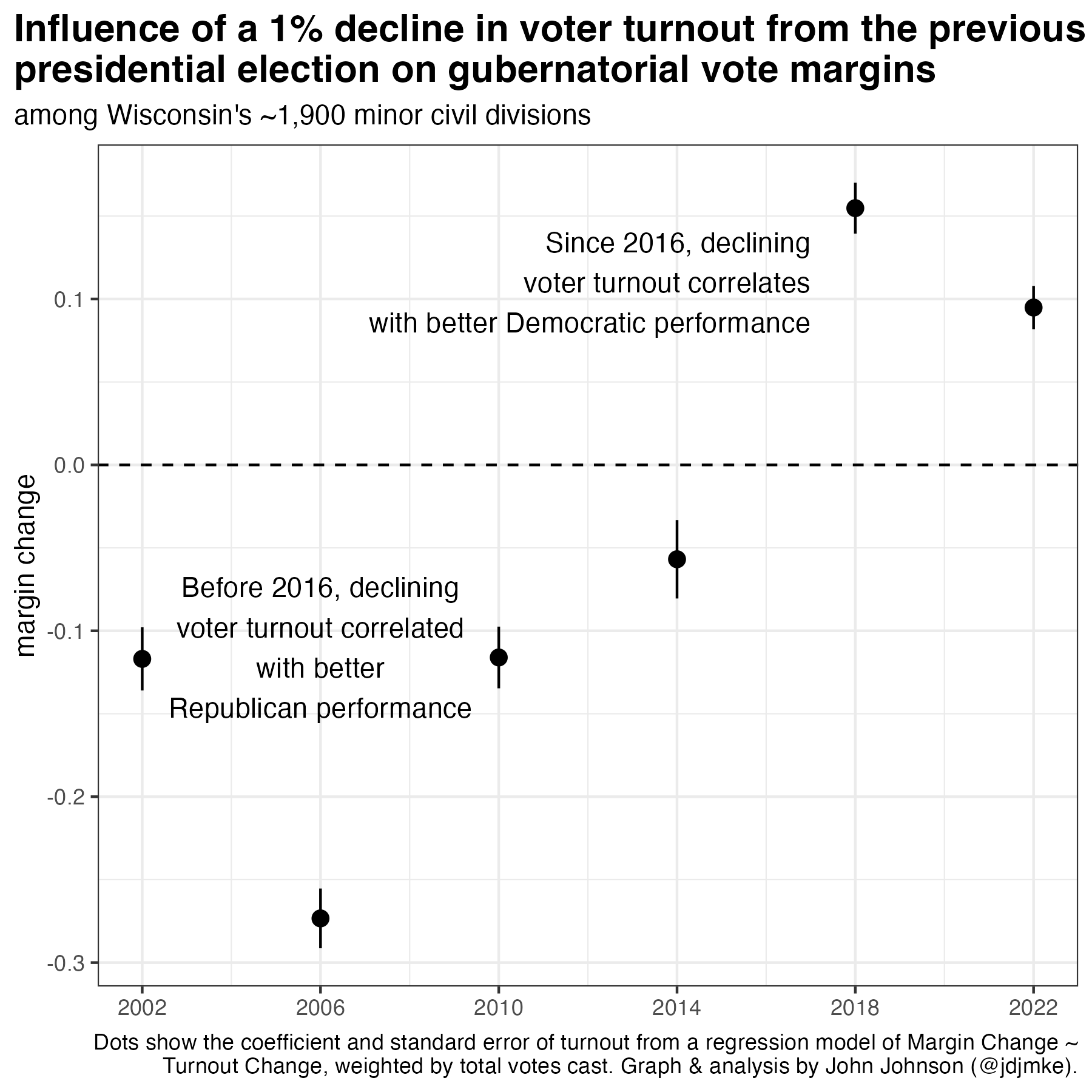
When I was a college student, in the early 2010s, the mantra among Democrats was “If everyone votes, we win.” When 2.2 million people voted in Wisconsin’s 2010 gubernatorial election, Republican Scott Walker won by 7 points. When 3.1 million people voted in Wisconsin’s 2012 presidential election, Obama won by 6 points. Two years later, when 2.4 million voted, Walker won reelection by 6 points.

Republican strength in lower-turnout elections gave them a structural edge in the state Supreme Court, whose elections may only be held in April. Conservative candidates won 4 of 6 such races held from 2008 through 2016, and the 2017 reelection of a conservative justice wasn’t even contested by a liberal. In the years since 2017, however, Democratic-backed candidates have gone 4 for 5. If they win the next two races in 2026 and 2027, they could hold a 6-1 majority on the court.

I can’t tell if either party has fully internalized this shift yet. Musk’s high-profile  shenanigans—offering voters cash to pose with photos of Schimel and advertising random drawings of $1 million prizes—struck me as the kind of thing a campaign might self-consciously do to appeal to low propensity voters.

On the other hand, both Trump and Musk celebrated the landslide passage of a referendum adding Wisconsin’s existing photo ID voting requirement to the state constitution. Trump wrote, “This is a BIG WIN FOR REPUBLICANS, MAYBE THE BIGGEST WIN OF THE NIGHT. IT SHOULD ALLOW US TO WIN WISCONSIN, LIKE I JUST DID IN THE PRESIDENTIAL ELECTION, FOR MANY YEARS TO COME!”

Recently, I completed my own analysis of the photo ID requirement’s impact on voting access in Wisconsin. My conclusion was that almost everyone has such an ID, so the practical effect of the requirement is small. Its introduction in 2016 has not prevented the state from setting turnout records.

Still, certain populations are less likely to hold an ID. These include poor people and young people not enrolled in college—decreasingly core Democratic constituencies. All else being equal, poor Black adults in Wisconsin are actually more likely to have a photo ID than poor white adults. I suspect this reflects concerted efforts by Democrats and their allies to help Black residents get their needed identification documents.

Hurdles to convenient voting access once worked to the benefit of the Republican party in Wisconsin, whether deliberately or not. Now, the calculus appears reversed. The best chances for a GOP candidate will appear in an electorate of 3 million or more. As any Democrat working on campaigns in the Obama years could tell you, winning elections by maximizing turnout is possible, but hard.

Continue ReadingThe 2025 Election Might be Wisconsin’s New April “Normal”

Who Lacks a Photo ID in Wisconsin?

Wisconsin has required residents to present a photo ID in order to vote in every November election beginning with 2016[1]. On April 1, voters will have the opportunity to add this requirement as an amendment to the state constitution. It will probably pass. The latest Marquette Law School Poll found 77% support for the ID requirement generally and 73% support for the constitutional amendment.

Supporters of the requirement argue that it’s a good way to prevent voter fraud. Opponents fear that it creates an onerous requirement for eligible citizens without IDs. During federal litigation following the bill’s passage an expert witness estimated that 300,000 then-registered voters lacked an appropriate identification card. Another witness ran a survey which found that 63,000 Milwaukee County residents likely lacked a state ID card.

To my surprise, I could find no more recent analysis of the number of Wisconsin adults lacking a photo ID card. This article is my attempt to answer two questions. How common is it for a Wisconsinite to lack a photo ID? Are there patterns in who lacks them?

Wisconsin Voter Turnout

First, here are some basic facts about voter participation in Wisconsin. Turnout has consistently been very high in this state—typically among the highest in the country.

Opponents feared that the introduction of the photo ID requirement would reduce turnout. This does not appear to have happened, at least in a long-term way.

In 2008, 69.8% of adults voted. This fell ever-so-slightly to 69.6% in 2012. Then, turnout dropped much more noticeably in 2016, down to 66.5% of adults. Voters became much more engaged after Trump’s first election. Turnout jumped to 71.8% of adults in 2020.

Despite a national decline in voter turnout in 2024, it grew in Wisconsin to 72.8% of adults. Turnout was probably highest in Wisconsin out of all 50 states, whether measured as a share of all adults or voting-eligible adults.

Midterm voter turnout grew even faster than presidential turnout after the introduction of the photo ID requirement. Before the requirement, in 2010, 49.9% of adults voted. In 2014, 54.4% participated, growing to 58.8% in 2018. Turnout dipped to 57.7% in 2022.

graph showing wisconsin's adult population and voter turnout from 2000 through 2024

Concerns about the impact of the photo ID law were particularly high in Milwaukee. Here, turnout dropped from 2012 to 2016 in presidential elections but grew in midterm elections from 2014 to 2018.

These overall turnout trends do not preclude the possibility that turnout would’ve been even higher in 2024 without a photo ID law. But they do imply a fairly low ceiling on the size of such an affect. The share of adults participating in Wisconsin’s democracy has probably never been higher than in the late 2010s and early 2020s, when they were also among the highest rates recorded by any US state since at least 1980.[2]

Current Photo ID Holders by Age

The circa 2011 estimates of people without a photo ID were mostly based on comparing the names in the registered voter database with the names in the DMV driver license database. That approach won’t work anymore, even if one had access to the DMV database (I don’t). Today, if you’re registered to vote in Wisconsin, you almost certainly also hold a photo ID.[3]

Instead, I obtained an aggregated dataset of ID holders by age from the Wisconsin DMV. It includes all kinds of IDs issued by the DMV (not just driver licenses). It does not include other permissible photo IDs, like tribal and student IDs.

My data shows the number of DMV photo ID holders in early 2025. In the chart below, I compare those totals for every year of age, 14 through 84, with our best estimate of the number of Wisconsin residents who were that age in January 2025.[4]

The number of ID holders is shown in red and the population estimate is shown in blue.

About 4% of 14 year-olds hold state ID cards, but the number increases rapidly with each subsequent teenage year. The number of 18 year-old ID card holders is 90% of the estimated 18 year-old population, and this grows to 98% among 24 year-olds. Recall, of course, that many of these young people are college students, and many student ID cards can be used to vote.

graph showing the number of IDs and the population for individual ages in Wisconsin

After age 24, something interesting happens in the data. Among those ages 25-42, the number of ID card holders noticeably exceeds the total population. The difference peaks at age 33, among whom there are 75,300 residents and 81,700 ID holders.

This excess in ID card holders is evidently the result of population mobility among young adults. The likelihood of moving out of Wisconsin peaks in the late-teens-to-early 30s. When such a person moves from Wisconsin to, say, Minneapolis, their existing ID card does not automatically or immediately expire.

Initial Wisconsin driver licenses last 2 years and renewed licenses expire 8 years after the recipient’s next birthday. So someone who renewed at age 20, then moved out-of-state after college graduation, would potentially be counted as a current Wisconsin photo ID holder until age 28, at least so long as they avoided getting a driver license in their new state.

Wisconsin participates in something called the “State to State (S2S) Verification Service,” along with 41 other states and the District of Columbia. This program alerts state DMVs when a person holding a license in one state receives a license in another (they match on SSNs). The goal is to prevent people from holding licenses in multiple states at once. Notably, Illinois is not a member of S2S (probably related to its still ongoing struggle to become real ID compliant). So Wisconsinites who move to Illinois will likely remain on the list of Wisconsin ID holders for longer than those moving into another neighboring state.

graph showing the percentage of each age group who moved out of Wisconsin in the past year

From the mid-40s onward, the number of DMV ID holders and the actual population converge. The degree of correlation is striking.

It’s not just that the general trends are similar. Even abrupt changes are matched in the two data sources. For example, the estimated population falls slowly between ages 75 and 77, sharply from 77 to 79, and slowly again from 79 to 80. This exact pattern is the same in both the population estimates and the ID counts.

AgePopulation Est.ID Holders #
7553,60053,700
7650,10050,700
7749,60049,800
7842,30042,500
7933,30033,800
8032,10032,300

Notice that the number of ID holders still slightly exceeds the population for each age. This reflects, I believe, an unavoidable delay in processing death certificates plus the continued effect of IDs expiring after their holder has left the state.

How Many Adults Lack an ID?

What we’d really like to know is the number of valid DMV ID cards held by a current resident of Wisconsin. . Nobody knows this statistic, but we can estimate its lower bound.

Each year, the Census Bureau estimates the number of people who moved out of Wisconsin in the previous year.[5] It bounces around a bit from one year to another, but typically about 10,000 18 or 19 year-olds and 83,000 adults age 20 or older leave the state.

Standard licenses last for 8 years after your next birthday and initial (or “probationary”) licenses last for two. Knowing this, we can estimate how many recent movers would hold an unexpired Wisconsin ID, if that ID remained valid until its scheduled expiration date.

For the purposes of this calculation I assume that every 18 or 19 year-old mover held a probationary license and every other adult held a full driver license (an overestimate, no doubt). I further assume that people leaving Wisconsin do so randomly with regard to their ID card’s expiration date. Someone leaving the state is equally likely to hold an ID card that they renewed 1 year ago as they are to hold a card expiring in 1 year.

Consequently, I estimate that three quarters of the 76,000 people (age 20 and older) who left the state 2 years ago still hold a DMV ID card that has not yet reached its printed expiration date.

Adding up each year’s fraction of the movers still holding an “unexpired” ID, I get an estimate of 304,000 “unexpired” DMV ID cards actually belonging to someone who no longer lives in Wisconsin.

Subtracting this number from the count of adult DMV IDs, we get 4.43 million ID card holders, or 94% of the state’s adult population of 4.72 million. By this measure, 290,000 adults (6%) would lack a DMV-issued ID card.

Of course, this is the outer boundary of estimates for the non-ID-having population. The actual number must certainly be lower—possibly much lower—thanks to Wisconsin’s participation in the S2S system.

When our hypothetical twenty-something moves to Minnesota after college, their Wisconsin ID will only last until they receive a Minnesota ID to replace it. How long they wait before applying for this ID is unknown. I can find no statistics from the S2S system reporting the number of matches they process.

And we have the issue of Illinois. The Census Bureau estimates that 14,000 people (of any age) made the move from Wisconsin to Illinois in 2023. Thanks to Illinois’ lack of participation in the S2S system, these movers are probably more likely to remain on the books in Wisconsin.

All of this is to say, the plausible share of adult Wisconsin residents without a DMV-issued ID lies somewhere less than 100% and greater than 94%.

What Predicts Fewer ID Holders?

The population without a DMV ID card is evidently small, but it could be concentrated among particular groups of people. To measure this, I designed a linear regression model predicting the ratio of ID holders per 100 adults in each census tract. The dependent variable is adult ID holders as a percentage of the adult population and the independent variables are listed with their coefficients in the table.

table showing regression results

Naturally, the largest predictor of more IDs is movers out of Wisconsin. For every 1 percentage point increase in the share of the population who left Wisconsin in the previous year, the number of IDs per 100 grows by 1.6.

The opposite is also true. If more people in the tract are recent arrivals to Wisconsin, the tract has fewer ID cards. As expected, ID cards are also less common in places with more college students and 18-19 year-olds. (Some of these will have student IDs that allow them vote.)

More concerning is the effect of poverty. The number of IDs per adults declines by 0.24 with every 1 point increase in the share of adults living below the poverty line.

A 1-year increase in the median age has a similarly-sized positive effect in increasing the number of ID holders.

All else being equal, a 1 percentage point increase in the Black and Asian populations is associated with 0.27 and 0.18 point increases, respectively, in the share with a photo ID.

Conclusion

The great majority of Wisconsin adults hold a photo ID card from the DMV. The total number of ID holders exceeds the adult population because ID cards often expire years after the holder moved out of the state. After estimating the number of unexpired IDs attributable to those who’ve left the state, I estimate that fewer than 6% of adult Wisconsin residents may lack a DMV photo ID card.

A regression analysis suggests that the adults least likely to hold an ID card are those in their late teens, college students, and new arrivals to the state. College students commonly receive photo IDs which can be used to vote and new arrivals likely just haven’t gotten around to updating their DMV registration.

This leaves young adults who aren’t enrolled in college and adults living in poverty as the two groups most likely to be harmed by the photo ID requirement for voters.

Wisconsin’s voter turnout rates have continued to climb since implementing a photo ID requirement for voters prior to the 2016 election. In 2024, Wisconsin actually had the highest voter turnout rate in the nation. This likely reflects government efforts to make voter ID cards freely available with minimal paperwork, and successful efforts to help more people apply for those cards. Nonetheless, it remains the case that young and poor people are less likely to have a photo ID, though this is not true of racial minorities according to the regression analysis.


[1] The law was originally passed in 2011, but it underwent extensive state and federal litigation that prevented its use in the 2012 and 2014 general elections. See this timeline for more details.

[2] See voter turnout rates as a share of the voting age population published by Michael McDonald.

[3] One must present proof of residence in order to register to vote, which could be a current photo ID but could also take the form of, e.g., a utility bill. A photo ID is only required in order to request a ballot. Wisconsin’s voter roll maintenance stipulates that, following each general election, postcards are mailed to every registrant who hasn’t voted in the past four years. If the registrant fails to return the postcard, they are struck from the voter rolls. So, technically, it would be possible for someone without a photo ID to register to vote, never actually cast a ballot, but remain on the voter rolls by faithfully returning the maintenance postcard every two years.

[4] I leave the 85+ population off the graph because that population estimate is given as a total and not by single year of age. The relationship of IDs to population is the same for this age bracket as for other older adults. After adjusting the 2023 population estimates for age specific mortality rates, I estimate that 120,800 adults age 85 and older lived in Wisconsin in January 2025. At that time, there were 121,500 DMV IDs issues to people in the age bracket.

[5] These numbers are collected by the American Community Survey (ACS). The 2024 estimate is unavailable, so I substituted the average of 2022 and 2023. No 1-year estimates were published for 2020 (due to pandemic disruptions to data collection), so I substituted the average of 2019 and 2021.

Continue ReadingWho Lacks a Photo ID in Wisconsin?

Perceptions of Donald Trump a month into his second term

The stability of Donald Trump’s approval rating was practically a meme during his first administration. No matter the headlines, scarcely any voters appeared to change their minds about the president, at least not when asked the simple question, Do you approve or disapprove of how Donald Trump is handling his job as president?

It remains to be seen whether Trump in his second term will enjoy (or suffer) from the same apparently locked-in public attitudes. But to shed more light into what Americans really think about him, the Marquette Law School Poll has begun asking two open-ended questions. What do you [like/dislike] about Donald Trump? We randomize the order of the two questions, and respondents can write whatever they want.

Each survey, we ask about 1,000 adults these questions. All but two or three percent share a response.

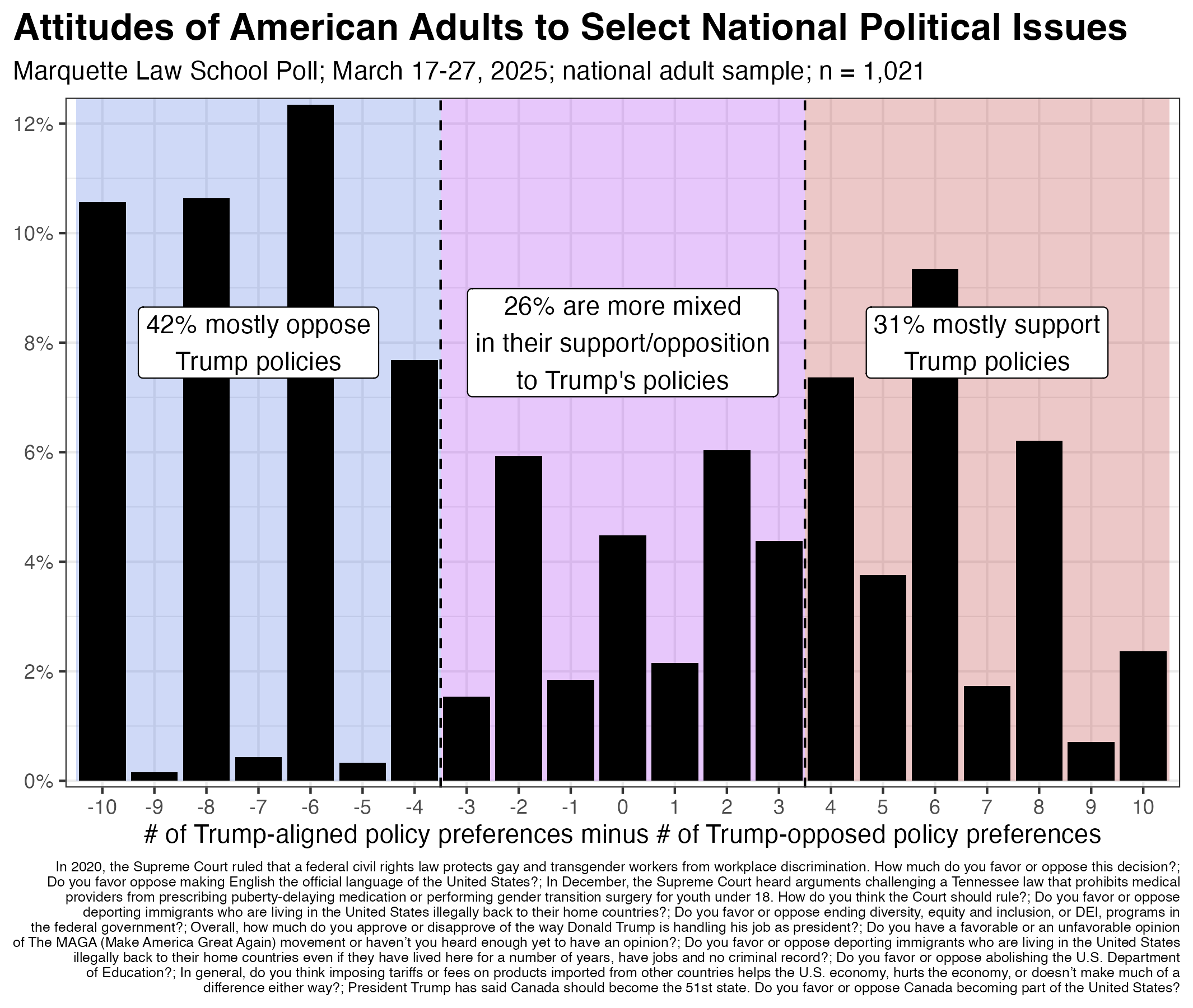
In December, 35% expressed entirely negative views of Trump, 12% were entirely positive, and 51% were mixed, sharing both likes and dislikes (the remaining 2% refused to answer). This changed only slightly in early 2025. The group with mixed opinions shrank by 4 percentage points, and the other categories grew by 1 or 2 points each.

Summary of open-ended survey responses
in the Marquette Law School Poll, national adult sample
Attitude toward Donald Trumpsurvey dates
12/2-11/241/27-2/6/25
Can name likes and dislikes51%47%
Doesn’t dislike anything12%14%
Doesn’t like anything35%36%
no answer2%3%

Donald Trump won in 2024 because he beat Harris by about 38 points among voters holding mixed views of him. He enjoyed especially high support among those who hadn’t voted at all in 2020.

Most of these people still approve of how Trump has begun his second term. However, Trump’s approval rating has slipped with this group, relative to December 2024.

In December 2024, 53% of adults approved (and 47% disapproved) of how Trump had handled his job during his first term. About a month into Trump’s second term, 48% approve and 52% disapprove of how Trump is currently handling his job.

The drop in approval is entirely due to lower views of Trump’s current job performance among those with more ambivalent views of him.

Among those who only listed things they like about Trump, 96% approved of his past job performance in the December poll and 96% likewise approve of his current job performance in the February poll.

Conversely, 97% of those with only negative things to say about Trump disapproved of his past job performance in December and disapprove of his current job performance in February.

But among those with mixed views of Trump, 77% gave him retrospective approval in December, falling to 67% approval in February.

Themes in the open-ended responses

Some voters express idiosyncratic combinations of views when given the opportunity. You’ll find the occasional conservative whose only complaint about Trump is his support for Israel or the odd Harris voter who dislikes Trump’s “racist attitude” but appreciates that he “doesn’t drink or smoke dope.”

But most responses fall into familiar categories. Here are a few themes that stood out to me.

  • Outside of the 36% of adults who despise Trump, Trump’s hyper-aggressive first month in office is usually perceived favorably. Many people said things like, “he’s fulfilling campaign promises,” or “He has already done more in a few days than Biden did.”
  • A common complaint among those who generally like Trump is his communication style. Some representative comments: “he talks too much”; “the way he talks, very crude”; and “mean tweets, rehearsing [sic] his wins in election too often.”
  • On the other hand, even some people who disapprove of him like aspects of his communication. “Confidence, has charisma, is funny on occasion”; “He’s funny. He says what he thinks.”
  • Quite a few people complained about Trump’s pardoning of the January 6th rioters, and few or none mentioned it favorably.

Finally, these data also undermine a point I have occasionally heard from conservative commentators. Referencing the more “muted” response to Trump’s second term from Democratic politicians and left-leaning organizations, some have argued that opposition toward Trump’s first term was largely an elite, media creation.

On the contrary, in reading these open-ended responses I see no diminution of opposition to Trump. If anything, the vitriolic tone may have intensified among those who like nothing about him. This group is not a majority of the country. It includes under 40% of adults in our sample, but is is more than twice as large as the group of people with only positive things to say about Trump.

During Trump’s first term, his opponents turned out at unusually high levels–flipping seats during special elections and midterms at a startling clip. Democrats will look to repeat that playbook in 2025 and 2026. The surprise victory of a Democratic candidate in a Trump +21 Iowa state senate district is a small, early indication that this strategy may work.

Explore the data

The above is just my interpretation of these responses. I strongly encouraged you to read them for yourself. Click here to access our web app for viewing responses. The tool allows you to see 5 randomly* selected responses with each click of the button. Some of these responses contain profane language and many contain typos. We present them in unedited form.

screenshot of a table from the web application showing random responses to the open ended questions about Donald Trump
Continue ReadingPerceptions of Donald Trump a month into his second term