Looking Forward to the 2025 Jenkins Finals

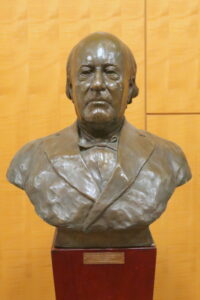
Statue of Hon. James G. Jenkins
Bust of Judge James G. Jenkins in Eckstein Hall’s Zilber Forum

The Jenkins Honors Moot Court Competition is a spring-semester invitational program for upper-level Marquette law students who have qualified based on their performance in the fall-semester Appellate Writing and Advocacy course. Proceeding in teams of two, students began writing their appellate briefs in January and have now submitted them.

Next up is the Jenkins Competition’s oral arguments. Students argue in multiple preliminary rounds, with the competition going from the original 12 teams to quarterfinal (8 teams), semifinal (4), and final (2) rounds.

We may pause to note that the primary “technical” result may be a single winning team, but along the way all participants will have learned a good deal about appellate advocacy and the law. And that’s the whole point: We denominate it an honors competition partly because of the way one qualifies and partly because there is no academic credit awarded in connection with the competition.

Let’s get back to the oral arguments: The preliminary rounds of this year’s Jenkins Competition are this coming weekend. In addition to joining Professor Love Koenig in wishing the 24 participating students good luck (see her blog post last month noting and naming them), we may peek ahead to next month.

The finals will occur at 6 p.m. on Tuesday, April 15, in the Law School’s Lubar Center. Anyone in the Law School community (very broadly defined) is welcome to register and attend.

It will be a privilege at this year’s Jenkins Finals for Marquette Law School to welcome—and for the two remaining teams to argue before—three distinguished members of the bench:

  • Hon. Paul C. Thissen, Justice, Minnesota Supreme Court
  • Hon. Shelley A. Grogan, L’92, Judge, Wisconsin Court of Appeals
  • Hon. Rachel M. Blise, L’10, Judge, U.S. Bankruptcy Court for the Eastern District of Wisconsin

The competition is named after the Hon. James G. Jenkins. Having retired as a judge of the U.S. Court of Appeals for the Seventh Circuit, Jenkins served as Marquette University Law School’s first dean (1908–1915). You can read about Judge (or, if you prefer, Dean) Jenkins in a blog post by the late Professor J. Gordon Hylton, which provides a good account of the path of a lawyer in Wisconsin from the mid-1800’s to the turn of the century.

I hope to see you at this year’s Jenkins Finals.

Continue ReadingLooking Forward to the 2025 Jenkins Finals

Judge Scudder Discusses “Resorting to Courts” in an Exemplary Hallows Lecture

Honorable Michael Y. ScudderThe Hon. Michael Y. Scudder, judge of the U.S. Court of Appeals for the Seventh Circuit, delivered this year’s Hallows Lecture, yesterday evening, to more than 200 individuals in Eckstein Hall’s Lubar Center. The lecture was exemplary.

The E. Harold Hallows Lecture is an annual highlight at Marquette University Law School. Most often delivered by a judge, the lecture is an opportunity to welcome into our community an accomplished individual from whom all of us interested in the law—students, faculty, other judges, lawyers, and all manner of interested individuals—might learn.

This was not Judge Scudder’s first trip to Marquette Law School, as he presided at the Jenkins Honors Moot Court Finals in 2023 (his similar service in 2021, during the COVID era, having been undertaken remotely by Teams). The judge keeps close to law schools, it would seem—for example, teaching national security law at the University of Chicago Law School and advanced federal jurisdiction at the Northwestern University Pritzker School of Law. Judge Scudder’s interest in legal education, especially in the Seventh Circuit’s region of Wisconsin, Illinois, and Indiana, is impressive and inspiring more generally.

Judge Scudder’s Hallows Lecture was titled “Resorting to Courts: Article III Standing as the Guardian of Free Speech & Democratic Self-Governance.” It proceeds in two main parts.

The first half explains and defends the standing requirement in federal courts. The judge describes the precept’s basis in the “Cases” or “Controversies” requirement of Article III of the Constitution, defends it as a structural limitation on the exercise of judicial power, yet acknowledges the ideological lens through which many individuals seem to view standing issues. The lecture offers a defense of the cases and a strong, institutions-based justification of the concept.

The lecture’s second half explores the relationship between the Case or Controversy requirement and free speech. It emphasizes that the standing requirement—particularly by disfavoring pre-enforcement facial challenges to government policies on very broad grounds—appropriately encourages people to hash out their differences in forums envisioned and intended as policy-setting. This half laments the echo chambers into which many individuals have placed themselves in our society and hopes that more open, respectful, and constructive dialogue, outside of courts, can occur to sort out the “cultural” issues and policies needing resolution at all levels of government.

Here’s a flavor:

. . . . This is how Article III’s limitation on the exercise of judicial power leaves policymaking, and the difficult line drawing it often entails, to the exercise of free speech. Speaking up, objecting, and sharing perspectives with those who differ from us is how we understand, persuade, and, often, find common ground where agreement seems beyond reach.

If that framing is too idealistic in today’s times, I would hope skeptics would at least recognize that the alternative—permitting very difficult legal questions to come to federal court based only on a showing of a genuine worry—casts a vote of little confidence in the role speech can play in finding solutions, or perhaps tolerable compromises, to some of the most divisive questions of our day. And even if these culture war lawsuits should not be viewed as a vote of confidence in federal courts as the ultimate decision makers, they put great pressure on principles of restraint designed to allow democratic processes—whether at the national or local level—to offer answers and outlets for persuasion and compromise in the first instance.

Our constitutional design envisions constitutional answers coming in slower-paced increments than contemplated by pre-enforcement facial challenges like the one Parents Protecting Our Children lodged against the Eau Claire policy. It is not happenstance that the architect who designed the Supreme Court, Cass Gilbert, thought the tortoise an appropriate decorative and symbolic feature for the building’s design. In the same way tortoises move slowly, sometimes the law develops best when principles, doctrines, and answers come with time and, I might add, with more speech and dialogue helping to bridge social divides. Pre-enforcement facial challenges, however, often result in expansive injunctions that apply in one fell swoop—the sort of forward-looking policymaking that is best left to the more democratic branches.

Judge Scudder’s lecture was outstanding, even beyond its timeliness. While versions of it will appear in the fall Marquette Law Review and Marquette Lawyer, one can watch the lecture here or read a working copy of it here.

Continue ReadingJudge Scudder Discusses “Resorting to Courts” in an Exemplary Hallows Lecture

Remembering a Marquette Lawyer (and Judge) on the Centennial of His Birth

Tom Curran A week and a half ago, the Law School held our annual Alumni Awards Reception and Conferral—always a highlight of our year. For it enables us to celebrate Marquette Law School’s spirit and ideals by recognizing four exemplars of the genus (or perhaps it’s the species) of the Marquette lawyer.

I had occasion that day to talk with a longtime colleague about past such alumni awards receptions and conferrals, including the one in 2007, where we honored Martin J. Greenberg, L’71, with the Charles W. Mentkowski Award for the Sports Law Alumnus of the Year; (now-Judge) Katie Maloney Perhach, L’00, with the Howard B. Eisenberg Service Award; the Hon. Patricia J. Gorence, L’77, as the Alumnus/a of the Year; and the Hon. Thomas J. Curran, L’48, with the Lifetime Achievement Award. Then, last week, my colleague noted to me that today would have been the 100th birthday of the last of these individuals (the other three, happily, still being active alumni). I relate a brief story about Judge Curran here.

I recall my commendation of him on that occasion in 2007. I said in part this:

You may think that it is his service for almost a quarter-century as United States District Judge here in Milwaukee that recommends [Tom Curran] for this award. And this is relevant, for it is a lifetime achievement award. I am inclined to think, though, that Tom Curran would be receiving this award even if he had never become Judge Curran, for his accomplishments from 1948 to 1983 would have sufficed.

Tom Curran joined his brothers’ law firm in Mauston, Wisconsin, in 1948, and for a brief moment—a year or so—the firm was Curran, Curran & Curran. That did not last, not I am sure because of any difficulty on the part of Irish brothers in getting along with one another, but because one of his brothers left in 1950 to become a circuit judge in Juneau County, where he served for the next 30 years. The firm flourished nonetheless, and today it is one of the largest firms in the state outside of a major metropolitan area (with apologies to the many Currans and others here today from Mauston for my characterization).

Of course, the fact that there are several Currans at the firm still (Judge Curran’s children) does contribute to the numbers somewhat, but you cannot maintain a firm of this size—or even stay in business for so long—without developing a reputation for quality and trustworthiness, and the Curran firm surely has that reputation. And much of that reputation developed during Tom Curran’s 35 years of practice in Mauston.

His own stature as a lawyer meant that Tom Curran was elected by his statewide peers to the presidency of the State Bar of Wisconsin, a signal honor.

I said more, but let me move the story along. I also recall a portion of Judge Curran’s remarks in then accepting the Lifetime Achievement Award:

Given the very special place Marquette already had in the lives of the Currans, it was no surprise, when I was discharged from the Navy in July 1946, that I would come up and enroll at Marquette. And I found myself, four days later, sitting in a classroom, as we then had the three-semester-a-year program, given that probably 95 percent of us were veterans. I would guess that we ranged in rank from a private to a brigadier general—a former brigadier general. The only problem was that the general had trouble remembering the “former” part of it—or at least he did, for maybe two or three weeks, until he ended up in Professor Ghiardi’s class.

Finally, I recall but, alas, cannot directly quote the moment in his acceptance remarks—not scripted, I should think—where Judge Curran turned around from the podium and looked back at Rev. Robert A. Wild, S.J., then the president of Marquette University, and me.

Judge Curran noted the coincidence of two guys from the South Side of Chicago leading a beloved Wisconsin institution, and his remarks were most generous. This was characteristic of Judge Curran, in my experience: he made that moment not about himself but about others—and about Marquette.

I have never forgotten it or him. It is pleasant to remember a generous and gracious Marquette lawyer and judge both on his 100th birthday and on other occasions.

Continue ReadingRemembering a Marquette Lawyer (and Judge) on the Centennial of His Birth