Congratulations to AWL Scholarship Winners Kapila and Van Gompel

kapilavan gompelToday, September 24, 2015, the Milwaukee Association for Women Lawyers (AWL) Foundation honored two Marquette University Law School students with scholarships.

Saiba Kapila, 2L (pictured at left), received the AWL Foundation scholarship. The AWL Foundation Scholarship is awarded to a woman who has exhibited service to others, diversity, compelling financial need, academic achievement, unique life experiences (such as overcoming obstacles to attend or continue law school), and advancement of women in the profession. Kapila’s grandfather was a nonprofit lawyer in a small rural village in India. Inspired by him, Kapila views law as a tool for social change. She does pro bono work and volunteers at the Milwaukee Hunger Task Force and with Wisconsin Special Olympics. She participated in the State Bar of Wisconsin’s Diversity Clerkship program, through which she worked at American Family Insurance in the corporate legal division.

Cassandra Van Gompel, 3L (pictured at right), received the AWL Foundation’s Virginia A. Pomeroy scholarship. This scholarship honors the late Virginia A. Pomeroy, a former deputy state public defender and a past president of AWL. In addition to meeting the same criteria as for the AWL Foundation scholarship, the winner of this scholarship must also exhibit what the AWL Foundation calls “a special emphasis, through experience, employment, class work or clinical programs” in one of several particular areas: appellate practice, civil rights law, public interest law, public policy, public service, or service to the vulnerable or disadvantaged. Active in student organizations, Van Gompel has served on the executive boards of the Public Interest Law Society, Client Skills Board, Alternative Dispute Resolution Society, and Criminal Law Society. She’s also a student advisory board member of the Milwaukee Volunteer Legal Clinic. She’s gained experience in a wide array of settings; she’s interned at the Seventh Circuit Court of Appeal, the American Civil Liberties Union of Wisconsin, the United States Attorney’s Office of the Eastern District of Wisconsin, and the West Allis City Attorney’s office. She hopes to pursue a career in governmental and public interest work. As of now, she’s already logged more than 170 pro bono hours.

Congratulations to both women for outstanding service and for their representation of Marquette University Law School.

Continue ReadingCongratulations to AWL Scholarship Winners Kapila and Van Gompel

Constitution Day Trivia Tidbits

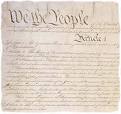
constitutionSeptember 17 marks Constitution Day, the day in 1787 on which delegates to the Constitutional Convention signed the United States Constitution. Yesterday, the ABA Journal posted an interesting article to celebrate. The article contains 10 lesser-known facts about our Constitution, including these:

  • Most voters today would not have had the right to vote under the original Constitution. Voting rights were limited to propertied white males.
  • The word “God” never appears in the Constitution or the Bill of Rights. The source of all government power is in “the People.”
  • The word “democracy” never appears in the Constitution or Bill of Rights. James Madison and Alexander Hamilton claimed in the Federalist Papers that democracies were a disaster.
  • The First Amendment was not originally first. It started out as the third. For that matter, the Second Amendment was not originally the second. The original first and second amendments dealt with the size of Congress and with issues relating to Congress’s pay.

See here for the rest of the facts, and test your knowledge of the Constitution with the short quiz How well do you know the U.S. Constitution at the bottom of the page. It’s not as easy as you’d think! Next week, I’ll post on Professor Chad Oldfather’s interesting Constitution Day presentation on constitutional interpretation.

Continue ReadingConstitution Day Trivia Tidbits

Gender-Neutral Pronoun on the Rise?

In English, there are three main singular pronouns: he, she, and it. When we’re talking or writing about people, we eschew it; after all, it suggests a non-human subject. This leaves us with he or she, which often are easy to use. We use he for male subjects and she for female subjects.

This is all easy enough, but there are two times when neither he nor she seems the right word choice. The first is where the gender of the subject does not matter. This situation comes up frequently in legal writing. In explaining a rule of law, we often need to include a pronoun. For example, For a plaintiff to maintain a cause of action for intentional infliction of emotional distress, he must prove the defendant’s conduct is extreme and outrageous. In that sentence, we want a singular pronoun to “match” our singular subject noun of “plaintiff.”

Writers are conscious of which pronoun to choose. Many are afraid if they pick the male pronoun—he­—they will be perceived as sexist. One easy fix to avoid picking a pronoun at all is to make the subject “plaintiff” plural so that we can use the plural pronoun “they” (e.g., For plaintiffs to maintain a cause of action for intentional infliction of emotional distress, they must prove the defendant’s conduct is extreme and outrageous.). But sometimes that doesn’t work well or we’d rather keep the subject singular. What to do then?

Continue ReadingGender-Neutral Pronoun on the Rise?