
Ambiguity Is Ambiguous
In an earlier post, I offered some preliminary thoughts about the Supreme Court’s six criminal statutory interpretation cases last term. I observed that Justice Scalia’s textualist approach now seems dominant on the Court. The six opinions thus reflect a great deal of effort to parse the texts of the statutes, and we get a number of passages like this one from Flores-Figueroa v. United States, 129 S. Ct. 1886, 1890 (2009):
In ordinary English, where a transitive verb has an object, listeners in most contexts assume that an adverb (such as knowingly) that modifies the transitive verb tells the listener how the subject performed the entire action, including the object as set forth in the sentence.
Stirring prose, no? One would hardly guess that two years of a man’s life were riding on this characterization of an obscure grammatical norm. Whatever else might be said for or against textualism, it does lead to opinions in which there is sometimes a disconcerting disconnect between the Court’s dry rhetoric and the human realities of crime and punishment.
In keeping with the Court’s current textualism, comparatively little attention is paid in the six opinions to legislative history, which is either ignored altogether or wheeled out as an apparent afterthought.
Of course, even textualists like Scalia acknowledge that texts are sometimes ambiguous. In such circumstances, rather than resort to legislative history or policy considerations, textualists will look to the traditional canons of statutory construction. One of these is the rule of lenity, which indicates that ambiguous criminal statutes should be interpreted in favor of the defendant.
 On the night of July 20, 2000, Katherine Christianson, Bryan Rivera, and two companions damaged or destroyed more than 500 trees at a United States Forest Service facility. Was it a prank? A dare? A harvest for the
 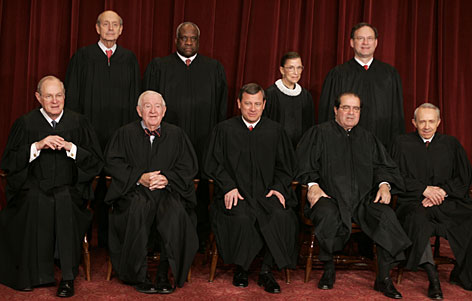 For the second autumn in a row, the federal public defenders here in Milwaukee were kind enough to invite me to speak on the U.S. Supreme Court’s criminal docket, reviewing last term’s cases and previewing the new term. The event is a great opportunity for me to think about patterns and themes that cut across individual cases. I plan now to recapitulate some of my obervations in a series of short blog posts over the next couple weeks. This is the first.