Seventh Circuit Week in Review, Part I: Use of Prior Convictions

The Seventh Circuit had two new criminal opinions in the past week, including a partial defendant win that broke a string of at least eleven consecutive victories by the government.  The two opinions focus on the admissibility of a defendant’s prior convictions at trial and the application of the crack cocaine sentencing guidelines, respectively.  Because I have a bit more than usual to say about the two cases, I will just cover the prior convictions case here, and leave the crack case (featuring a partial defendant victory) for another post tomorrow.

In United States v. Perkins (No. 07-3383), a jury in the Southern District of Illinois convicted Perkins of various drug trafficking offenses.  During his trial, the prosecutor introduced into evidence Perkins’ three prior convictions for cocaine-related offenses, as well as testimony that Perkins had attempted to hide cocaine in his mouth when he was arrested in connection with one of the earlier convictions.  On appeal, Perkins argued that the evidence should have been excluded under Federal Rule of Evidence 404(b).  Although the Rules do indeed prohibit the use of prior convictions to establish a defendant’s propensity to commit new crimes, the Seventh Circuit (per Judge Bauer) rejected Perkins’ argument.  More specifically, the court held that Perkins’ prior convictions were admissible because they helped to establish “proof of motive, opportunity, intent, preparation, plan, knowledge, identity, or absence of mistake” — all acceptable purposes of prior convictions evidence under Rule 404(b).

For what it’s worth, my own view is that propensity evidence actually should be admissible as such.
Continue ReadingSeventh Circuit Week in Review, Part I: Use of Prior Convictions

Laboratories of Democracy at the Local Level

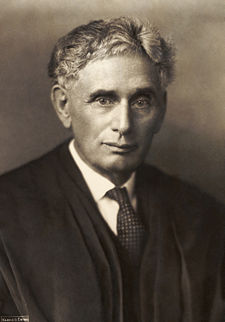
Matt Parlow has a thought-provoking new article in print: Progressive Policy-Making on the Local Level: Rethinking Traditional Notions of Federalism, 17 Temp. Pol. & Civ. Rts. L. Rev. 371 (2008).  (A draft can be downloaded here.)  Matt contends that the oft-quoted argument of Justice Brandeis (pictured to the left) that states may appropriately serve as laboraties for “novel social and economic experiments” applies equally well — indeed, perhaps even better — to cities and other local units of government.  Citing recent immigration initiatives and living wage ordinances (including one in Madison, Wisconsin), Matt notes a long history of local-level policy innovation in this country.  He argues,

Because they are smaller in size, local governments are more capable of being responsive to the needs of their respective communities because they are more in touch with their constituents.  This leads, in theory, to more responsive and representative policy-making as local government officials make decisions informed by the community’s wants and needs.

In light of these considerations, Matt argues against the tendency of some courts to squelch local initiatives through narrow constructions of home rule powers and liberal invocations of the implied preemption doctrine.

All of this connects nicely to the recent, lively discussion on this Blog of Milwaukee’s ballot initiative mandating paid sick leave for employees.  I take it that Matt would be skeptical of arguments that the Milwaukee law is preempted by state and federal law — at the least, his analysis would suggest some good reasons why a court ought to be slow to find preemption. 

Continue ReadingLaboratories of Democracy at the Local Level

Seventh Circuit Week in Review

The Seventh Circuit had two new opinions in criminal cases this week, with the government winning both.  (Since I started this Week in Review series three weeks ago, the government has gone 10-0 — an even better run than the Tennessee Titans have been enjoying.  Let’s hope the Packers don’t have the U.S. Department of Justice coming up on their schedule!) 

In United States v. Anderson (No. 07-3654), the court considered a bank robber’s request for appointment of an expert to evaluate his mental health.  The district court had denied the request, and the Seventh Circuit (per Judge Posner) affirmed.  Normally, we think of mental health evaluations in connection with the insanity defense or determinations of competency to stand trial, but Anderson wanted an expert to help him advance a sentencing argument, specifically, that he suffered from diminished mental capacity at the time of his bank robbery.  (And the fact that he did rob a bank provides prima facie evidence of diminished capacity: bank robbers are successfully apprehended at a much higher rate than most other criminals.  As I tell my students, if you want to steal money, there are a lot smarter ways to do it than to rob a bank!) 

Continue ReadingSeventh Circuit Week in Review