
Truth in Sentencing: We Like the Symbolism, But Have Mixed Feelings About the Practical Policy

Two-thirds of Wisconsin voters support truth in sentencing, the 1998 law that abolished parole in the state and required prisoners to serve the full term of their sentences.  At the same time, a majority of Wisconsin voters (54.5 percent) agreed that once a prisoner serves half of his term, he should be released and given a less costly form of punishment if he can demonstrate that he is no longer a threat to society.  These seemingly inconsistent opinions point to complex, mixed feelings about sentencing policy in the state.

The numbers come from the Marquette Law School Poll, which earlier this week released the results of its latest survey of Wisconsin voters regarding politics and public policy.  This edition of the poll included a rich array of questions relating to truth in sentencing.  (Full disclosure: I collaborated in the design of these questions with Poll Director Charles Franklin and Professor Darren Wheelock of the Marquette Social and Cultural Sciences Department.)

The poll results this year were remarkably consistent with results from a year ago, when some of the same questions were posed.  Last July, 63% supported truth in sentencing, while 55% supported release opportunities at the half-way mark.  An even more decisive two-thirds majority supported awarding credits toward early release to recognize prisoners’ rehabilitative accomplishments, which also violates truth in sentencing (at least in the particularly hard-line way in which it was adopted in Wisconsin).

What gives?  
Continue ReadingTruth in Sentencing: We Like the Symbolism, But Have Mixed Feelings About the Practical Policy

Milwaukee Arrest Trends, 1980-2011 — Part Three: Chicago Comparisons

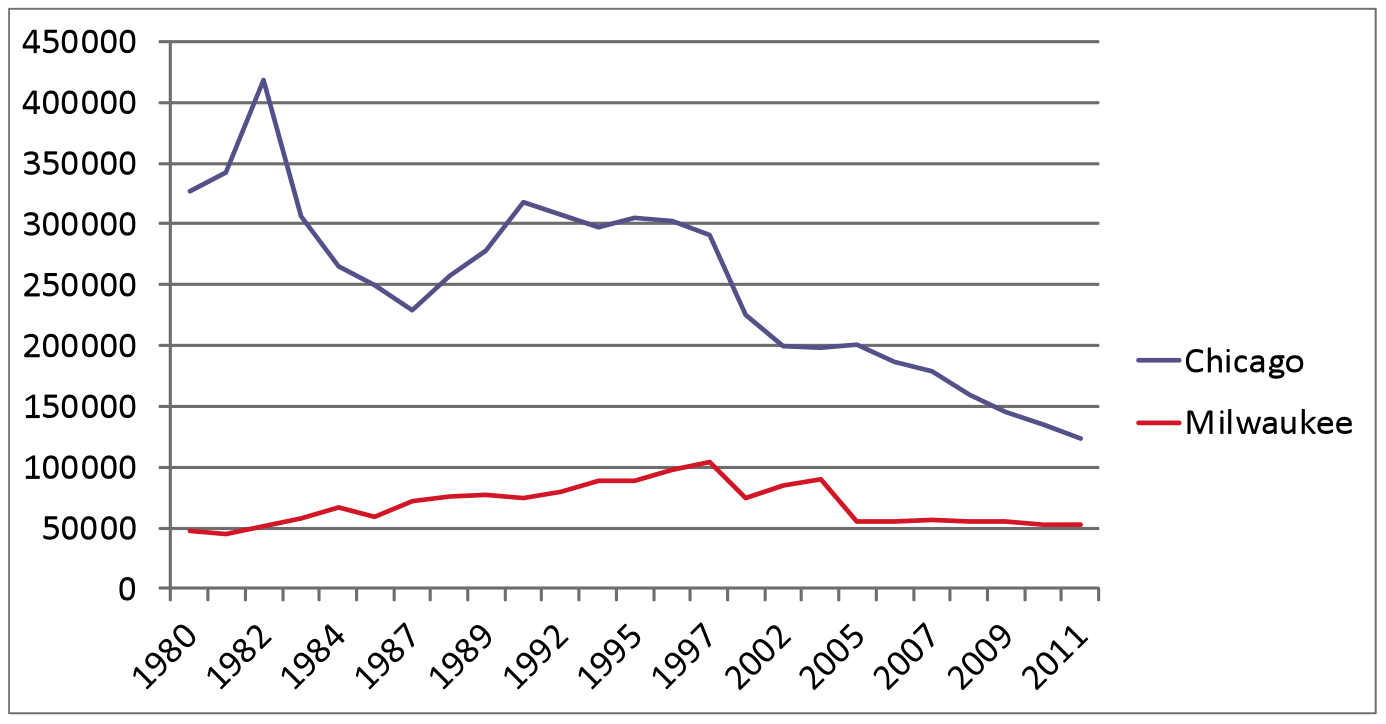
Chicago’s population is about 4.5 times larger than Milwaukee’s, but, surprisingly, the arrest totals in the two cities have been slowly converging for many years.  Here are the numbers reported to the FBI since 1980 (omitting a handful of years in which one city or the other did not report arrests):

two city totals


To some extent, the convergence may result from underlying crime trends in the two cities.

Continue ReadingMilwaukee Arrest Trends, 1980-2011 — Part Three: Chicago Comparisons

Bounty Hunters at the Gates: Wisconsin’s Flirtation with the Bail Bonds System

Surely you’ve noticed when flipping through TV channels the reality show Dog the Bounty Hunter on A&E. The show centers upon Duane “Dog” Chapman—a bearded, tattooed, and bemulleted bounty hunter—as he and his family of fellow bail enforcement agents apprehend fugitives in sunny Hawaii. Chapman has gotten a fair amount of publicity outside of his show, including a Paula Deen-esque racial slur controversy (unlike Deen, he had no merchandising empire to lose) that resulted in the temporary cancellation of his show, and for being arrested and briefly imprisoned in Mexico for illegally capturing celebrity fugitive Andrew Luster.

Like most reality shows, Dog the Bounty Hunter follows a set format. It begins with a briefing, where we are introduced to the fugitive’s criminal history. Next comes an investigation, which generally involves phone calls and visits to former neighbors and family members. Each episode’s climax is generally the discovery and capture of the bail jumper. The show then shifts from action to tear-jerking drama, with Dog and family providing homespun advice to the re-apprehended fugitive about taking responsibility for life, finding a job, and quitting drugs. “Smoke brah?” counselor-mode Dog asks, slipping a cigarette into the handcuffed man’s mouth and lighting it for him. Typically, the fugitive’s family is present to provide tearful commentary on exactly where things went wrong. Dog the Bounty Hunter is sleazy, shamelessly tacky, and unquestionably entertaining.

Fast forward to Wisconsin, the summer of 2013.

Continue ReadingBounty Hunters at the Gates: Wisconsin’s Flirtation with the Bail Bonds System