 The third annual U.S.- German Summer School in International and Comparative Law came to a successful conclusion with the program’s closing ceremony on August 12, in Giessen, Germany. This year’s session of the program, sponsored jointly by Marquette University Law School, the University of Wisconsin-Madison, and the University of Giessen, featured 68 law students from 20 countries. Faculty members came from the University of Giessen; the University of Gottingen; the University of Wisconsin; and Marquette.
The program’s Marquette contingent for 2011 consisted of 24 law students and Professors Gordon Hylton and Alan Madry. The session lasted from July 16 through August 13.
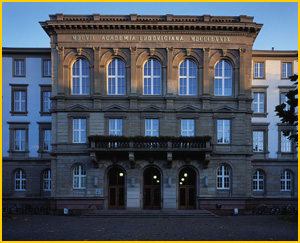
This year’s course offerings included International Human Rights (team-taught by a group of professors from Giessen and Gottingen including program co-director Thilo Marauhn of the University of Giessen); Comparative and International Sports Law (taught by Professor J. Gordon Hylton of Marquette); International Business Transactions (taught by Adjunct Professor Eric Ibele of the Univeristy of Wisconsin); and International Economic Law (taught by Sven Simon of the University of Giessen). Classes were held at the law and economics campus of the University of Giessen. The program also included law-oriented field trips to Brussels and Berlin and a recreation tour of the Rhine Valley.
Also participating in the program in Giessen were co-directors Professor Alan Madry of Marquette and Professor Stephen Barkan of the University of Wisconsin. (Professor Barkan is also a former Marquette law professor who served as Interim Dean of the Law School during the 1994-95 academic year.) Students were expected to enroll in two of the courses, although a number of foreign students enrolled in three or four.
Students from Marquette included: Ryan Albregts, Andrea Austin, Margaret Barr, Justin Bertron, Tyler Brennan, Allison Ceille, Jason Cooper, Alexandra Dziamski, Matthew Galvin, Cody Garza, John Graham, Patricia Heise, Aneet Kaur, Patrick Kern, Derek Kulland, Stephen Laczniak, Adam Lopez, Patricia Mattingly, Jonathan Meulemans, Brad Meyer, Jessica Pfau, Lauren Raupp, Bryan Strand, and Ryan Truesdale.
In addition to the Marquette students, there were six law students from the University of Wisconsin as well as students from the law schools at Northern Kentucky University and the University of Southern California. The 36 remaining students came from the following countries: Brazil, the Central African Republic, Croatia, the Czech Republic, Georgia, Germany, Greece, (South) Korea, Krygystan, Latvia, Montenegro, Poland, Romania, Russia, Singapore, South Africa, Spain, Turkey, and Ukraine.
An article on the program published earlier this week in the Giessener Anzeiger (a local newspaper) can be found at http://www.giessener-anzeiger.de/lokales/hochschule/11064040.htm. Unfortunately, the article is in German, and the photo accompanying the article is of the class attending the University of Giessen’s International Summer School in Biodiversity and Law, rather than the students and faculty in the International and Comparative Law program. (Both programs held commencement exercises in the same building on the same day.) One of the students in the picture is Professor Hylton’s daughter Veronica.
A program description provided by the University of Giessen can be found at http://www.recht.uni-giessen.de/wps/fb01/home/summer_program_law/1002292/. The Marquette description is here.