
Our Boys: Statewide Loyalty to Wisconsin’s Sports Teams
They may be called the Green Bay Packers and the Milwaukee Brewers, but the degree to which major sports teams in Wisconsin are embraced by fans everywhere else in the state is not common in the sports world. These are “our teams” even if they play 100 or 200 miles away.

That’s on exhibit for all the world to see this week with the Packers’ appearance coming up Sunday in the Super Bowl. Fan loyalty to the Packers in Milwaukee, for example, often seems to know little limit, even though the team stopped playing in Milwaukee in the mid-1990s and (dare I say this) from Milwaukee, it is just about the same distance to Soldier Field in Chicago as it is to Lambeau Field in Green Bay.

Much less noted is the degree to which the Brewers are a Wisconsin team.

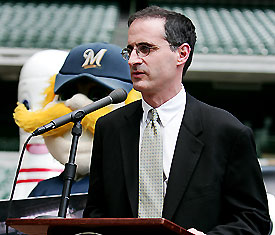
In an “On the Issues with Mike Gousha” session last week at Eckstein Hall, Rick Schlesinger, the Brewers’ executive vice president for business operations, talked about how important it is for the team to give people who attend games a good experience, and how important out-state fans are to the Brewers.

“We have to draw from not just Milwaukee and southeastern Wisconsin,

Continue ReadingOur Boys: Statewide Loyalty to Wisconsin’s Sports Teams

California Parole May Be Broken, But Federal Courts Cannot Fix It

By some curious coincidence, at about the same time that Jonathan Simon was explaining in his Barrock Lecture yesterday that parole has effectively become unavailable in California in homicide cases, the United States Supreme Court was overturning a pair of Ninth Circuit decisions that would have established a basis for federal-court review of parole denials.

The California parole statute indicates that the state Board of Prison Terms “shall set a release date unless it determines that . . . consideration of the public safety requires a more lengthy period of incarceration.”  According to the California Supreme Court, the statute requires that there be ”some evidence ” in support of a conclusion “that the inmate is unsuitable for parole because he or she currently is dangerous.”  As Simon discussed, this requirement of some evidence of current dangerousness has been applied by the state courts such that the state can justify a parole denial in nearly any case. 

The two cases decided by the Court yesterday in Swarthout v. Cooke (No. 10-333) nicely illustrate Simon’s point. 

Continue ReadingCalifornia Parole May Be Broken, But Federal Courts Cannot Fix It

Murder Sentences Becoming “Too Flat and Too Severe,” Barrock Lecturer Says

A reactor or a radiator?

A radiator performs service by dissipating heat. A reactor generates increasingly intense heat, presenting difficult challenges for how to contain that heat.

Punishment for murder in the United States increasingly resembles a reactor more than a radiator, Prof. Jonathan Simon at Boalt Hall, University of California-Berkeley School of Law, said in a lecture at Marquette University Law School Monday. And like a reactor, the trends in murder sentences are building up heat that presents increasing challenges.

Continue ReadingMurder Sentences Becoming “Too Flat and Too Severe,” Barrock Lecturer Says