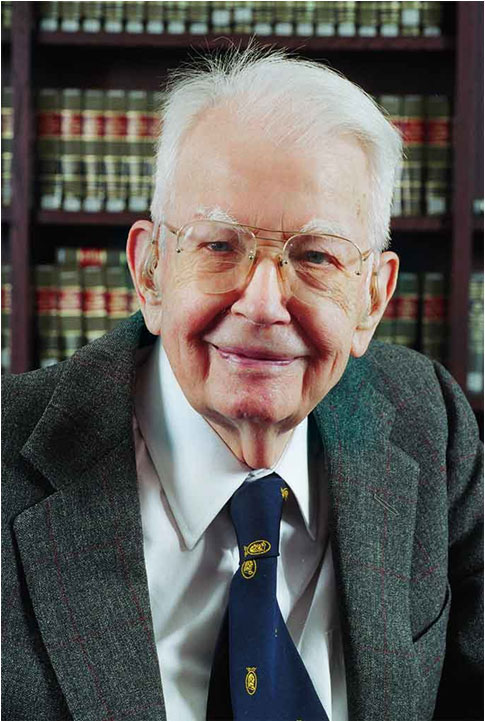
Farewell to Ronald H. Coase

CoaseAlmost every student who has attended law school in the past 40 years has encountered Ronald Coase and the Coase Theorem. Even professors who disagree with Coase feel compelled to expose their students to his famous theorem, even if only to rebut its argument. As a long-time teacher of both Torts and Property who is not an advocate of law and economics, I cannot imagine teaching either course without references to the Coase Theorem as a way of evaluating the correctness of legal rules.

In a nutshell, Coase, widely acknowledged as the founder of the law and economics movement, posited that in a world without transaction costs, individuals would bargain with each other to achieve the most efficient use of resources, and legal rules would be irrelevant. As a consequence, in a world with transaction costs, Coase seemed to suggest that legal rules should be constructed so that they favor the most efficient user, since that is the party who will eventually end up with the resource . The Coase Theorem was presented to the world in a 1960 article entitled, The Problem of Social Cost, which appeared in the Journal of Law and Economics and is still the most frequently cited law review article in history.

Sadly, Robert Coase died last week in Chicago at the age of 102. Born in London and educated at the London School of Economics, Coase first achieved widespread recognition in 1937 with the publication of his article, The Nature of the Firm, which introduced the concept of transaction costs and explained why large economic deals were handled by large integrated firms rather than by temporary market-based alliances of suppliers.

Coase came to the United States in 1951 as a professor at the University of Buffalo, and moved to the University of Virginia in 1958. He was a member of the University of Virginia’s Thomas Jefferson Center for Political Economy when he published his most famous article. In 1964, he left Virginia for the University of Chicago, where he remained until his death.

Coase was awarded the Nobel Prize in Economics in 1991. His final book, How China Became Capitalist, was published in 2012 when Coase was 101 years old.

 

Continue ReadingFarewell to Ronald H. Coase

Any Chance of Protection?

I was inspired to write this post after a lovely conversation with my roommates (for those of you that might not know, by “roomies/roommates” I mean my parents #Living@Home) who were up north skiing over winter break. Essentially, my roomies called me with a very urgent question regarding the law. “Son, it appears they are having us sign a ‘Waiver and Release’ form that is really long, with lots of statements in capital letters that really don’t make any sense. Is there a statute on point that requires companies to use the word NEGLIGENCE in all capital letters over 30,000 times? What do we DO!?!?” asked my confused father. Fresh off my Professor Anzivino contracts exam, I knew exactly how to respond.

“Dad, you guys are in Wisconsin correct?”

“Yes, we are in Wisconsin.”

“Excellent. Dad, Mom, as an aspiring law student, and in order to adhere to the heightened Ethical Code that comes with being a lawyer, please understand I cannot provide any legal advice… but I think you should read the contract and ski away!”

Continue ReadingAny Chance of Protection?

New Article by Prof. Mitten on Coach Liability for Player Injuries

The recent news of two lawsuits brought by the families of high school football players who died after strenuous summer workouts raises difficult questions regarding the legal and ethical obligations of coaches to protect their players from harm.  Coincidentally, Matt Mitten has a new paper on SSRN that explores just such questions.  Among other things, Matt thoroughly surveys the leading tort cases from across the country.  He highlights significant state-to-state variations in the law and identifies what may be an emerging (and troubling) trend among courts toward a special liability standard for coaches that is less protective of athletes than ordinary negligence.  Here is the abstract to Matt’s paper:

Regardless of the level of athletic competition, a coach is not an insurer of an athlete’s safety and is not necessarily liable for injuries that occur while coaching a sport. Although coaches generally are not liable for athlete injuries that are ‘‘part of the game,’’ there is potential legal liability if a coach’s action or inaction increases the inherent risks of injury in a sport. To recover damages for an injury, an athlete is required to prove tortious (i.e., wrongful) action or inaction by a coach caused his injury. This chapter provides an overview of the developing law regarding the nature and scope of a coach’s duty to protect the health and safety of athletes participating in youth and high school sports (who generally are minors entrusted to coaches’ custodial care) or college sports (who generally are adults that do not have a custodial relationship with their coaches) and illustrates a coach’s ethical obligation to do so. It also notes that state statutes and judicial decisions may immunize coaches at public educational institutions from liability for negligence that causes injury to athletes, and that pre-injury releases and waivers may protect both private and public school coaches from liability for their negligence.

The paper will be published as a chapter in Ethics and Coaching (Robert L. Simon ed., Westview 2012).

Continue ReadingNew Article by Prof. Mitten on Coach Liability for Player Injuries