
Wastewater to Wealth

For decades, municipal wastewater treatment operations focused solely on cleaning the incoming wastewater so that it could be discharged and later reused without posing a risk to human health or the environment. During the treatment process, not much attention was paid to the extraction and recovery of other valuable resources contained in the waste stream, such as energy and nutrients. This dismissal was in line with broader societal attitudes of distaste for anything having to do with wastewater. As a Wisconsin court put it, even the post-treatment cleaned water prompted “revulsion.”[1]

Today, it has become increasingly clear that wastewater is part of a broad nexus of resource inputs and outputs including water, energy, food, and carbon. The failure to harvest the secondary resources from wastewater has been a missed opportunity, because those resources can play a critical role in efforts to develop a sustainable circular economy and reduce waste generation. That realization has prompted some municipalities to pursue projects aimed at more complete utilization of the resources in the wastewater.

In two recent grant-funded projects,[2] the Law School’s Water Law and Policy Initiative examined pathways to overcoming legal and regulatory barriers to these efforts.

Energy

The wastewater treatment process involves significant energy consumption, but today’s water resource recovery facilities (WRRFs) could become net energy generators by extracting energy from the wastewater they clean. Energy costs account for a quarter or more of a typical WRRF’s operating budget. The total annual energy usage for water and wastewater treatment in the United States is approximately 56 billion kilowatt-hours, costing about $4 billion each year, according to the United States Environmental Protection Agency. In some places, the electrical grid is under significant strain, and heavy energy demand for wastewater treatment could further degrade its functionality.

While estimates vary as to the amount of energy contained in wastewater, there is general agreement that it is significant. By some estimates, assuming complete capture and efficiency, a large WRRF could theoretically power thousands of residential customers with electricity produced from anaerobic digestion; however, this “back of the envelope” calculation neglects losses during the energy production and transmission processes, which can be substantial.

When it comes to harnessing this energy, true success stories are still somewhat rare, in part due to an array of barriers. These include financial barriers such as capital and operational costs, regulatory barriers such as uneven implementation of the Public Utility Regulatory Policies Act, a federal law designed to expand opportunities for renewable energy generation by small power producers like WRRFs, market entry barriers, and state-specific issues such as designation (and regulation) as a public utility. Removing these barriers and extracting this untapped source of energy could be a “game changer.” As described in more detail in a forthcoming publication in the LSU Journal of Energy Law and Resources, policymakers should consider streamlining regulatory policies and energy markets to incentivize those developments.

Nutrients

As compared to energy generation, it has been more common for WRRFs to recycle or even sell the solid component generated by the wastewater treatment process, known as “biosolids,” because biosolids are valuable fertilizer due to the nutrients they contain. But a different problem has arisen in this context.

WRRFs and the municipalities that operate them have struggled to quantify and manage the potential for legal liability resulting from emerging contaminants such as per- and polyfluoroalkyl substances (PFAS) that pass through treatment facilities but are not removed by standard treatment practices. PFAS are hazardous to human health, persistent in the environment, and difficult to remove from wastewater, making for an intractable problem, especially when intertwined with potentially valuable byproducts of the wastewater treatment process such as biosolids.

Our interdisciplinary research effort examined the potential liability concerns associated with PFAS residue in biosolids and then identified preliminary strategies for utilities to control the sources of PFAS discharges to wastewater collection systems. The concerns include responsibility for environmental remediation costs under federal and state laws, toxic tort lawsuits brought by plaintiffs alleging injury caused when they came into contact with PFAS contained in biosolids applied to the land, and enforcement actions resulting from noncompliance with state or federal laws and regulations governing biosolids.

Prohibiting the application of biosolids to the land due to trace PFAS contamination may transfer the risk to groundwater (if the biosolids are impounded in a landfill), strain the assimilative capacity of the environment, and impose financial burdens on municipalities and other operators of public wastewater treatment systems. The only solutions are development of affordable and effective PFAS removal techniques, or source control to keep PFAS out of the waste stream. Wastewater utilities should be very diligent about understanding the sources of wastewater to their operations, the potential risks to human health and the environment, and the legal risks involved. The resulting paper will appear in the Natural Resources Journal published by the University of New Mexico School of Law.

I presented these research results at a recent Law School event held in conjunction with Chicago Water Week presented by Current. A recording of that program is available here.


[1] Stearns v. State Committee on Water Pollution, 274 Wis. 101, 109-10 (1956).

[2] Both projects were funded by the National Science Foundation I/UCRC for Water Equipment and Policy.

Continue ReadingWastewater to Wealth

New Marquette Lawyer Features Accomplishments and Insights from Right at Home

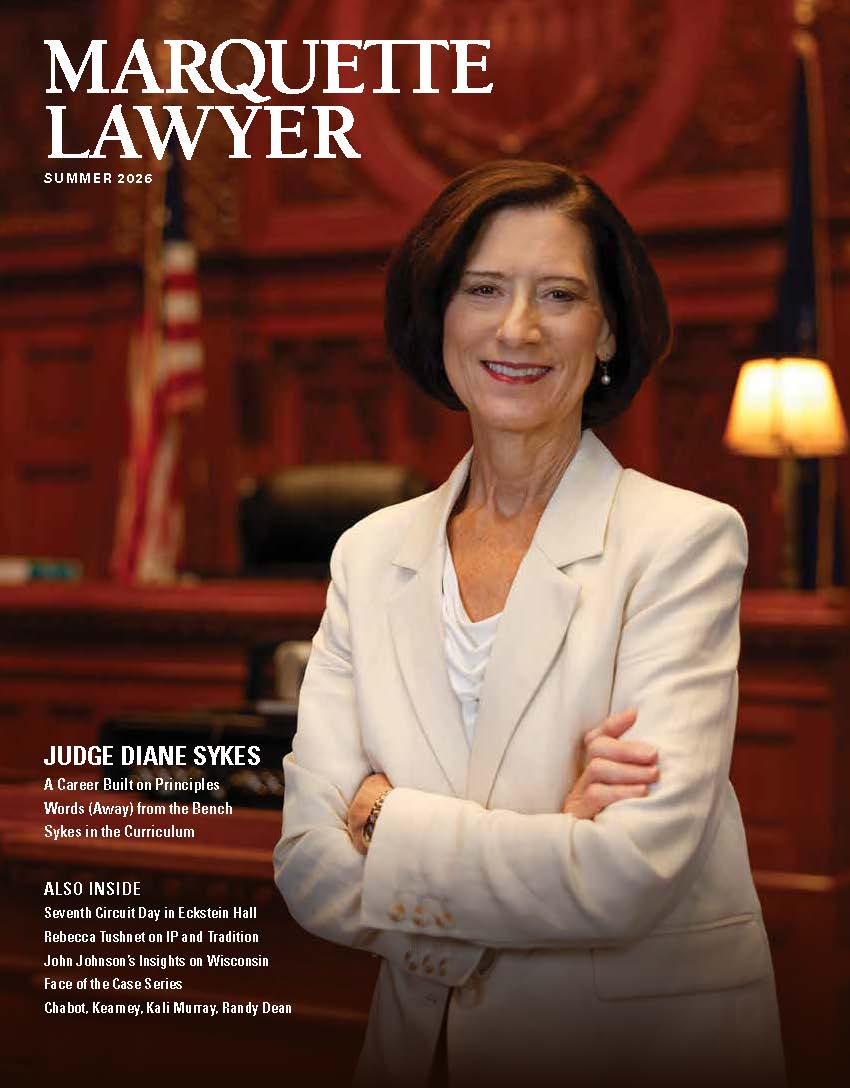
2026 Marquette Lawyer SpringThe Marquette Lawyer magazine often covers a broad range of important issues beyond the walls of the Law School. While this continues to be true in the new issue (Summer 2026), its contents also offer a propitious opportunity to draw readers’ attention—and, if we may, appreciation—to the faculty of Marquette Law School, as well as our alumni and supporters.

The cover feature profiling Judge Diane Sykes, L’84, leads a package of stories focused on one of the Law School’s most distinguished graduates. Sykes stepped down recently as chief judge of the U.S. Court of Appeals for the Seventh Circuit, moving to senior status on the court.

Along with the profile, the magazine entries connected to Sykes include descriptions of how decisions and opinions from her work on the Wisconsin Supreme Court and on the federal appeals bench form part of the courses that seven members of the Marquette Law School faculty teach. The package also includes excerpts from speeches Sykes has given, including two at Marquette Law School. And “Seventh Circuit Day”—an occasion last September of oral arguments and legal education programs at the Law School—is described in a fourth piece, including a behind-the-scenes description of preparation for the court’s visit.

Continue ReadingNew Marquette Lawyer Features Accomplishments and Insights from Right at Home

Judge Sykes in the Curriculum—Advanced Civil Procedure

The summer 2026 issue of the Marquette Lawyer magazine has a number of entries concerning the Hon. Diane S. Sykes, L’84, including a set of one-page essays by seven different faculty on how their Marquette Law School courses draw on her writings as a judge of the U.S. Court of Appeals for the Seventh Circuit since 2004 or as a justice of the Wisconsin Supreme Court between 1999 and 2004. This is the last of the seven essays. The illustration of the faculty member, taken from the magazine and appearing here with the blog post, is by John Jay Cabuay.

Headshot art of Dean Joseph D. KearneyIn Advanced Civil Procedure, an upper-level elective offered each spring, we have occasion to read all or parts of five opinions by the Hon. Diane Sykes. One we consider for its role in establishing the law, whereas the others we take up more for their exemplifying it. The distinction is familiar in the law: Some cases break ground or set precedent, while others are less well-known but useful for their representativeness of a doctrine or concept. Both sorts can be valuable in teaching and learning. In the Advanced Civil Procedure instances, perhaps it is not surprising that it is one of Justice Sykes’s decisions (i.e., from her time on the Wisconsin Supreme Court) that falls into the precedent-setting category.

Let’s start there. Yahnke v. Carson (2000) came toward the end of Justice Sykes’s first year of her half-decade tenure on the state Supreme Court. In a matter of summary judgment process (and substance) and with Justice Sykes writing for a majority, the court adopted what it termed “the so-called ‘sham affidavit’ rule.” The legal precept announced by the court may be less provocative than that phrasing, but it is still significant: “we hold that for purposes of evaluating motions for summary judgment pursuant to Wis. Stat. § 802.08, an affidavit that directly contradicts prior deposition testimony is generally insufficient to create a genuine issue of material fact for trial, unless the contradiction is adequately explained.” Just about every federal court of appeals had previously come out the same way interpreting the materially identical federal law (Fed. R. Civ. P. 56) on which Wisconsin modeled § 802.08. Yet the interpretation barely made it into Wisconsin law, as Yahnke was decided by a four-to-three vote, with Justice William Bablitch dissenting for himself, Chief Justice Shirley Abrahamson, and Justice Ann Walsh Bradley. In class, we find the Yahnke case valuable both for its specific rule and as an example of Wisconsin’s embrace of a number of summary judgment concepts found in the federal system.

The Seventh Circuit cases in Advanced Civil Procedure relevant here are less prominent but interesting all the same. Two of them are personal-jurisdiction cases. Northern Grain Marketing, LLC v. Greving (2014) involved a successful objection by a Wisconsin farmer to being sued in federal court in Illinois on a contract dispute with the plaintiff, Northern Grain. Greving lived very close to Illinois (just over the border, in Walworth County, Wis.) and had some connections with the state—but not the “minimum contacts with Illinois that would permit the district court, consistent with the due process clause of the Fourteenth Amendment, to exercise personal jurisdiction over him.” As Judge Sykes explained, “although it may seem convenient as a practical matter for Greving to defend this suit in Rockford, the Constitution doesn’t permit the Illinois courts—and, thus, [under Fed. R. Civ. P. 4(k)(1)(A)] federal district courts in Illinois—to exercise jurisdiction over him.” Judge Sykes’s opinion for the Seventh Circuit in Felland v. Clifton (2012) contributes to the law of personal jurisdiction in a different way: It has occasion to discuss how a court’s federal “minimum contacts” due process analysis can contribute to its consideration whether the requirements of a Wisconsin longarm statute (there, § 801.05(3)) are satisfied.

Finally (though early in the course), to demonstrate to the students an important way that the federal court system can connect with state supreme courts, we include brief excerpts from three Seventh Circuit opinions where a close question of state law was presented. In two of these cases, the federal court of appeals certified a question of state law to a state supreme court. Judge Sykes wrote these two opinions, seeking answers from the Illinois Supreme Court and the Minnesota Supreme Court. In the third instance, a diversity case where the Seventh Circuit had to sort out state law in a classic “Erie guess” or prediction situation (in fact, Wisconsin law), it didn’t even discuss the possibility of certifying to the Wisconsin Supreme Court. For the contrast of interest here, Judge Sykes was not part of the panel in this third case. Had she been, I imagine, the court might well have proceeded differently, certifying the question. Judge Sykes might have been more apt to recall Justice Sykes, we may say.

Continue ReadingJudge Sykes in the Curriculum—Advanced Civil Procedure