
Wisconsin Supreme Court Accepts Two More Cases, Including Question of Probable Cause to Arrest for OWI

Yesterday the Wisconsin Supreme Court voted to accept two more cases this term, Zellner v. Herrick, no. 2007AP2584, and State v. Lange, 2008AP882-CR.

At issue in Zellner v. Herrick is whether the transcript of Robert Zellner’s closed arbitration proceeding is a “public record” under Wisconsin’s public records law, and if so, whether personal information must be redacted before release of that record.  Zellner is the Cedarburg School District teacher who lost his job for allegedly viewing pornography on a school computer.  The issue of whether the transcript of Zellner’s arbitration proceeding is a public record was certified to the court from the court of appeals.  At the same time as it accepted the certification, the Wisconsin Supreme Court declined to hear Zellner’s appeal of the court of appeals decision that affirmed the trial court’s conclusion that an arbitration panel wrongly reinstated Zellner to his position.

Does a police officer have probable cause to suspect a driver is operating a vehicle while intoxicated, when the officer observes a car driving more than 84 miles per hour in a 30 mph zone, on the wrong side of the road, shortly after bars have closed, and then hitting a utility pole and flipping over, leaving the driver unconscious? That is the question in State v. Lange, where the State appeals from the Court of Appeals decision that the police lacked probable cause.
Continue ReadingWisconsin Supreme Court Accepts Two More Cases, Including Question of Probable Cause to Arrest for OWI

Chief Flynn Discusses “Issues”

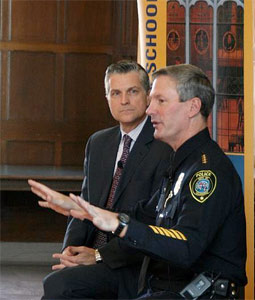
Mike Gousha and Police Chief Ed FlynnMike Gousha began his spring-semester series of conversations “On the Issues” by hosting Milwaukee Police Chief Ed Flynn, who had come to the Law School last January within weeks of starting as chief and thus has a year under his belt (in addition to his substantial experience elsewhere). Anyone who has never heard Flynn speak is missing a treat: he is smart, extraordinarily well-spoken, and witty. A podcast of the interview, which includes as usual with Gousha questions from the audience, is available here and is well worth a listen.

Perhaps the most striking part, for me, was Flynn’s description (at about the 30-minute mark) of how bad police drag good police down:

And I’m not minimizing or mitigating when I say, “Show me a hospital-ful of doctors, and I’ll show the white-coat wall of silence. Show me a roomful of attorneys, and I will show you the pinstripe wall of silence. Show me a roomful of police officers, and if we’re not thoughtful about it, we will have the blue wall of silence.”

Because the devil’s bargain becomes this—and trust me, this is the truth—the overwhelming majority of your police officers come into the job with notions of moral clarity, and they want to protect the good guys from the bad guys. They function in a world that is far more ambiguous than they thought. And they have to make the kinds of decisions which the order book doesn’t cover and the general orders don’t cover, but they live in a rule-based environment. They know they’re expected to do something, and they do things—and most of the time they’re within a margin of error of right. Sometimes they’re wrong—their colleagues know it. Sadly, over the course of the years, if you’re not careful, if you don’t have adult discussions about it, the devil’s bargain is this: The good cop who screws up makes the devil’s bargain with the cop who’s a thief or a brute, where neither one of them says anything. And that’s where you don’t want to get.

Flynn then proceeds to describe how in his estimation anyone who wishes to change this police subculture has to look upon the general police culture with a basic degree of empathy. Other aspects of the interview included Gousha’s asking Flynn to compare Milwaukee’s drop in violent crime over the past year with Chicago’s rise in the same.

To the list of adjectives that I earlier used in describing Flynn, I should add another. He seems loyal as well: he never misses the opportunity, even while appearing at this Jesuit institution, to credit the Christian Brothers, whose institutions he attended for both high school and college.

Continue ReadingChief Flynn Discusses “Issues”

Tuesday’s Gone

Inauguration day has come and gone, but the euphoria of a historic election will likely remain for some time.  For President Obama and the 110th Congress, the work is just beginning.  The economy continues to show signs of weakening, even amidst hope that the downturn will be neither as severe nor as prolonged as some have prognosticated.  Although Israel draws down its forces in Gaza, tension in the Middle East remains high.  The status of the American presence in Iraq and the oft-criticized detention facility at Guantanamo Bay remain uncertain.  Pricey health care and a failing education system also appear at the top of the President’s to do list.

Given these conditions, it is curious that some have anticipated one of the most prominent pieces of reform that will come on the heels of the inauguration to be the Freedom of Choice Act. 

Continue ReadingTuesday’s Gone