
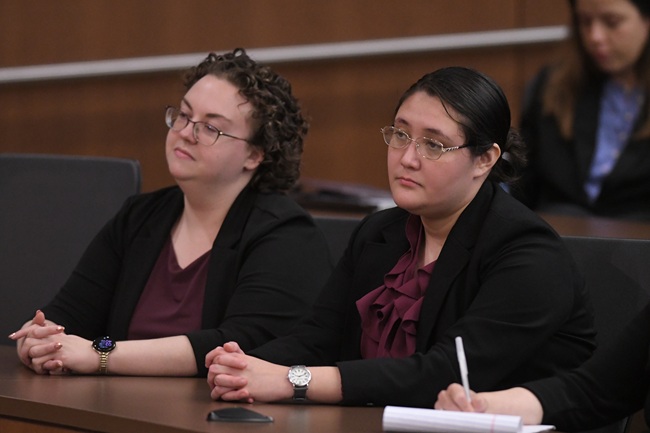
Did people walk a little taller at Marquette Law School on September 25, 2025? Was there more electricity in the air? Was there an almost tangible sense that something important was taking place? None of this was quantifiable, but it certainly seemed true during what became known within Eckstein Hall as Seventh Circuit Day.
“It felt like this event,” said Mariana Calvo Argus, a second-year student originally from El Paso, Texas. This sixth and final blog post in the Seventh Circuit Day series seeks to capture a bit of the feeling.
Kaya Dreger, a first-year student originally from Idaho, said, “I was super-excited.” The court’s visit furthered her interest in career paths involving advocacy in court. Observing arguments before three federal appellate judges underscored for Dreger how cases involve “real, tangible people” and how an aspect of the U.S. Constitution comes alive in proceedings such as these.
It was a very full day for four judges of the U.S. Court of Appeals for the Seventh Circuit and for the Marquette Law School community as a whole. In the morning, the Law School’s Lubar Center was the setting for oral arguments in six cases before then-Chief Judge Diane S. Sykes, L’84, and Judges Frank H. Easterbrook and Michael B. Brennan. Judge Michael Y. Scudder joined his colleagues for programs for afternoon programs (see Part 1). The day came as Sykes was within days of finishing her term as chief judge and moving to senior status and as Brennan, another Milwaukeean, prepared to become chief judge of the Chicago-based circuit encompassing Wisconsin, Illinois, and Indiana.
A majority of the Law School’s students observed at least one of the three hours of oral arguments, in carefully organized shifts of almost 200 attendees, both students and others, for each session. The Zilber Forum outside the Lubar Center was abuzz as long lines of students, faculty, and community members entered and exited the Lubar Center between each hour of arguments.
The judges also had lunch with a group of students and took part in a question-and-answer session with upper-level students in the Lubar Center, moderated by Professor Anne Berleman Kearney (see Part 2). There followed a CLE session, titled “Judges on Judging: A Window into Appellate Decision Making,” attended by about 200 lawyers and moderated by Professor Chad Oldfather (see Part 3). The day ended with a reception in the Zilber Forum at which Judges Sykes was saluted for her accomplishments (see Part 4).
For Joe Yamat, a second-year student, both the formal session of the court and the informal occasions to talk with some of the judges were valuable. “It was great just to have that opportunity,” he said, noting that it was particularly relevant to his Appellate Writing and Advocacy course this semester. He was impressed to see the quality of the work of the attorneys who presented arguments to the court and to realize how much the judges were concerned about the long-term impact of their work in setting or following precedents and shaping what is done by judges across the legal system. He was much impressed by the idea and execution of bringing the court to Marquette Law School.
Calvo Argus said, “It’s just so different seeing it [the court proceedings] in person.” She said she was nervous for the attorneys appearing before the court, but that they generally did “fantastic” jobs. It also struck her how much the personalities of the judges were visible—and how different their personalities were.
Some of the advice the judges gave during the afternoon Q&A session made a big impression on Calvo Argus. Keeping briefs short and remembering that you’re presenting your case to judges who are “generalists” were among the themes in the judges’ remarks. Judge Brennan asked rhetorically, “When is the last time the fifth issue won a case?” He said that attorneys preparing briefs in an appeal should “stick to issues one, two, or three. . . . Limit your number of issues, and make them good.” Calvo Argus and others recalled that and other counsel in conversations recalling the day.
Dreger said it was particularly motivating for her to observe and then to speak briefly with Judge Sykes—or, as she put it, to see how “an honorable chief judge of the Seventh Circuit” handled herself and her duties.
Professor Oldfather said afterward, “You can learn a lot about being a lawyer by watching more people who are farther along in their professional development do it. My impression was that the students found it to be a valuable experience, and it was certainly one that they were discussing well after the arguments were over. And the lessons they learned that day, as well as ones they’ve learned in the months and years leading up to it, were reinforced by the Q&A session with the students. There’s always value in having judges underscore the lessons that we try to impart in the classroom.”
Professor Rebecca Blemberg said, “Students very much appreciated the opportunity to witness oral argument before the Seventh Circuit judges. They were both impressed by the level of preparation put in by the judges and lawyers and heartened that the arguments unfolded more as conversations than canned remarks or soundbites.”
She added, “The students had the sense that they witnessed professionals making real efforts to understand positions and reasoning, a type of ‘argument’ lacking in public and political discourse.”
Dreger said that some of her classmates were taken aback by how assertive some of the judges were in questioning lawyers during the oral arguments. Frequently, the judges cut into lawyers’ remarks with questions or criticisms, as is common in such proceedings. But Dreger thought this added to the sense of importance of what they were considering, as well as her sense of being motivated by the experience.
Calvo Argus said, “Just getting to see it live” was valuable. She described it as “a unique experience—and a very beneficial one.”
While the behind-the-scenes faculty and administrative work involved in preparing for Seventh Circuit Day may not be widely known or long remembered (cf. Part 5), the benefits for the participating Marquette law students should be evident for a long time to come.
Describing the court’s visit in a conversation later, Dreger, the first-year law student, underscored the success of the day by using one word several times: “Motivating.”