
And How Many Early Voters Wasted Their Vote
In Wisconsin, anybody can vote early by mail or in-person at an early voting site for any reason, and many people do. This is referred to, interchangeably, as “early” or “absentee” voting.
In the August 2026 primary, 25.8% of ballots were cast by mail and another 11.9% in-person at an early voting center. Thirty-eight percent of Wisconsin Democrats didn’t wait until election day to cast their ballot in the governor’s primary.
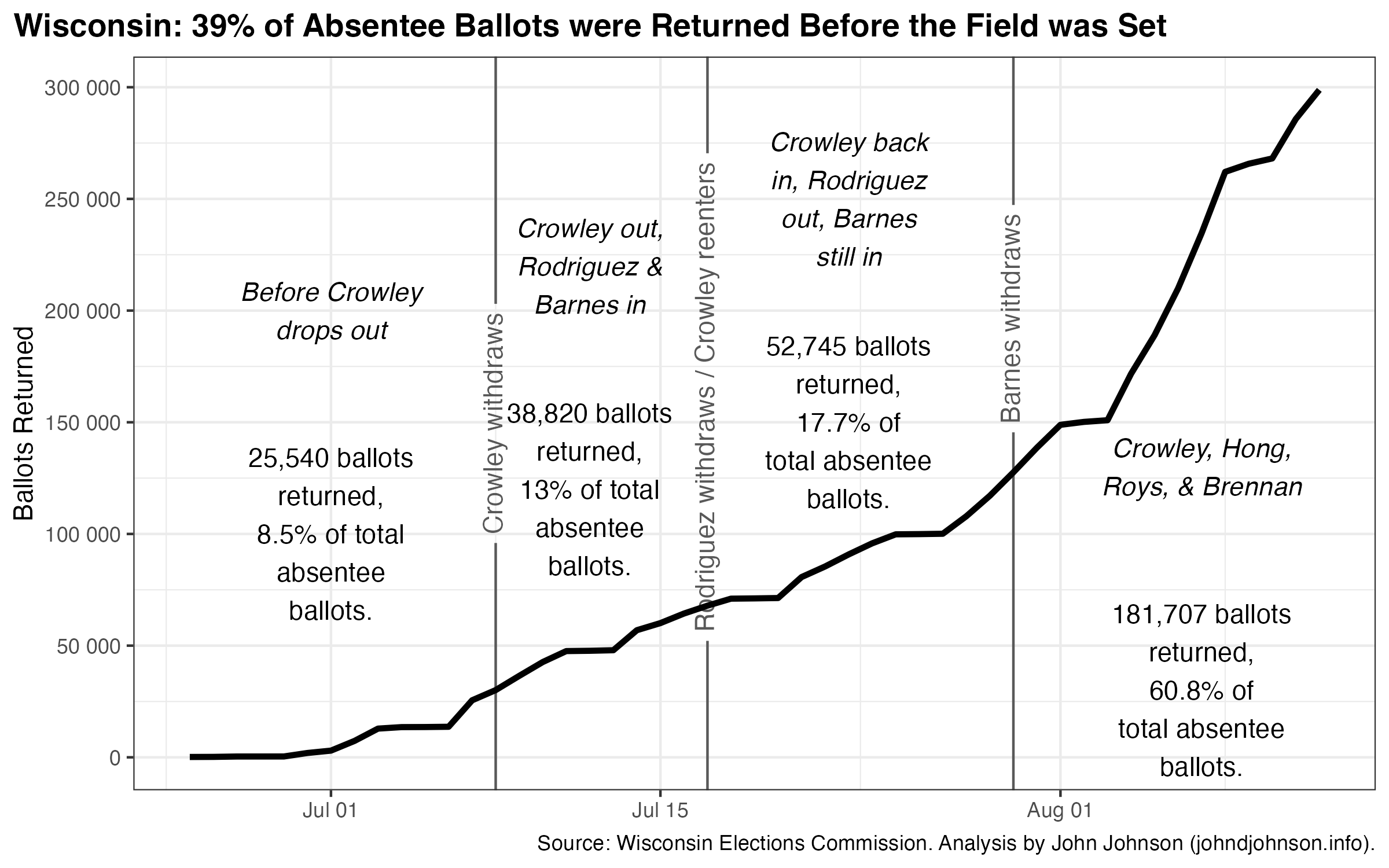
Voting early is risky in a primary election, because the nature of the contest can change a lot in the weeks before a race. The first absentee ballots were sent out in late May and early voting centers opened on July 28th. David Crowley withdrew his candidacy on July 8th. On July 17th, Sara Rodriguez dropped out and Crowley reentered. On July 30th, Mandela Barnes–then polling in second place–ended his campaign. Any voter casting a ballot before July 30th ran the risk of wasting their vote on a candidate no longer running by election day on August 11th.
Statewide, 8.5% of absentee ballots were cast before Crowley dropped out the first time. Thirteen percent were cast while Crowley was officially out of the race but Rodriguez was still in. Then, another 17.7% were cast after Crowley reentered but before Barnes dropped out. Across Wisconsin, 39% of early voters cast their ballot before the final field was set.
How many of them voted for a candidate who subsequently dropped out? Doubtlessly, some of them. According to the Associated Press on Wednesday afternoon, the three suspended campaigns (Rodriguez, Barnes, and Hughes) collectively received 68,343 votes, or 8.6% of the total. Recall that Crowley defeated Hong by about 3,800 votes.
In most places, it is impossible to tell who those early voters voted for, because their ballots are counted along with those of regular, election day voters at each individual polling place. The complete results for each ward are reported one time, including ballots from every mode of voting.
However, many larger municipalities count their early votes separately at a central count location. The City of Milwaukee is one of these. In Milwaukee, the process of counting absentee ballots often drags on late into the night, well after the election day results from each ward have been tallied and published. Because Milwaukee always has tens of thousands of absentee ballots, this means that close statewide elections can never be called until those votes are reported–a process that occurs all at once and involves some drama as elections officials (accompanied by a police escort) transfer thumb drives containing the absentee results from the central count location to the courthouse. Once the thumb drives arrive, the early votes are added to the ward totals where each voter would’ve gone had they voted on election day. This instantaneous addition of thousands of votes to Milwaukee’s total is commonly called the “ballot dump.”
The ballot dump causes much angst in Wisconsin by providing fodder for conspiracy theorists who watch Milwaukee’s late addition of votes lift Democratic candidates to victory, as happened in 2018, 2020, and 2024. In fact, state law prohibits Milwaukee’s election commission from taking steps to speed up their central count, such as pre-processing absentee ballot signatures and envelopes before election day, and Republican legislative leadership killed a bipartisan bill aimed at reforming this in 2023.
As bad as these late-night ballot updates are for confidence in our elections, they are useful for researchers like me. We can use them to measure differences between the early vote and the election day vote. The contents of the early vote ballot dump are not explicitly reported, but by subtracting the election day totals for each ward from the final, complete totals, we can see exactly how early voters cast their ballots.
Crowley led Hong by just over 1,000 votes in Milwaukee’s election day returns, and he doubled that raw vote lead once the city’s absentee ballots were added. Unlike in several previous general elections, Milwaukee’s late night ballot dump did not change the leader of the 2026 Democratic primary. The added ballots merely added to the lead he already held in AP’s running tally. When it was all said and done, the City of Milwaukee was not individually decisive in Crowley’s statewide victory. He won the state by around 3,800 votes. Of that victory margin, the City of Milwaukee contributed about 2,200 votes–half from early voters and half from election day ballots.
| Votes for Crowley vs. Hong | |||
| City of Milwaukee1 | |||
| vote mode | David Crowley | Francesca Hong | Crowley net |
|---|---|---|---|
| early | 9,423 | 8,357 | +1,066 |
| in-person | 28,564 | 27,473 | +1,091 |
| total | 37,987 | 35,830 | +2,157 |
| 1 Excludes three wards (24th, 25th, & 27th) which did not separately report election day and early votes. | |||
| Data Source: Milwaukee County Election Commission unofficial election night results posted at 10:36PM and 1:09AM. Analysis by John Johnson (johndjohnson.info). | |||
Milwaukeeans who cast their ballots early did waste their votes at a much higher rate. This table shows the share received by each candidate listed on the ballot among early vs. election day voters.
| Share of the Vote, by Vote Mode | |||
| City of Milwaukee1 | |||
| Dem. Gov. candidate | early | in-person | total |
|---|---|---|---|
| David Crowley | 38.7% | 47.4% | 44.9% |
| Francesca Hong | 34.3% | 45.6% | 42.3% |
| Joel Brennan | 5.1% | 2.3% | 3.1% |
| Kelda Roys | 4.1% | 3.0% | 3.3% |
| Mandela Barnes | 10.4% | 0.9% | 3.7% |
| Missy Hughes | 0.3% | 0.1% | 0.2% |
| Sara Rodriguez | 7.0% | 0.6% | 2.5% |
| write-in: | 0.1% | 0.0% | 0.1% |
| 1 Excludes three wards (24th, 25th, & 27th) which did not separately report election day and early votes. | |||
| Data Source: Milwaukee County Election Commission unofficial election night results posted at 10:36PM and 1:09AM. Analysis by John Johnson (johndjohnson.info). | |||
Sara Rodriguez, who ended her campaign on July 17th, received 7% of early votes and only 0.6% of election day ballots. Mandela Barnes, who dropped out on July 30th, took 10.4% among early voters but just 0.9% on election day.
All told, 17.7% of early voters voted for somebody who dropped out before the election, compared to just 1.6% of election day voters. In this way, election day voters appear to have been very well informed about which candidates remained actively in the running.
People who waited to vote until election day also appear to have consolidated more behind one of the two front-runners. Joel Brennan and Kelda Roys remained in the race until the very end, but they never drew much support. Combined, 9.2% of Milwaukee’s early voters picked one of these minor candidates. This fell to 5.3% by election day.
As discussed above, Crowley received a similar number of net votes (relative to Hong) in both the election day totals and the smaller absentee totals. But in percentage terms, Crowley actually did better with early voters, among whom he beat Hong by 4.4 points, than among election day voters, among whom his margin of victory shrank to 1.8 points. By the end of the race, Milwaukee’s Democratic primary voters had thoroughly consolidated behind the two frontrunners, with Hong winning 45.6% of election day voters to Crowley’s 47.4%.