
Wisconsin votes a lot. I mean that in two ways: voter turnout is often high and opportunities to vote arrive frequently. In 2024, the state’s voter turnout was the highest in the nation (76.66% of eligible voters). And statewide elections occur almost every year, often more than once. The total number of voters participating in these contests routinely varies by millions, with inescapable consequences for the parties. With maximum turnout, Republicans enjoy a slight edge, but Democrats have opened a seemingly insurmountable advantage in lower-turnout contests.
For the purposes of this analysis, I’m interested in statewide elections when Democrats, or Democratic-endorsed nonpartisan candidates, ran against Republicans, or their endorsees. This includes November general elections, April elections for State Supreme Court Justice or State Superintendent, and February primaries for those same offices. Unlike in partisan primaries, when Democrats and Republicans vote in separate contests, nonpartisan Wisconsin primaries occur only when at least three candidates are on the ballot, and the top two vote-getters both advance to the April general.
These days, the nonpartisan status of statewide April (and February) elections is just a formality. The parties endorse and fund their preferred candidates, and the voters are well aware of even these unofficial candidate affiliations. The correlation between the vote for Wisconsin Supreme Court Justice and the previous presidential election grew from 0.002 in 1978 to 0.99 by 2025.
Since 2020, there have been 11 statewide elections pitting Democrats against Republicans, counting formally nonpartisan races in which the party affiliation of the candidates was clear.
Those elections ranged in turnout from 3.4 million in the November 2024 presidential election to 326 thousand during the February 2021 primary for State Superintendent.
At the Marquette Law School Poll, we draw most of each sample from the list of registered voters in the state, so for those voters, we can see their actual voting history—not who they voted for but if they voted in each election. I identified everyone we’ve interviewed who remained registered to vote in Wisconsin throughout this entire period, 2020–2026. This includes about 78% of current registered voters in the state and 8,275 respondents to our polls.
I used those respondents to measure the party split among voters at every level of engagement, shown in the graph below.
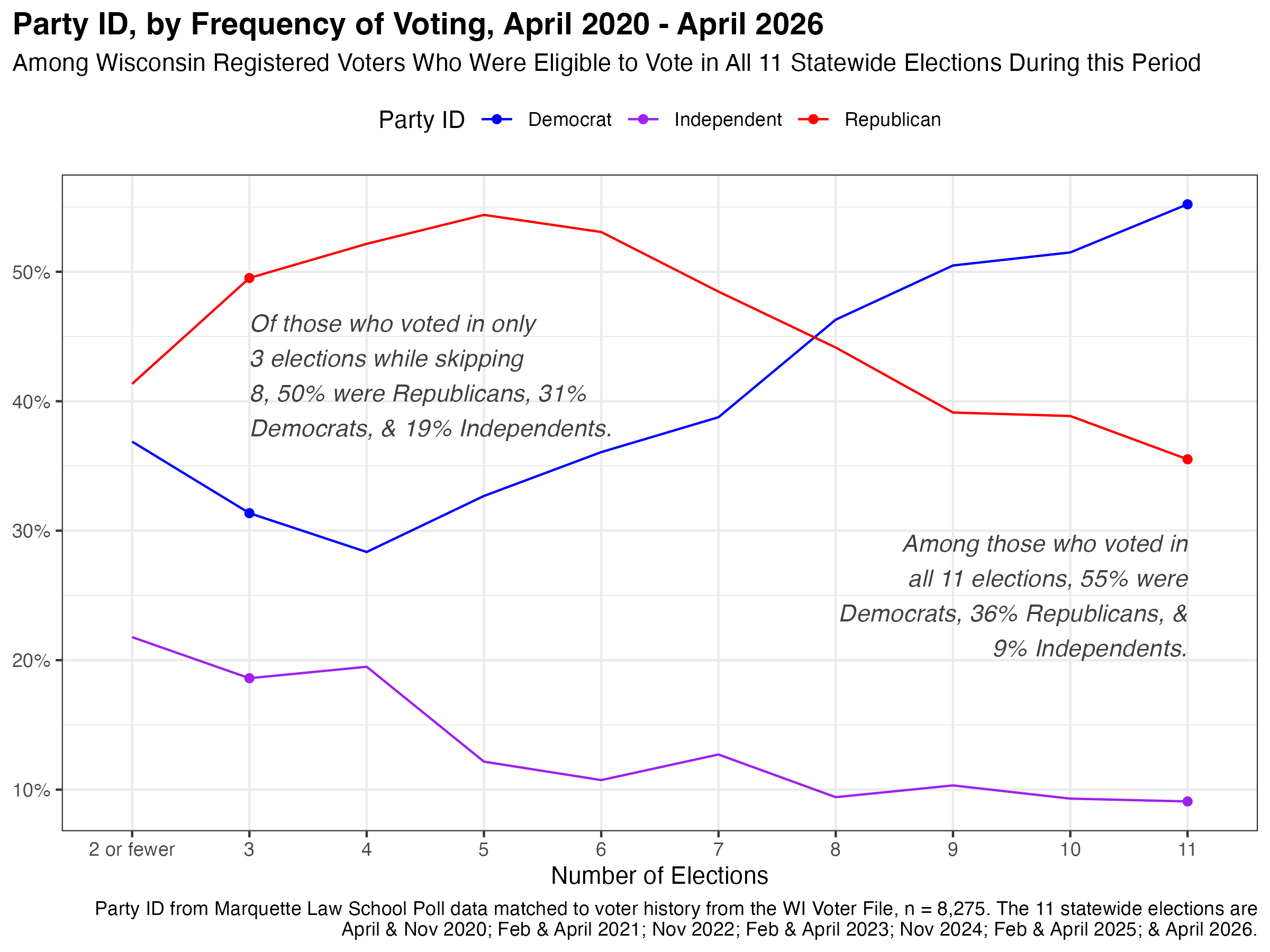
Republicans enjoy a strong advantage in party ID among those who voted in 7 or fewer of the 11 elections for which they were registered. For instance, about 10% of registered voters voted in only 3 elections, most commonly the three November contests during this period. Among these 3-time voters, our poll finds that 50% identify as Republican, 31% Democratic, and 19% Independent.
Democrats have the advantage with those who voted in 8 or more elections, and the advantage grows steadily with frequency of voting. About 5% of these registered voters had a 100% participation rate; among them, 55% were Democrats, 36% Republicans, and just 9% Independents.
Independents are far less likely to vote frequently. These are “pure” Independents who deny leaning toward either party. Among registered voters who vote the least, more than a fifth are pure Independents. That is more than twice the rate of Independents among high frequency voters.
This means that, as the electorate shrinks, it also becomes more predictable and more ideologically extreme. Among those who voted in two or fewer elections—prototypically, someone who only votes for president, if that—45% describe themselves as moderate, 8% very conservative, and 8% very liberal. Contrast that with the ideology of those who voted all 11 times. Just 20% describe themselves as moderate, 15% very conservative, and 26% very liberal.
In other words, during a high-turnout presidential election, the last voters to be convinced to vote often reject both parties along with the terms “liberal” and “conservative.” A successful politician must appeal to these voters to win in Wisconsin. However, in a low-turnout April election, about 90% of the participants identify with one of the parties and few see themselves as “moderate.” Candidates in these elections play to their respective bases because there is little audience for doing anything else.
Of course, knowing turnout alone can only tell you so much. The qualities of the candidates, the national environment, and other dynamics of the race play a role. But the importance of turnout to shaping the outcome can’t be denied. There were 17 individual contests in the 11 statewide elections from 2020 through April 2026. Here are the results of each of those, compared with the total number of voters in each.
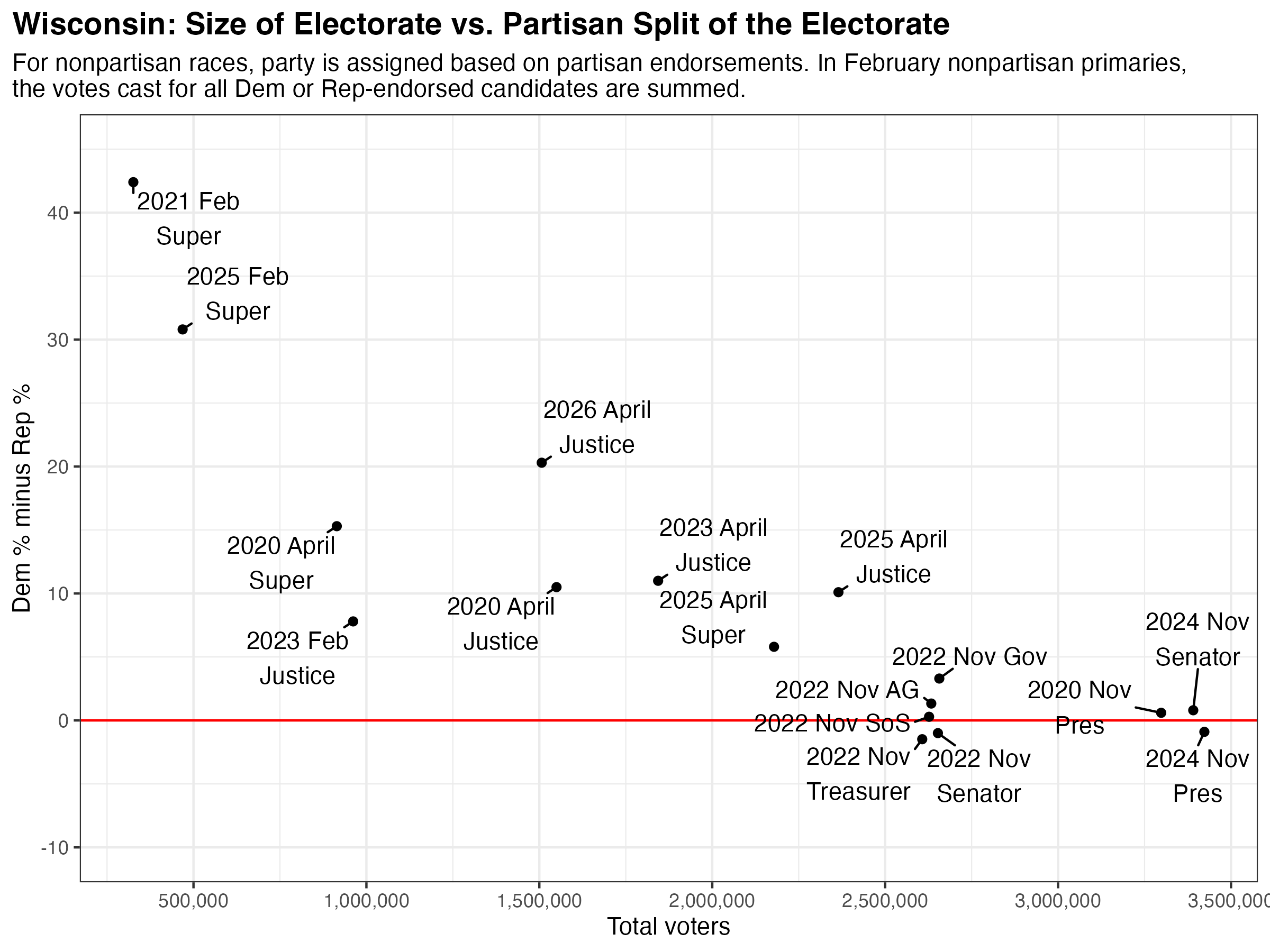
Overall, Republican vote share increases with the size of the electorate. It’s no coincidence that Donald Trump’s 2024 victory coincided with record-breaking turnout in the state.
In general, Republicans remain quite competitive whenever turnout is above 2.5 million. They also won the State Treasurer and U.S. Senator races in 2022. However, no Republican or Republican-endorsed candidate has come within 5 points of victory this decade in a race with turnout below 2.5 million.
Things are particularly dire for Republicans in State Superintendent primaries, when voter turnout can fall below half a million. In 2021 and 2025, multiple Democratic-aligned candidates ran, receiving about two-thirds of the vote combined. Although the single Republican-endorsed candidate in those races still managed to advance to the general election, it’s conceivable that a future February primary could result in two Democratic-aligned State Superintendent candidates advancing to the general.
Given the way that low turnout now works to the benefit of Democrats while Republicans need high turnout to win, it may appear surprising that Democrats remain the party promoting voting access while Republicans pursue efforts that would shrink the electorate. It can seem as if each party is accidentally working to make things better for the other. A few long-standing political beliefs contribute. Many Democrats believe that higher turnout is normatively good, and the Obama-era mindset that “When everyone votes, we win” is still common. Likewise, I suspect many Republicans still believe, despite evidence to the contrary, that the marginal voter is more likely to vote for a Democrat than a Republican.