A Tenancy in Common Tragedy

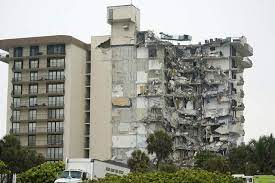
pic of Surfside, Florida condo building, showing collapseThere is lots of blame to go around for the horrifying collapse of the Champlain Towers condominiums complex in Surfside, Florida, in June 2021:

(1) Engineers’ reports on structural flaws in Champlain Towers could have been more forceful and explicit,

(2) Members of the Champlain Towers condo board could have been more attentive and willing to act regarding the dangerous conditions, and

(3) State and local governments could have made inspections earlier and warned that the residents of Champlain Towers of their vulnerability.

Add to the list of causes for the disaster the tenancy in common (TIC) and the modern-day attitudes about ownership of property that the TIC brings to the surface.

Many will recall from first-year Property that a TIC is a shared tenancy in which each owner has a separately transferable share of the property but may not claim ownership of a specific part of the property.  All of the tenants in common are able to use the whole property.  TICs emerged in early-modern England and were much treasured by the gentry as a way to consolidate family interests.  Family bloodlines, after all, were often indistinguishable from family property lines.

A variety of the TIC has lived on into the contemporary United States and is common in what seems sometimes like our ubiquitous condominium complexes.

Continue ReadingA Tenancy in Common Tragedy

Jury Duty in de Tocqueville’s Time and in the Present

Alexis de Tocqueville was a French aristocrat sent by his country to inspect American penitentiaries during the 1830s.  He dutifully delivered his report, but he also found himself interested in more than penitentiaries.  In Democracy in America (1835), he provided a wide-ranging and to this day highly regarded account of life in the youthful, rambunctious American Republic.  Somewhat surprisingly, de Tocqueville discussed at length the role and function of jury duty.

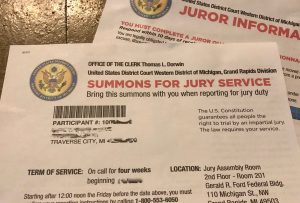
photo of jury summons

Although de Tocqueville recognized the jury as a “juridical institution,” that is, a body that renders verdicts, he was more interested in the jury as a “political institution.”  He argued that the jury “puts the real control of affairs into the hands of the ruled, or some of them, rather than into those of the rulers.”  The jury was a vehicle through which the citizenry could exercise its sovereignty.

What’s more, jury duty struck de Tocqueville as a “free school.”  “Juries, especially civil juries,” he thought, “instill some of the habits of the judicial mind into every citizen, and just those habits are the very best way of preparing people to be free.”  As a form of “popular education,” jury duty offers practical lessons in the law and teaches jurors their rights under the law.

Overall, de Tocqueville was pleased Americans took eagerly to jury duty and felt robust, active juries were extremely important in the success of the nation.  Jury duty, he said, “makes men pay attention to things other than their own affairs” and thereby “combat that individual selfishness which is like rust in society.”

How disappointed de Tocqueville would be learn how people perceive jury duty in the present.  While people who actually serve on juries tend to say their experiences were positive ones, a huge percentage of Americans dread receiving a summons for jury duty and do their best to avoid serving.  Websites such as “How to Get Out of Jury Duty” and “10 Ways to Avoid Jury Duty” are popular.

Continue ReadingJury Duty in de Tocqueville’s Time and in the Present

The Worst Places in America

person sitting in wheelchair in empty nursing home hallwayNumerous social commentators have noted how the pandemic has hit the least powerful and prosperous parts of the population the hardest.  Infections, hospitalizations, and deaths have been disproportionally high among the poor, people of color, recent immigrants, Native Americans, and the elderly.

The pandemic has also underscored the worst places to work and live, with the pejorative “worst” referring to the way certain places weigh heavily on the body, mind, and spirit.  These places are not only individualized but also organized into types and categories.  I nominate three types of places as the worst in the United States:  prisons, nursing homes, and food processing plants.

Media accounts have reported at length on how COVID-19 has ravaged prison populations, but prisons were undesirable places long before the virus arrived.  The nation has in general abandoned any commitment to rehabilitate inmates, and prisons have deteriorated into demeaning, dangerous warehouses.  Diseases and medical problems are four to ten times as common as they are in the general population, and the Prison Policy Initiative and Wisconsin Department of Corrections estimate that 42% of the state’s inmates suffer from one or more mental illnesses.   According to the prominent sociologist Jonathan Simon, most of the nation considers prison inmates to be “toxic waste” of a human variety and thinks of the people who run the prisons as engaged in “waste management.”

Nursing homes have been the places in which 40% of COVID-19 fatalities have occurred, and some of the most excruciating pandemic scenes have involved distraught friends and relatives saying goodbye to confused and dying residents through tightly-sealed windows.

Continue ReadingThe Worst Places in America