Marquette Lawyer Magazine Looks at the Milwaukee Public Schools—and Seemingly Timeless Societal Problems, Especially Segregation (Post 2 of 3)

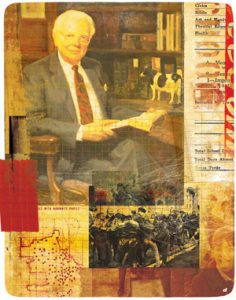
Judge John W. Reynolds sitting in a chairA previous blog post discussed a pair of stories in the Summer 2019 Marquette Lawyer magazine and concluded by quoting one of them: specifically, an observation by Professor David Strauss of the University of Chicago, based on the Boden Lecture at Marquette Law School by Duke’s Professor Ernest Young, that “in the end, there is only so much the law can do to save a society from its own moral failings.” This post takes up a second pair of stories in the magazine, from which one might draw the same conclusion.

While it remains a fact about the large majority of schools in the Milwaukee area now, segregation of Milwaukee school students by race was the subject of great energy—attention, advocacy, and controversy—in the 1960s and 1970s. Two pieces in this summer’s Marquette Lawyer focus on the Milwaukee education scene of that earlier era.

In one, Alan Borsuk, the Law School’s senior fellow in law and public policy, writes about the decision issued in January 1976, by U.S. District Judge John W. Reynolds, which ordered that the Milwaukee Public Schools be desegregated. “A Simple Order, a Complex Legacy” touches upon the legal history of school desegregation cases, Reynolds’ 1976 ruling itself, and the legacy of that Milwaukee ruling. To borrow a phrase from Professor Young’s Boden Lecture, there is scarcely “an optimistic, onward-and-upward feel” to the account.

Continue ReadingMarquette Lawyer Magazine Looks at the Milwaukee Public Schools—and Seemingly Timeless Societal Problems, Especially Segregation (Post 2 of 3)

New Marquette Lawyer Magazine Sees Past Problems as Shedding Light on Future Challenges (Post 1 of 3)

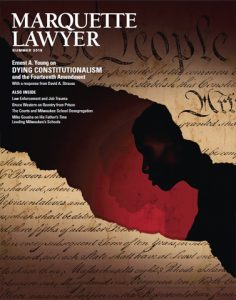
This cover of the summer issue of the Marquette Lawyer. The Summer 2019 issue of Marquette Lawyer features three pairs of stories with an underlying common theme that can be summed up by one of the headlines: “In Search of Better Outcomes.” This issue of the Marquette Law School semiannual magazine overall has a substantial historical orientation, but it also speaks strongly to current realities and issues—as has become even clearer since the magazine hit the streets a few weeks ago. Simply put, learning about the past helps in understanding the present and considering the future. This post takes up one pair of articles: the cover story and a reaction to it.

The cover story, “Dying Constitutionalism and the Fourteenth Amendment,” is an edited version of the Robert F. Boden Lecture given at Marquette Law School in fall 2018, by Ernest A. Young, the Alston & Bird Professor at Duke Law School. While the Fourteenth Amendment later would be crucial to the growth of constitutional protections and the extension of civil rights—the linchpin of America’s “second founding,” as it is sometimes called—Young focuses on the first 75 years after the amendment was ratified in 1868. It was a period of broad suppression of civil rights, particularly those of African Americans—the Fourteenth Amendment not working much to the contrary.

Young’s purpose is not so much historical as jurisprudential: He presents his essay as a cautionary tale about “living constitutionalism,” demonstrating that, while that mode of constitutional interpretation was not the Court’s stated approach in those 75 years, it could have been: For “every one of [living constitutionalism’s] modalities strongly supported the compromise or even abandonment of the amendment’s core purpose of freedom and equality for black Americans.” Simply stated, the history of the use of the amendment is a reminder that “social progress is not inevitable, that social forces can push constitutional meaning in bad as well as good directions, that living can turn into dying constitutionalism if we are not very, very careful,” Young writes.

In a comment on Young’s lecture, David A. Strauss, Gerald Ratner Distinguished Service Professor of Law at the University of Chicago and author of The Living Constitution (Oxford 2012), says that the early failures under the Fourteenth Amendment need to be reckoned with by those who are proponents of living constitutionalism. He writes that Young’s lecture shows that “in the end, there is only so much that the law can do to save a society from its own moral failings.”

A future post will discuss another pair of articles in the magazine that would support the same reaction. Click here to read both Young’s lecture and Strauss’s comment.

Continue ReadingNew Marquette Lawyer Magazine Sees Past Problems as Shedding Light on Future Challenges (Post 1 of 3)

Justice Scalia at Marquette Law School

Judge Diane Sykes introduces Justice Antonin Scalia at the dedication of Eckstein Hall
Judge Sykes introduces Justice Scalia

It seems to be common ground that it will be hard to imagine the United States Supreme Court without the late Justice Antonin Scalia. He was a force also in legal education more directly. That is, he was a teacher, and he taught his theories of constitutional and statutory interpretation with intellect and energy, even outside of his writings in the U.S. Reports.


Justice Scalia visited us at Marquette University Law School on two occasions. The first was in 2001 to deliver our annual Hallows Lecture, where some 500 people were with him in the Weasler Auditorium, while a group of the same size watched a video feed in the Monaghan Ballroom of the Alumni Memorial Union. For me, the more memorable moment in that visit came when the Justice first arrived to campus, where an overflowing group of law students awaited him in Room 307 of Sensenbrenner Hall. The dean at the time, Howard B. Eisenberg, told the students that I would introduce him, because “Without Professor Kearney, there would be no Justice Scalia here.” Even before I could say anything, Justice Scalia brought the house down with this interjection: “I thought that, without Justice Scalia, there would be no Professor Kearney here.”

Justice Scalia returned to deliver the keynote address at the dedication of Eckstein Hall on September 8, 2010. He relaxed his strictures on recording, and the entire ceremony can be seen here, with an account of it appearing in the Marquette Law Review. I especially recall this comment of Judge Diane S. Sykes, L’84, in introducing the Justice:

“So we are fortunate, indeed, that this history-making justice has joined us here today as we make a little history of our own. When Dean Kearney unveiled the plans for this beautiful building two years ago, he famously declared that Eckstein Hall will be ‘noble, bold, harmonious, dramatic, confident, slightly willful, and, in a word, great.’ It certainly is. And with the possible exception of harmonious—Justice Scalia has been known to say that one of his charms is that he likes to tell people what they don’t want to hear—the dean’s description of this distinguished and splendid building might likewise be applied to our distinguished and splendid visitor. So, ladies and gentlemen, please join me in welcoming the noble, bold, dramatic, confident, slightly willful, and, and in a word, great Justice Antonin Scalia.”

There are things to learn from the remarks of Justice Scalia and the other speakers that day, including then-Chief Justice Shirley S. Abrahamson, whether in the recording or the law review account linked above. My own recollection of Justice Scalia has appeared in the Milwaukee Journal Sentinel and can be found here.

Continue ReadingJustice Scalia at Marquette Law School