Justice Scalia at Marquette Law School
It seems to be common ground that it will be hard to imagine the United States Supreme Court without the late Justice Antonin Scalia. He was a force also in legal education more directly. That is, he was a teacher, and he taught his theories of constitutional and statutory interpretation with intellect and energy, even outside of his writings in the U.S. Reports.
Justice Scalia visited us at Marquette University Law School on two occasions. The first was in 2001 to deliver our annual Hallows Lecture, where some 500 people were with him in the Weasler Auditorium, while a group of the same size watched a video feed in the Monaghan Ballroom of the Alumni Memorial Union. For me, the more memorable moment in that visit came when the Justice first arrived to campus, where an overflowing group of law students awaited him in Room 307 of Sensenbrenner Hall. The dean at the time, Howard B. Eisenberg, told the students that I would introduce him, because “Without Professor Kearney, there would be no Justice Scalia here.” Even before I could say anything, Justice Scalia brought the house down with this interjection: “I thought that, without Justice Scalia, there would be no Professor Kearney here.”
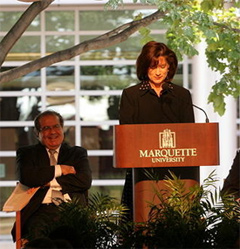
Justice Scalia returned to deliver the keynote address at the dedication of Eckstein Hall on September 8, 2010. He relaxed his strictures on recording, and the entire ceremony can be seen here, with an account of it appearing in the Marquette Law Review. I especially recall this comment of Judge Diane S. Sykes, L’84, in introducing the Justice:
“So we are fortunate, indeed, that this history-making justice has joined us here today as we make a little history of our own. When Dean Kearney unveiled the plans for this beautiful building two years ago, he famously declared that Eckstein Hall will be ‘noble, bold, harmonious, dramatic, confident, slightly willful, and, in a word, great.’ It certainly is. And with the possible exception of harmonious—Justice Scalia has been known to say that one of his charms is that he likes to tell people what they don’t want to hear—the dean’s description of this distinguished and splendid building might likewise be applied to our distinguished and splendid visitor. So, ladies and gentlemen, please join me in welcoming the noble, bold, dramatic, confident, slightly willful, and, and in a word, great Justice Antonin Scalia.”
There are things to learn from the remarks of Justice Scalia and the other speakers that day, including then-Chief Justice Shirley S. Abrahamson, whether in the recording or the law review account linked above. My own recollection of Justice Scalia has appeared in the Milwaukee Journal Sentinel and can be found here.