
The Interstate Commerce Act: A Final Convocation
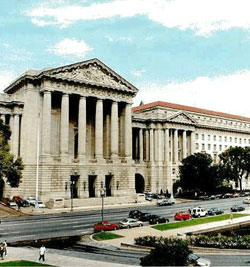 Earlier this year I observed the 125th anniversary of the Interstate Commerce Act, among the most important statutes that Congress has ever enacted. I allowed that a future issue of the Marquette Law Review would publish essays by a number of leading scholars concerning the Act and its legacy. With the summer issue of the Marquette Law Review now out, that future is now.
The remembrance is titled “125 Years Since the Interstate Commerce Act: A Symposium in the Form of a Final Convocation.” As I explain in my Foreword (“The Last Assembly of Interstate Commerce Act Lawyers”), the essays, collectively available at the link at the beginning of this paragraph, are by an impressive collection of scholars:
- James W. Ely, Jr., the emeritus Milton R. Underwood Professor of Law and emeritus Professor of History at Vanderbilt University, recalls “The Troubled Beginning of the Interstate Commerce Act”;
- Randal C. Picker, the Paul and Theo Leffmann Professor of Commercial Law at the University of Chicago Law School, writes of the interplay between the Act and the antitrust law enacted only three years later, in “The Interstate Commerce Act and the Sherman Act: Playing Railroad Tycoon”;
- Thomas W. Merrill, who is Columbia University’s Charles Evans Hughes Professor of Law, discusses the unusual phenomenon of administered contracts in the Act’s regulatory scheme, suggesting that the form of regulation was more impressive than the fact (in “The Interstate Commerce Act, Administered Contracts, and the Illusion of Comprehensive Regulation”);
- Paul Stephen Dempsey, Tomlinson Professor of Global Governance in Air & Space Law and Director of the Institute of Air & Space Law at McGill University, focuses on the ICC as an agency, taking us broadly from its creation to its demise, in “The Rise and Fall of the Interstate Commerce Commission: The Tortuous Path from Regulation to Deregulation of America’s Infrastructure”;
- Richard D. Cudahy, Senior Judge of the U.S. Court of Appeals for the Seventh Circuit (whose scholarly and judicial career was recently celebrated by the Yale Journal on Regulation, but no link is available), points us to the future, sketching the possible relevance of the Interstate Commerce Act’s paradigm for modern debates over regulation (“The Interstate Commerce Act as a Model of Regulation”); and
- James B. Speta, Professor of Law at Northwestern University (and my fellow editor of this symposium), concludes the project with a critical assessment of the Act’s pertinence in an area—namely, telecommunications—with almost as much importance to the twenty-first century as the railroads (which the Act was passed to control) possessed in the nineteenth: “Supervising Discrimination: Reflections of the Interstate Commerce Act in the Broadband Debate.”
Most of these essays are short, and each is an engaging assessment of an act whose legacy can be felt today, not only in the general fact of the administrative state whose creation began with the Interstate Commerce Act but also in specific debates (as Prof. Speta demonstrates) about regulation today. We invite you to read the essays.
 Marquette University Law School and the Milwaukee Journal Sentinel will host a conference next week. The conference title—“Milwaukee’s Future in the Chicago Megacity”—reflects that Chicago is one of the world’s emerging “megacities”; for example, it is ranked No. 6 in Foreign Policy magazine’s Global Cities Index (behind only New York, London, Tokyo, Paris, and Hong Kong).
  Marquette University Law School is fortunate to welcome this week the Hon. Jeffrey S. Sutton of the U.S. Court of Appeals for the Sixth Circuit. Judge Sutton will deliver our annual Hallows Lecture on Tuesday, February 28, at 4:30 p.m. in the Appellate Courtroom of Eckstein Hall. His lecture, titled “Barnette, the Roosevelt Appointees, and the Progressive Embrace of Judicial Review,” focuses on Board of Education v. Barnette, the U.S. Supreme Court’s 1943 decision holding that the First Amendment protected students unwilling on religious grounds to salute the American flag. The 6-3 decision overturned Minersville School District v. Gobitis, a 7-2 decision only three years earlier. Appointees of Franklin D. Roosevelt were central in this drama: Robert H. Jackson wrote for the Court in Barnette, over the dissent of Felix Frankfurter, who had authored Gobitis but found himself abandoned by William O. Douglas and Hugo L. Black. Judge Sutton will discuss how this reversal of course happened so quickly and why it marked a turning point away from the progressive opposition to many forms of judicial review. The lecture is free and open to the public (