
Addicted to the Internet?

Whoa, you like to think that you’re immune to the stuff, oh yeah
It’s closer to the truth to say you can’t get enough
You know you’re gonna have to face it, you’re addicted to [the Internet].

Robert Palmer, Addicted to Love (1986) (more recently covered by Florence & The Machine (2010))

This morning, I awoke and reached for my smartphone to turn off the alarm. Because I already had the phone in my hand, I checked the day’s weather (for both the Madison area, where I live, and Milwaukee, where I work). Then, of course, I had to check email, to see what had come in during the night. And, while I was at it, I took my turn in the eight concurrent games with three different people that I have going on Words with Friends. After that, I finally got out of bed.

According to an article by Tony Dokoupil in the July 16, 2012 issue of Newsweek, that kind of morning makes me just like more than one-third of smartphone users. We are the ones who check our phones before we even get out of bed. Really? Only one-third of us do that? 

Technology has allowed us to be continuously connected to a wider world, and too many of us are tethered to those portals.
Continue ReadingAddicted to the Internet?

Thinking Like a Lawyer Redux

This week, Marquette University Law School welcomed its Class of 2015.  The start of an academic always has an energy to it unlike other times during the year.  Excited and nervous 1Ls begin their journey to their J.D.s, steeped those first couple weeks in what seems like a foreign culture with a foreign language. While they’re not exactly sure what they’re going to learn in those 1L classes, new students do understand, within days of being in Eckstein Hall, that what they will learn is how to “think like a lawyer.”  Whatever that means.  With that, I am reposting something I wrote several years ago that remains important:  “Thinking like a lawyer” is a legal skill, not a life skill.

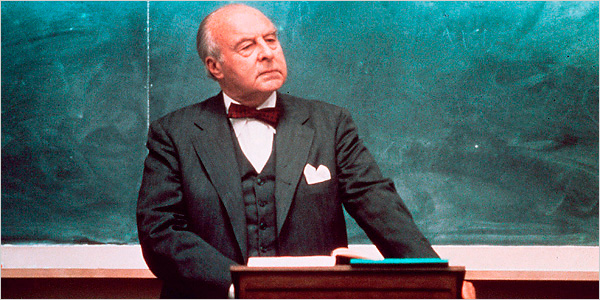
At the start of each academic year, I cannot help but to think of Professor Kingsfield, the notorious contracts professor in The Paper Chase. The various classroom scenes where Professor Kingsfield grills student after student on classic contracts cases like Hawkins v. McGee have for years served as a sort of example of the “typical” 1L experience with the dreaded Socratic method.

While Professor Kingsfield surely sits at one end of the spectrum for professorial style, the Socratic method he uses endures. It is, as one text notes, law school’s “signature pedagogy.” It’s the way the law school professors across the country have been teaching law students about legal analysis for more than a century.

And students learn. They begin their first year of law school with, to paraphrase Professor Kingsfield, “a head full of mush.” Even by the end of that first semester, though, most 1Ls have developed an ability to turn that mush into cogent analysis, to make fine-line distinctions, to look for weaknesses in another’s argument, and to argue both sides of any issue; in other words, they learn to “think like a lawyer.” This “thinking like a lawyer” is undoubtedly a necessary professional skill; however, mastering the process can come at a personal cost.

Continue ReadingThinking Like a Lawyer Redux

Reviewing John Nichols’ Uprising: How Wisconsin Renewed the Politics of Protest, from Madison to Wall Street

What is it that is swelling the ranks of the dissatisfied?  Is it a growing conviction in state after state, that we are fast being dominated by forces that thwart the will of the people and menace representative government?

Robert M. LaFollette, July 4, 1897, Mineral Point, Wis.

With that quote, John Nichols begins the first chapter of his unapologetically biased book Uprising:  How Wisconsin Renewed the Politics of Protest, from Madison to Wall Street (2012). Nichols, The Nation’s Washington correspondent and an associate editor of Madison’s Capital Times newspaper, recounts the protests in Madison and around the state in early 2011 and analyzes their importance in renewing a spirit of protest that spread from Madison to, ultimately, Manhattan.

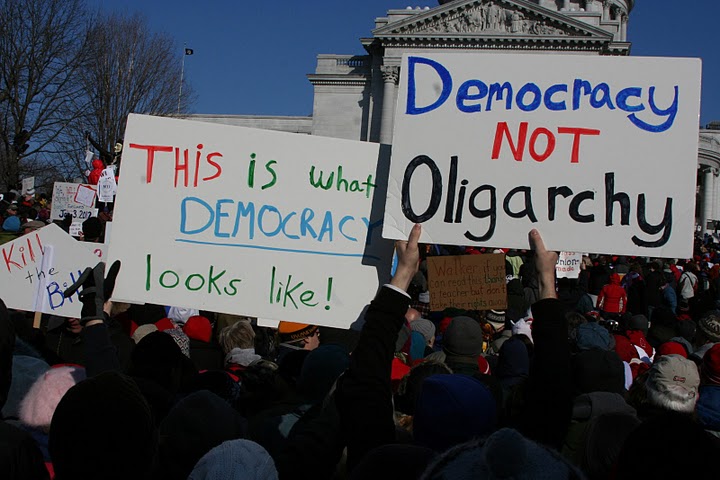
Just as Nichols is not an unbiased author, I am not an unbiased reader. What Nichols writes about brings back vivid memories of weekends around the capitol square, in sun as well as in snow and cold, as part of the massive, diverse, palpably energetic crowds that marched around the square in February and March 2011.  Uprising is not a chronological account of the protests; rather, Nichols organizes thematically, beginning with the beginning:  the cold mid-February day, one day after Governor Scott Walker announced his 144-page budget repair bill that contained provisions that went far beyond repairing the budget to stripping collective bargaining rights of public employees.  On that day, Nichols says, fifty members of UW Madison’s Teaching Assistants’ Association (TAA) gathered in front of UW Madison’s Memorial Union and protested (4).  Two days later, Nichols tells us, more than 1,000 TAA members marched to the capitol. They were joined each day thereafter by hundreds and then thousands of others from all walks of life – union and non-union members, public and private employees alike – and they continued marching.

How and why what fifty or so students started became an incredible historical event is chronicled in Nichols’ subsequent chapters. 

Continue ReadingReviewing John Nichols’ Uprising: How Wisconsin Renewed the Politics of Protest, from Madison to Wall Street