
“Behind the Scenes” of Organizing a Visit by an Appellate Court (Seventh Circuit Day, Part 5)

Seventh Circuit 5
A glimpse into Dean Fodor’s email inbox.

What we hope you saw: An exciting early-semester announcement that oral arguments before the Seventh Circuit would take place in Eckstein Hall on September 25; a smooth registration process; and on the day of, insightful lines of questioning during argument and various post-argument programs designed for students and attorneys to learn directly from the judges whose decisions fill our casebooks and support our federal filings.

But, in the nearly four months preceding, here is what was happening: Emails, meetings, more meetings, drafts upon drafts, games of phone tag, some mistakes, more emails, brisk walks, smiles, notes, and, at the end of the day, a sigh of happiness and, yes, relief.

It goes without saying that putting together a day like September 25 takes work. This is true for all of our big events at the Law School, from orientation to the National Sports Law Institute’s annual conference to PILSgiving to our annual lectures to the Jenkins Moot Court Competition to graduation. Staff and faculty work together to provide a seamless experience for students and guests. In some cases, it starts with a spreadsheet or a checklist from the previous year. The September 25th Seventh Circuit visit, without recent precedent, started with an email.
Continue Reading“Behind the Scenes” of Organizing a Visit by an Appellate Court (Seventh Circuit Day, Part 5)

Appellate Judges Give a Window into How They Do Their Work (Seventh Circuit Day, Part 3)

In two noteworthy ways, the term “dialogue” was central to an event involving four judges of the U.S. Court of Appeals for the Seventh Circuit at Eckstein Hall on September 25, 2025.

Seventh Circuit
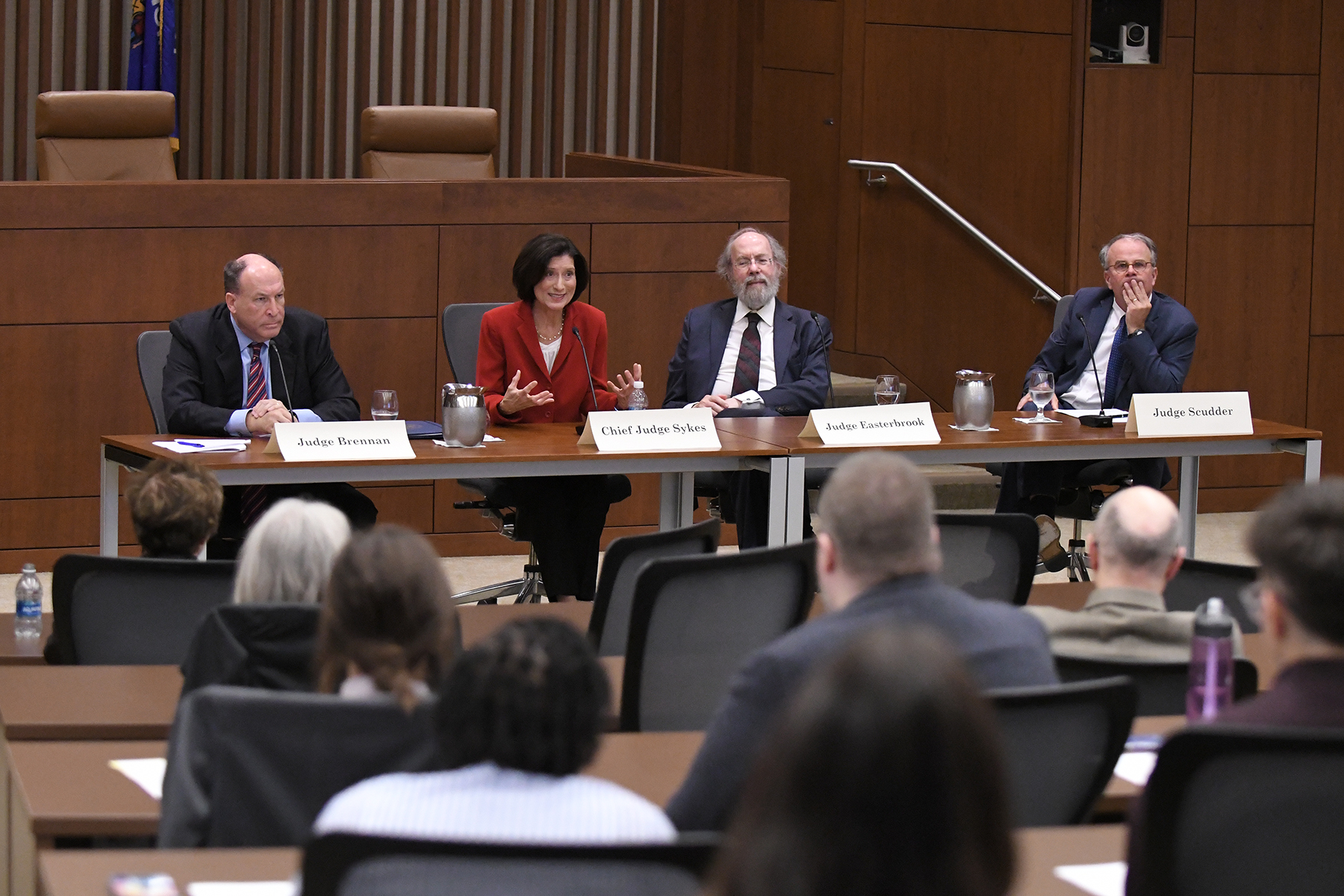
Seventh Circuit Judges Michael Brennan, Diane Sykes, Frank Easterbrook, and Michael Scudder participate in a CLE session at Marquette Law School’s Lubar Center on Sept. 25, 2025.

A daylong visit by Seventh Circuit judges to Marquette Law School had multiple components. It included a morning session in the Law School’s Lubar Center in which the court heard arguments on six cases; a midafternoon program in which the judges discussed their work with an audience of Marquette law students; and an end-of-day reception which included a recognition of the Hon. Diane S. Sykes, L’84, as she completed her term as chief judge of the Seventh Circuit and assumed senior status (the next blog post in this series will say a few words about that event).

Even beyond all of this, the day included a late-afternoon CLE panel discussion program, before about 200 lawyers in the Lubar Center. It was titled “Judges on Judging: A Window into Appellate Decision Making” and moderated by Marquette Law School Professor Chad Oldfather.

That is the first reason to use the term “dialogue.” The relatively informal program offered a chance to hear collegial conversation among Chief Judge Sykes and Judges Frank H. Easterbrook, Michael B. Brennan, and Michael Y. Scudder about how they approach cases that come before them.

Continue ReadingAppellate Judges Give a Window into How They Do Their Work (Seventh Circuit Day, Part 3)

Effective Appellate Advocacy: Advice from the Bench (Seventh Circuit Day, Part 2)

7th Court
Professor Anne Berleman Kearney (left) moderates a question-and-answer session for students with Seventh Circuit Judges Michael Brennan, Diane Sykes, Frank Easterbrook, and Michael Scudder in Marquette Law School’s Lubar Center on Sept. 25, 2025.

What constitutes effective appellate advocacy? As part of Seventh Circuit Day in Eckstein Hall on September 25, 2025, Marquette Law School students heard answers firsthand from a group of judges of the U.S. Court of Appeals for the Seventh Circuit. These were Chief Judge Diane S. Sykes and Judges Frank H. Easterbrook, Michael B. Brennan, and Michael Y. Scudder. (Judge Brennan became chief judge a few days later, on October 1, upon Judge Sykes’s taking senior status.) Earlier in the day, students attended oral arguments before the court in the Law School’s Lubar Center, as described by Dean Kearney in the first of this series of blog posts. Those attending the midafternoon Q&A session, moderated by Professor Anne Berleman Kearney, were primarily upper-level students taking Appellate Writing and Advocacy.

Chief Judge Sykes started the discussion by stating that briefs are 95 percent of persuasive advocacy on appeal. Oral argument then amplifies, tests, and probes the strengths and weaknesses of the parties’ arguments. First, regarding the factual history in a brief: tell the facts in a story form. Make the factual narrative efficient, readable, and quickly understandable. Judges are generalists who need to ramp up quickly on the facts and procedural history. The facts should read like a good magazine article. Second, regarding the argument: select issues carefully. Pick the most salient issues. Present a well-organized package for pivot points that may be decisive. Help a court understand why the rule advocated for is the right one.

Continue ReadingEffective Appellate Advocacy: Advice from the Bench (Seventh Circuit Day, Part 2)