That Extra Incentive

Most of us are familiar with wellness programs—programs sponsored by our employer or health plan that try to incentivize us to eat healthier, sleep well, and get more exercise.  If you’re anything like me, it helps to have that extra push or incentive, especially around the holidays when sweets abound, to stay on track—or at least, to not stray too far from health goals. Most of these programs have the added advantage of lowering health care costs, both by providing financial incentives to reduce immediate costs to the individual employees and by boosting the overall health of the employees as a whole, which could reduce future health care costs.   However, extensive technical regulations and recent litigation by the AARP make implementing health and wellness programs increasingly tricky for employers.

Title II of the Genetic Information Nondiscrimination Act of 2008 (“GINA”) and the regulations promulgated by the U.S. Equal Employment Opportunity Commission (the “EEOC”) thereunder, generally prohibit “an employer [from] request[ing], require[ing], or purchas[ing] genetic information [which includes an individual’s family medical history] with respect to an employee or a family member of the employee.”  42 U.S.C. § 2000ff–1(b). However, there is an exception for wellness programs, as long as employers jump through a set of hoops. 29 CFR § 1635.8(b)(2).  While not without its own problems and excesses, the exception in the EEOC regulations at least allows employers to provide incentives to those employees willing to participate in employer-sponsored wellness programs.

The AARP doesn’t like this whole “incentive” idea to begin with. It recently filed a lawsuit against the EEOC in an attempt to vacate the regulations entirely.  AARP v. U.S. Equal Employment Opportunity Commission, No. 1:16-cv-02113 (D. D.C. 2016) (hereafter the “AARP Complaint”).  This actually might not be a bad idea, except for the fact that the AARP thinks that the regulations do not have enough hoops.  In fact, the AARP would prefer that the regulations abolish any permission for any incentives or penalties to induce participation in employer-sponsored wellness programs. The AARP alleges in its complaint that all employer incentives or penalties to induce participation in employer-sponsored wellness programs violate Title I of the ADA and Title II of GINA.  AARP Complaint at 3

Continue ReadingThat Extra Incentive

Court Wrestles With Vagueness and Retroactivity in Sentencing Context

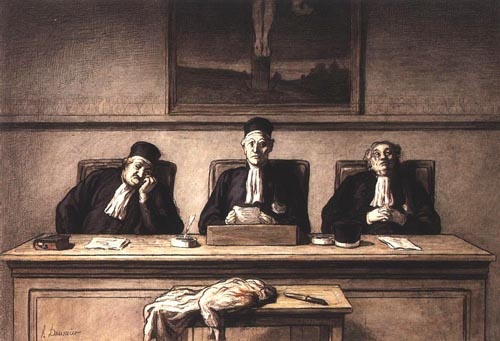
honore%20daumier%20-%20le%20proveYesterday’s oral argument in Beckles v. United States found the justices wrestling with retroactivity and vagueness in the context of the U.S. Sentencing Guidelines. The petitioner, Travis Beckles, questioned the constitutionality of the residual clause of the career-offender provision in Section 4B1.2 of the guidelines after the Supreme Court, in Johnson v. United States, found an identically worded residual clause in the Armed Career Criminal Act to be unconstitutionally vague. Beckles asked the court to rule first on whether a favorable ruling on the constitutional question – on which he and the government agree — would be retroactive on collateral review. Even if the court were to find in favor of Beckles on both counts, he could still lose because of a unique interplay between the career-offender guideline and the guideline commentary, which specifically declared his offense – possession of a sawed-off shotgun – to be a crime of violence.

With her opening question, Justice Ruth Bader Ginsburg forced Janice Bergmann, representing Beckles, to focus on the third issue in the case: the relationship between the guidelines’ residual clause and the commentary, which specifically listed Beckles’ offense of conviction as a crime of violence. A number of justices took issue with Bergmann’s assertion that the commentary cannot define “shapeless” language, a term taken from Johnson. After all, they noted, the guideline commentary, at least in part, interpreted the residual clause, presumably providing meaning in that manner. They also questioned whether the commission was not in the best position to clarify its own language. Bergmann responded that the guideline language was not the commission’s, but rather was drawn from the ACCA residual clause. Any interpretation and examples offered by the commission, she argued, would therefore be arbitrary.

Justice Samuel Alito was the first to direct the argument to the question of what vagueness would mean in a guideline-free world. Along with Justice Stephen Breyer, Alito reminded Bergmann that pre-guideline sentencing appears substantially more vague and arbitrary than the residual clause, as do many of the current guideline provisions. In response, Bergmann asserted that the guideline residual clause is unique among those provisions because of its identity with the ACCA residual clause, and that it shares the same characteristics embodied in the categorical approach that ultimately caused the court to declare the ACCA provision void for vagueness.

Chief Justice John Roberts and Justice Anthony Kennedy continued along similar lines by pointing to the decrease in vagueness any guideline, even a vague one, would provide as compared to the previous system of discretionary sentencing. Why, they asked, should greater precision lead to greater vagueness?

Continue ReadingCourt Wrestles With Vagueness and Retroactivity in Sentencing Context

Judicial Challenges to the Collateral Impact of Criminal Convictions: Is True Change in the Offing?

galler_hornsgatan_2012aMy recent article, “Judicial Challenges to the Collateral Impact of Criminal Convictions: Is True Change in the Offing?,” examines judicial decisions that reflect an increasing dissatisfaction with harsh criminal penalties and severe collateral consequences for nonviolent offenders.  Here is the abstract:

Judicial opposition to disproportionate sentences and the long-term impact of criminal records is growing, at least in the Eastern District of New York. With the proliferation and harshness of collateral consequences and the hurdles in overcoming a criminal record, judges have asked for greater proportionality and improved chances for past offenders to get a fresh start. The combined impact of punitiveness and a criminal record is not only debilitating to the individual but also to their families and communities. A criminal case against a noncitizen who will be subject to deportation and a decade-long ban on reentry and three different requests for expungement will demonstrate how three federal judges struggled with the long-term effects of the current sentencing and collateral consequences regime. These cases exemplify both judicial creativity and judicial impotence, as the courts have to call upon the support of other actors within the executive and legislative branches for change, in these individual cases and systemically.

These judicial critics of the current approach argue within an emerging normative framework that is coming to dominate the societal discourse on punishment. Increasingly some offenders are deemed “worthy” of receiving our assistance in reintegration. They are generally nonviolent first offenders, those with an unblemished record save for the offense of conviction, those who have been gainfully employed or desperately want to work, and those who have cared for their children. They present no danger to the community, and their continued punishment may negatively impact them, their surroundings, and ultimately the country. On the other hand, those labeled violent or sex offenders or terrorists are being considered dangerous, unredeemable, and deserving of the harshness the criminal justice system has brought to bear on them. The specific categorization of offenses, the definitions of terms, and the categorization of offenders remain fluid, contingent, and subject to constant revision. Still, these judicial efforts expand on the incipient efforts at full reintegration of some of those with a criminal record. Whether their challenges will resonate with their colleagues and in other branches of government remains to be seen.

A full copy of the article can be downloaded at the New York University Law Review Online.

Nora Demleitner is the 2016 Boden Visiting Professor at Marquette University Law School.

Continue ReadingJudicial Challenges to the Collateral Impact of Criminal Convictions: Is True Change in the Offing?