
Murder and Milwaukee

Sunday on my statewide television show UpFront, I asked Milwaukee Police Chief Ed Flynn a simple question. Given the recent rash of shootings and homicides in Milwaukee, what would he say to out-state residents who might be wondering whether the city is safe?

“As long as they’re not coming here to engage in crime,” the Chief responded, “they’re safe.” Flynn said Milwaukee has one of the safest big-city downtowns in the country, but it also has a well-armed criminal community. According to the chief, 85 percent of Milwaukee’s victims and 95 percent of its offenders in gun-related cases have significant criminal records.

To address the spike in violent crime, Flynn and Mayor Tom Barrett asked the state to kick-in $500,000 for additional police overtime. But their suggestion didn’t get a warm reception from Assembly Speaker Robin Vos. In an interview with WisconsinEye’s Steve Walters, Vos criticized how city officials were running the department, and said the strategy to combat violence in Milwaukee isn’t working.

Nearly two dozen shootings in a week. Seven gun-related murders in seven days. The recent events have led to a fierce public debate. Was Milwaukee well on its way to becoming Detroit? Had police strategies to combat violent crime failed? Or was Milwaukee no different from many other big cities which have experienced similar spikes in crime?
Continue ReadingMurder and Milwaukee

Milwaukee Arrest Trends, 1980-2011 — Part Three: Chicago Comparisons

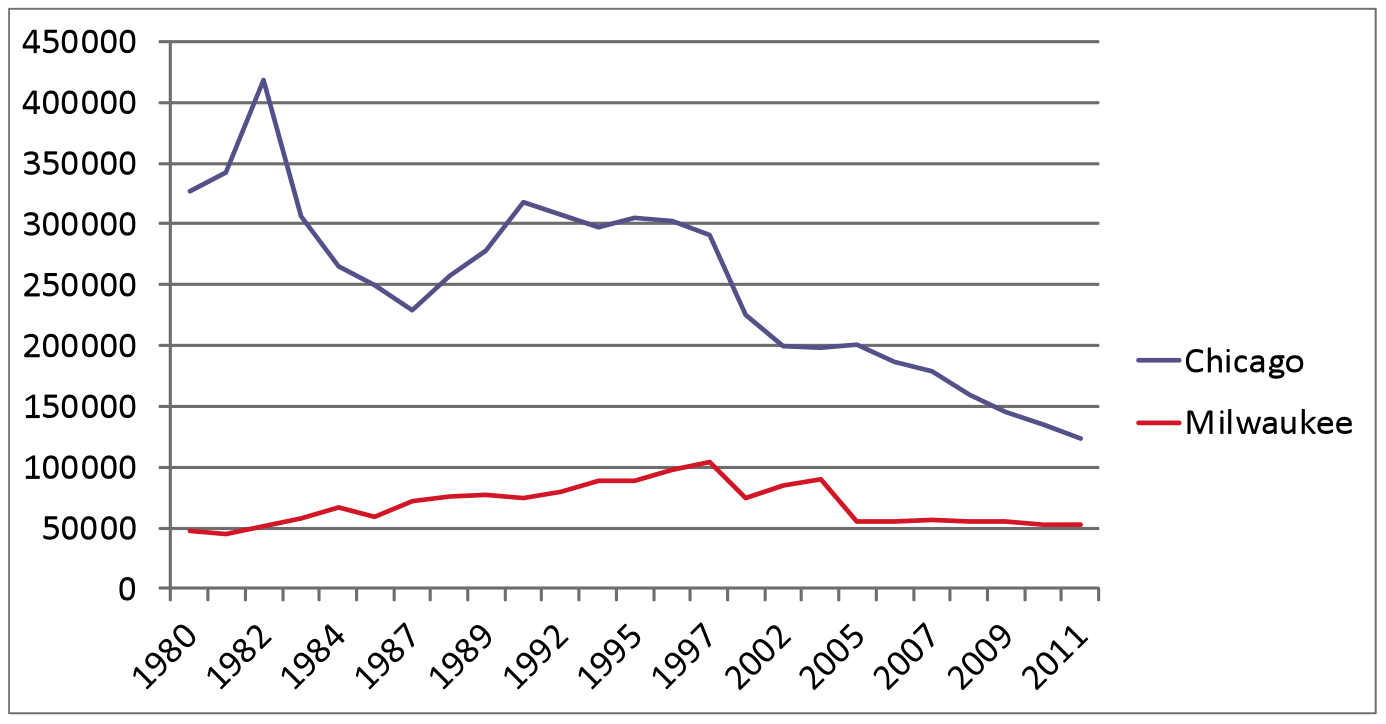
Chicago’s population is about 4.5 times larger than Milwaukee’s, but, surprisingly, the arrest totals in the two cities have been slowly converging for many years.  Here are the numbers reported to the FBI since 1980 (omitting a handful of years in which one city or the other did not report arrests):

two city totals


To some extent, the convergence may result from underlying crime trends in the two cities.

Continue ReadingMilwaukee Arrest Trends, 1980-2011 — Part Three: Chicago Comparisons

Arrest Trends in Milwaukee, 1980-2011 — Part Two

In the first post in this series, I compared black and white arrest rates in Milwaukee over time. In this post, I present arrest data by offense type.

In 2011, the seven leading arrest offenses were disorderly conduct, “other assault” (i.e., not aggravated assault), drug possession, theft, vagrancy, vandalism, and weapons possession.  Together, these seven offenses accounted for more than 53 percent of all Milwaukee Police Department arrests.  This amounts to almost exactly ten times the number of arrests for the violent “index crimes” — the most serious violent offenses that dominate media coverage of the criminal justice system (homicide, robbery, forcible rape, and aggravated assault).  To get a more realistic sense of the day-in-day-out work of the system, it may be helpful to appreciate that for every homicide arrest you see in the news, there are 123 arrests for disorderly conduct and 47 arrests for simple drug possession — nearly all of which fly well below the media radar screen.  It is an interesting question to what extent these lower-level arrests contribute to public safety.

These offense distributions do not differ much by race.  The first pie chart below indicates the distribution of the Big Seven arrest offenses among blacks; the second provides the distribution among whites.  

Continue ReadingArrest Trends in Milwaukee, 1980-2011 — Part Two