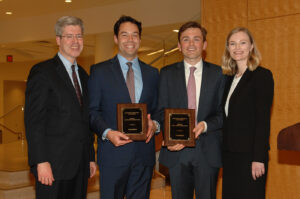
Jenkins Competitors Advance to Quarterfinals

This weekend the Law School hosted our Jenkins Honors Moot Court Competition in person for the first time since 2019. Congratulations to the students advancing to the quarterfinal round:

Team 1: Nicole Jennings & Fefe Jaber
Team 2: Bailey Groh Rasmussen & Aimeé Treviño
Team 4: JP Curran & Matt Kass
Team 6: Jake Apostolu & Hunter Cone
Team 7: Jessica Zimpfer & Emily Ward
Team 9: Meg Wallace & Robyn Shepard
Team 10: Samantha Jozwiak & Kyle Kasper
Team 13: Travis Goeden & Ruth Nord-Pekar

Continue ReadingJenkins Competitors Advance to Quarterfinals

GOP Appeal in Wisconsin Redistricting Case Could Have Far-reaching Impact—If U.S. Supreme Court Takes It Up  

This blog post continues the focus of the Law School’s Lubar Center on redistricting

A Republican appeal of the Wisconsin Supreme Court’s legislative redistricting decision earlier this month could have national significance for the federal Voting Rights Act, according to a Marquette University law professor. To that extent, at least, others agree.

If the U.S. Supreme Court rules in favor of GOP state lawmakers, the federal justices could allow so-called “race-neutral” redistricting nationwide, says Marquette Professor Atiba Ellis, who has written about the landmark 1965 civil rights law. Combined with previous high court decisions reducing the strength of other parts of the Voting Rights Act, such a ruling would amount to “erasing the efforts of Reconstruction” and going back to a time before the 15th Amendment to the U.S. Constitution extended voting rights to people of color, Ellis fears.

“That’s my worst-case scenario,” he says.

Not all agree, of course, and much is uncertain or debatable, even the timing: The U.S. Supreme Court might hold off on a decision until after the fall elections, allowing a map drawn by Democratic Gov. Tony Evers and approved by the state supreme court to be used for those contests, says Robert Yablon, associate professor of law at the University of Wisconsin.

Or the justices might refuse to take up the appeal at all, says Mel Barnes, an attorney at Law Forward, the legal organization that is representing three voting rights groups in the case.

Continue ReadingGOP Appeal in Wisconsin Redistricting Case Could Have Far-reaching Impact—If U.S. Supreme Court Takes It Up  

Au Revoir To Kill a Mockingbird

A photo of the cover of "To Kill a Mockingbird"My oldest daughter teaches bilingual English in a City of Milwaukee high school, and I greatly enjoy our conversations regarding the literary works she assigns.  However, I was surprised when she told me recently that she and her fellow teachers no longer felt comfortable assigning Harper Lee’s Pulitzer Prize-winning To Kill a Mockingbird.

Published in 1960, Lee’s novel has for over sixty years garnered great admiration and respect as an American literary work.  Many have considered the novel’s Atticus Finch to be an inspiring lawyer hero and taken the novel’s law-related narrative to be one of courageous resistance to racial injustice.  As recently as ten years ago, virtually every American high schooler was expected to have read To Kill a Mockingbird Bird.

Why has the novel fallen so precipitously?  I can think of at least three developments that have hurt its standing:

Continue ReadingAu Revoir To Kill a Mockingbird