Welcome to Greg Helding, Our Guest Blogger for July
 Many thanks to our June guest, Jack Vrett ’09. Our July guest is Greg Helding ’14.

Many thanks to our June guest, Jack Vrett ’09. Our July guest is Greg Helding ’14.
 A year ago, the ABA featured an article titled “Flunking Civics: Why America’s Kids Know So Little.”
The article starts out with some alarming results from a survey that assessed the teaching of civics across the country:
Only one state deserved a rating of A when it came to teaching its students American history, according to a recent study. Most states fall in the category of ‘mediocre to awful.’
The study ranked history standards in 49 states and the District of Columbia (Rhode Island has no mandatory history standards, only suggested guidelines) for ‘content and rigor’ and ‘clarity and specificity’ on a scale of A to F. Only South Carolina got straight A’s.
Nine states’ standards earned a grade of A- or B. But a majority of states—28 in all—had standards ratings of D or F, the study found.
To test your knowledge of civics, take this sample practice civics test.
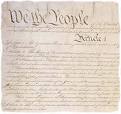 One of the side-debates in the ACA decisions yesterday was between Chief Justice Roberts and Justice Ginsburg over the meaning of the term “regulate.” The Commerce Clause of the Constitution, Art. I, sec. 8, cl. 3, empowers Congress “[t]o regulate commerce . . . among the several states . . . .” Much of the pre-decision debate over the ACA mandate involved whether mandating the purchase of a service — health insurance — fell within the definition of “commerce.” This is where the famous “activity/inactivity” distinction arose: choosing not to buy something is not “commerce,” the argument went, and therefore not within Congress’s Commerce Clause powers.
Chief Justice Roberts didn’t exactly adopt that argument, however, in his opinion denying that Congress had Commerce Clause authority to mandate the purchase of health insurance. (I’m not an expert on Supreme Court voting rules, but there’s considerable debate about whether, even though five justices said the mandate was beyond the Commerce Clause, that’s actually a binding holding of the court.) Instead, what Roberts held was that mandating the purchase of health insurance isn’t regulation:
The language of the Constitution reflects the natural understanding that the power to regulate assumes there is already something to be regulated. . . . The individual mandate, however, does not regulate existing commercial activity. It instead compels individuals to become active in commerce by purchasing a product,on the ground that their failure to do so affects interstate commerce. Construing the Commerce Clause to permit Congress to regulate individuals precisely because they are doing nothing would open a new and potentially vast domain to congressional authority.
Nat’l Fed. of Indep. Bus., slip op. at 19, 20. This is a novel twist on the argument. Chief Justice Roberts is clear that he is not rejecting the idea that choosing not to buy health insurance affects commerce, at least in the same way that Filburn’s growing the wheat his family consumed affected commerce. It’s that a law forbidding individuals from making a choice not to do something doesn’t regulate commerce.
To an economist, perhaps, there is no difference between activity and inactivity; both have measurable economic effects on commerce. But the distinction between doing something and doing nothing would not have been lost on the Framers, who were “practical statesmen,” not metaphysical philosophers. . . . The Framers gave Congress the power to regulate commerce, not to compel it, and for over 200 years both our decisions and Congress’s actions have reflected this understanding. There is no reason to depart from that understanding now.
Perhaps I am missing something (a good friend of mine evaluated my argument below as follows: “Meh”), but I don’t see how this can be right.