
Over the past 20 years, the number of cases processed by Milwaukee’s Municipal Court fell dramatically. In the late 2000s, the court’s annual caseload fluctuated between 130,000 and 160,000, but during the past three years, the annual number of cases has remained well below 40,000. Cases fell by 72% for adults and 94% for children between 2006 and 2025.
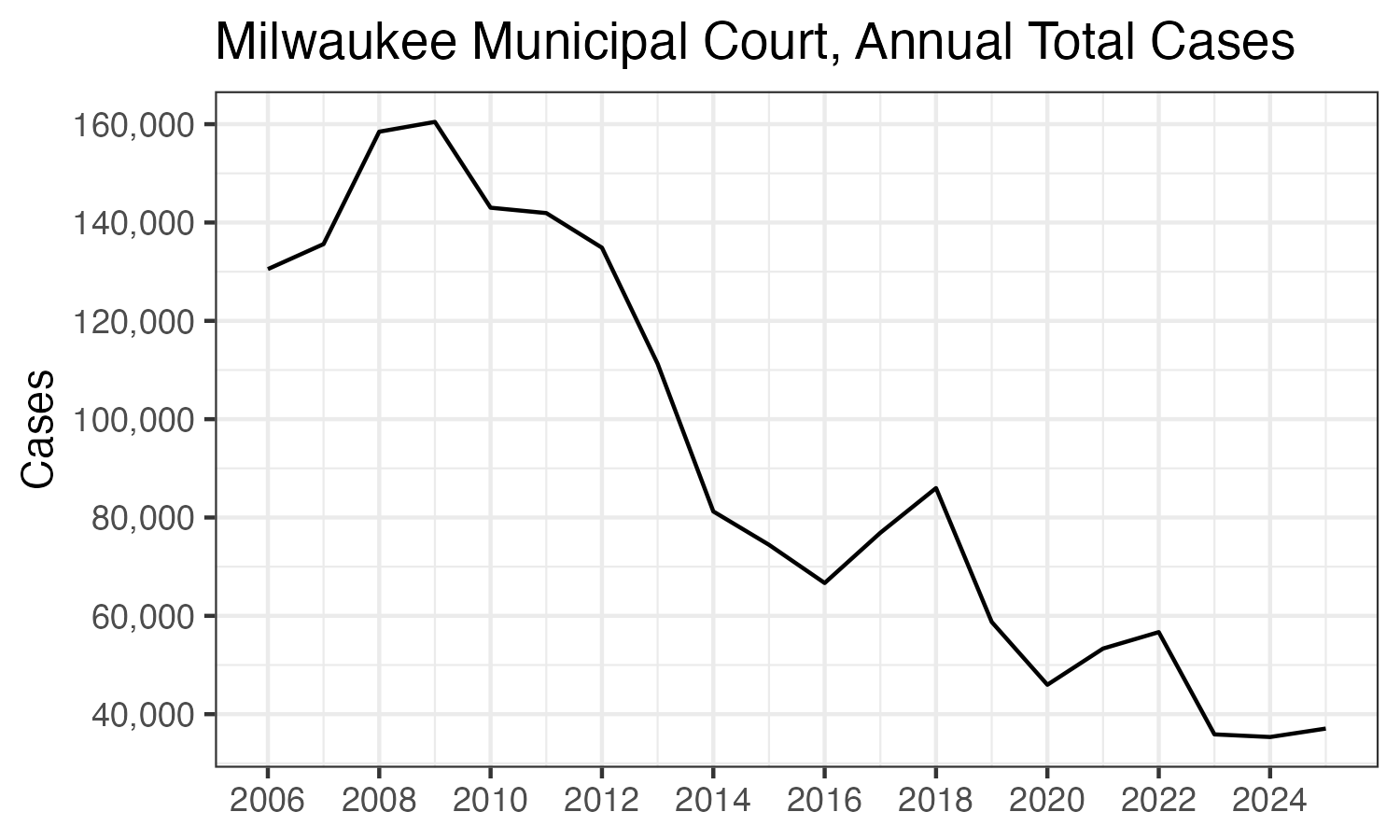
My colleague Mike Gousha and I unpack the municipal court statistics, all of which are taken from the court’s official annual reports, in a new article for the Milwaukee Journal Sentinel. A fuller accounting of the court’s data is available in this report: Milwaukee Municipal Court’s Caseload, 1999 – 2025.
In Wisconsin, municipal courts hear civil matters that do not necessarily rise to the level of a criminal misdemeanor. These include offenses against municipal ordinances and almost all traffic violations. To quote the Wisconsin court system’s website, “The majority of municipal court cases involve traffic, parking, and ordinance matters, including first-time drunken driving offenses. Juvenile matters, such as truancy, underage drinking, drug offenses and curfew violations are also a significant part of municipal court caseloads.”
Unlike in circuit court, where police can recommend charges but a district attorney makes the ultimate charging decision, in municipal court, citations (or “tickets”) automatically become a municipal court case when submitted by the filing agency. Paying a ticket by mail or online is equivalent to pleading guilty or “no contest” in the case. In this way, municipal court caseloads more directly reflect decisions made by the filing agency, which is to say the local police department in most instances. (While Milwaukee’s municipal court does handle cases brought by, for instance, local health departments and building inspectors, the great majority of their case volume involves police matters).
Gousha and I connect the sharp drop in municipal court cases to the shift away from “broken windows” policing and the fallout from a series of abuse scandals involving Milwaukee Police Department (MPD) officers. It coincides with other changes in the way the department operates. In 2024, the Wisconsin Policy Forum’s Arresting Developments report noted that arrests by MPD fell from 51,000 in 2012 to 9,000 in 2023. Traffic stops fell from 150,00 in 2015 to 28,000 in 2023. And subject (pedestrian) stops fell from 46,000 in 2015 to about 700 in 2023.
Meanwhile, the volume of charges for criminal offenses referred to circuit court by MPD has remained comparatively stable, or even increased slightly. In 2010, the department referred about 12,000 felony and 16,000 misdemeanor charges to the DA, according to agency records. In 2024, they referred 14,000 felony charges and 19,000 misdemeanors.
As Gousha and I ask in our piece, “Has the pivot away from broken windows gone too far and made some neighborhoods feel less safe? Or is reducing discretionary police-citizen interactions and focusing on more serious, reported crimes a better use of police resources?”
Opinions on these and related questions will differ, but we hope our article sheds light on an important change in how MPD approaches its job in Milwaukee.