
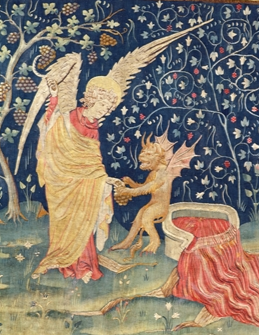
The Grapes of Roth

My latest article, “The Grapes of Roth,” has just come out in print in the Washington Law Review. In it, I argue that copyright law passed through at least three important phases over the course of the last century, in which judges struggled in different ways with the process of how to determine whether two works are infringing. This periodization of copyright decision-making is, I believe, insufficiently appreciated; copyright lawyers, scholars, and students tend to read cases from any era as going about the decision-making process in the same way. The goal of the article is to focus more attention on how decision-making has varied over time, and to at least begin the discussion of which era’s procedure is closer to optimal.

The title is a reference to the old copyright chestnut Roth Greeting Cards v. United Card Co., in which the majority concluded that infringement was the right call based on the shared “total concept and feel” of the plaintiff’s and defendant’s greeting cards. The “total concept and feel” standard from Roth is one that copyright lawyers love to hate. The phrase is nearly meaningless: concepts are explicitly excluded from protection under 17 U.S.C. § 102(b), and copyrighted works are distinct from any physical embodiment, meaning they have no “feel.” The influential Nimmer treatise has for decades reproached the standard as “invit[ing] an abdication of analysis.”

So why is it so popular? Judges seem to have no qualms about using it, no matter what the commentariat says. They have cited it regularly as the standard for infringement in cases involving non-identical works from the 1980s to the present day. Indeed, it has found its way into jury instructions: juries are commonly told, without further elaboration, that two works are infringing if one was copied from the other and they share the same “total concept and feel.” The answer to this puzzle, I argue, sheds light on the transition from the first phase to the second, and reveals the trap sprung (or the “grapes” pressed) in the third.

Over the next several days I’m going to serialize the article here. I’ll cover in somewhat less detail (but with more images!) the three historical phases I identify, and then wrap up with a concluding post on whether those phases are limited to copyright law.
Continue ReadingThe Grapes of Roth

Marquette Hosts 2023 Junior Faculty Workshop

Last weekend, it was my privilege to participate in the Law School’s Ninth Annual Junior Faculty Works-in-Progress Conference. I look forward to this event every year, when we invite a group of scholars at the outset of their legal academic careers to present draft papers to each other and to commenters from the Marquette faculty, followed by an hour of nonstop feedback and discussion. The energy of these workshops is illustrated by the fact that in our last couple of sessions, participants were slamming their cards down on the table like Jeopardy contestants to grab a top spot in the comment queue!

This year we had a fabulous group of participants:

  • Julie Campbell, Faculty Fellow at the Jaharis Health Law Institute at DePaul University College of Law;
  • Jade Craig, Assistant Professor at Nova Southeastern University Shepard Broad College of Law (currently visiting at the University of Mississippi);
  • Alexandra Fay, Richard M. Milanovich Fellow at the Native Nations Law and Policy Center at UCLA School of Law;
  • Meredith Filak Rose, Senior Policy Counsel at Public Knowledge;
  • Jordana Goodman, Assistant Professor at Chicago-Kent College of Law;
  • Jason Reinecke, Assistant Professor at Marquette University Law School; and
  • Lauren Roth, Assistant Professor at Touro Law Center.

Commenters from Marquette included Prof. Christine Chabot, Prof. Alex Lemann, Prof. Michael O’Hear, and Prof. David Papke. The workshop was organized by Associate Dean Nadelle Grossman, Professor Kali Murray, and myself, with the expert assistance of Stephanie Danz, Jourdain LaFrombois, Ben Manske, and the Facilities student workers.

It is a wonderful opportunity for the law school to bring together such a talented group of legal scholars from a wide variety of backgrounds and fields that ordinarily would not be in close conversation with each other, and to be able to offer constructive feedback at a stage when it could have a meaningful impact. Thanks to everyone for participating!

Continue ReadingMarquette Hosts 2023 Junior Faculty Workshop

Alan Latman and the Modern Fair Use Doctrine

The AWF oral argument was yesterday morning — here’s SCOTUSBlog’s recap — but I’ll save my thoughts on it for later. At the end of my last post, I had reached the 1950s. At that time, the term “fair use” was being used in a desultory way to refer to all instances of noninfringement, whether due to limitations on the scope of copyright or some sort of exception. As Arthur Weil put it, “‘fair use’ simply means a use which is legally permissive.”

That was where things stood when the Copyright Office, in 1955, began to conduct a series of studies to pave the way for a thorough-going revision of the 1909 Copyright Act. The 1909 Act contained no reference to fair use at all; the doctrine was entirely a judicial creation. So one question was whether a new, revised copyright act should take official notice of fair use, and if so, what it should say.

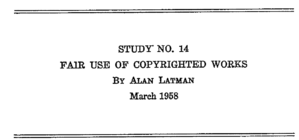
The “fair use” study was assigned to a young attorney, Alan Latman, then a rising star in the copyright field. Latman’s report was one of the key founding documents for what eventually became Section 107 of the 1976 Copyright Act, the fair use statute that we have today, and has been cited repeatedly by the Supreme Court in its attempts to divine the contours of fair use.

In his report, Latman immediately identified a significant problem with “fair use”: what courts were referring to as a single concept was in fact two different things.

Continue ReadingAlan Latman and the Modern Fair Use Doctrine