
The Supreme Court and the Fate of the Ministerial Exception

In 1999, Cheryl Perich began service as a lay teacher at the Hosanna-Tabor Evangelical Lutheran Church and School in Redford, Michigan.  A year later, she became a “called teacher,” selected by the congregation to serve as a commissioned minister and charged with duties of a more pastoral nature, such as teaching religion classes, leading the students in devotional exercises, and participating in weekly chapel functions, though continuing to teach predominantly secular subjects.

In June 2004, however, Perich developed symptoms of a medical disorder, eventually diagnosed as narcolepsy. Despite obtaining in February 2005 a doctor’s certification of her ability to return to work, the school had already made alternative arrangements and proposed that she resign her call. After she threatened legal action for alleged disability discrimination, the congregation then rescinded her call and she was duly terminated from her teaching position at the school.

Continue ReadingThe Supreme Court and the Fate of the Ministerial Exception

The Constitutional Right of Recall

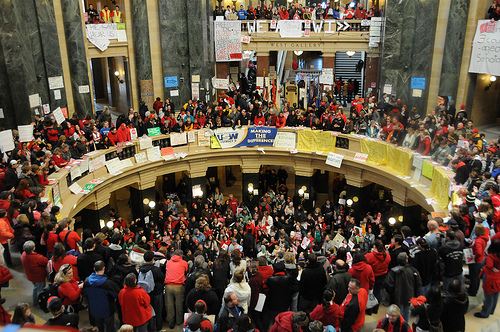
The largest newspaper in Wisconsin, the Milwaukee Journal-Sentinel, continues to take the editorial position that the public’s right to recall elected officials should only be exercised in cases of misfeasance in office or of criminal conduct.  The editorial page actively disparages the use of the recall process in cases where voters simply disagree with the policy choices of their elected representatives.  Recent examples of this editorial position can be seen here, and in the decision to excerpt a similar editorial published by the newspaper USA Today here.  On this past Sunday, Steven Walters commented in the Journal-Sentinel on possible amendments to the Wisconsin Constitution intended to modify the existing recall provisions and to bring them into line with the more limited scope advocated by these editorials.

I have commented on this issue before.   The editorial position of the Milwaukee Journal-Sentinel is misguided.  In particular, in editorializing against the exercise of the recall power, the Journal-Sentinel fails to account for both the specific text of the Wisconsin Constitution and the understanding of the recall power among the founding generation of our country.  The key to understanding the proper scope of the recall power is the basic conception of “the sovereignty of the people.”

Continue ReadingThe Constitutional Right of Recall

The Constitutional Equality of Women

For young women coming of age today, their equality with men seems assured.  As youngsters they’ve played on co-ed sports teams; they’ve often been more successful than boys in school; they’ve pursued careers in previously male-dominated fields like math and science, medicine and law.  For them, women have always been able to vote, abortion has always been legal, and women have reached high places in politics.  Many probably have mothers (and fathers) who came of age during and after the second wave of feminism, believing they would raise their daughters to believe in their capacity to be equal citizens.

It might surprise some women, then, to learn that women’s equality is not guaranteed, at least not constitutionally.

Continue ReadingThe Constitutional Equality of Women