
Another Law Gone Wrong

I’m not sure if this meets the precise definition of a “law gone wrong,” but in my home state of Virginia it is illegal “to hunt or kill any wild bird or wild animal, including any nuisance species, with a gun, firearm or other weapon on Sunday, which is hereby declared a rest day for all species of wild bird and wild animal life.”

Although I was born into a family of church-going hunters, I was always more sympathetic to the church part than to the hunting part.  Consequently, I have no problem whatsoever with Sunday, or any other day for that matter, being declared a day of rest for wild animals (or at least a day on which they cannot be killed).

What I find peculiar (and wrong) is the statute’s one exception:  day of rest notwithstanding, raccoons can be hunted and killed in Virginia on Sundays, so long as the hunting is done between midnight and 2:00 a.m.  (I am not making this up.  If you doubt this, check out Va. Code § 29.1-521(A)(1).)

Because of their semi-domesticated qualities, especially when young, raccoons have always been my favorite wild animals.  But even without this affection, I would like to think that I would find it unfair, and  maybe even unconstitutional in some sublime sense, that one species of woodland animal would be deprived of 1/12 of its statutory day of rest.

Can such a classification purport to have a rational basis?  After Romer v. Evans and United States v. Virginia, I think not.
 

Continue ReadingAnother Law Gone Wrong

The Unitary Governor

“The executive power shall be vested in a governor” proclaims Article V, Section 1 of the Wisconsin Constitution. Over the course of the past two decades, there has been a tremendous amount of legal scholarship about the “unitary executive theory,” based on the executive vesting clause of Article 3, Section 1 of the U.S. Constitution: “The executive Power shall be vested in a President of the United States of America.” Thus far, this scholarship and its accompanying cases (see especially Justice Scalia’s dissent in Morrison v. Olson) has focused entirely on the presidency, but the legal principles are virtually identical.

All of this bears on two recent news stories: first, regarding Governor Walker’s bill requiring executive review of administrative rulemaking, and second, the budget repair bill’s adjustment of several positions in the executive branch from civil service to gubernatorial appointment.  The February bill on administrative rules requires that all regulations from state agencies be reviewed by the governor’s office before entering into force. Democrats opposed this bill on the grounds that it violates the “separation of powers,” the proper relationship between the executive, legislative, and judicial branches. State Senator Lena Taylor objected that the bill “breaks down the wall of independence around independent agencies.”  More recently, this week Democrats slammed the budget repair bill’s reclassification of several positions from civil service to gubernatorial appointment.

Continue ReadingThe Unitary Governor

The Morning After: Lessons From the Wisconsin Budget Battle

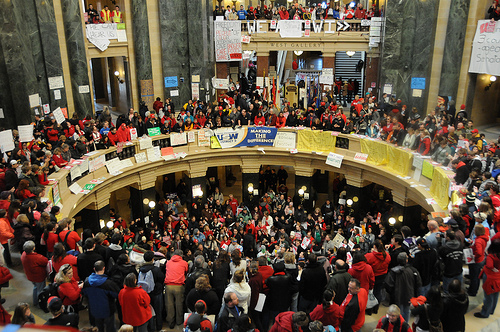
At last the end game has arrived for the budget bill, after more than three weeks of deadlock in Madison.  Indeed, it was obvious to everyone that the impasse could not persist, and that the only two options available were either a compromise (unlikely) or the eventual adoption of Governor Walker’s bill intact.

Wisconsin’s largest newspaper, the Milwaukee Journal Sentinel, has largely failed to take a coherent editorial position on the budget debate.  In fact, the entire local media, both print and television, seem to have bent over backwards in order to appear sympathetic to the arguments of both sides.  In this regard, the local media seems to see its role as something akin to the role of an arms dealer during a civil war: issue statements generally supportive of both sides and hope to sell your product to the widest possible audience. 

However, I believe that there are larger lessons to be learned from the budget battle, and that the issues raised over the last three weeks transcend partisanship. 

Continue ReadingThe Morning After: Lessons From the Wisconsin Budget Battle