
What’s Next for the Right to Effective Assistance of Counsel?

I have a new article on SSRN that considers recent developments in the Supreme Court relating to effective assistance of counsel. Here’s the abstract:

This article considers the interplay between habeas corpus law and the Sixth Amendment right to effective assistance of counsel. Certain peculiarities of federal habeas have given a schizophrenic character to recent Supreme Court decisions on ineffective assistance. At the same time that the Court has displayed a new willingness to extend Sixth Amendment protections to the plea-bargaining arena, the Court has also evinced a particular hostility to ineffective assistance claims arising in habeas. The present article identifies the roots of this schizophrenia in the Court’s 2000 decision in Williams v. Taylor. The Court’s trajectory from Williams to the present suggests that, absent a significant ideological makeover, the Court is unlikely in habeas cases to bring greater vigor and clarity to the right to effective assistance. The Court and advocates pushing the Court to adopt stronger Sixth Amendment protections should thus focus their efforts on cases emerging directly from state-court systems, rather than on collateral post-conviction challenges in federal court.

Continue ReadingWhat’s Next for the Right to Effective Assistance of Counsel?

2012 Annual George and Margaret Barrock Lecture on Criminal Law: The Accidental Crime Commission: Its Legacies and Lessons

On October 4, 2012 Professor Franklin E. Zimring delivered the Annual George and Margaret Barrock Lecture on Criminal Law to a large audience of interested public, law students, faculty, and members of the legal profession. Professor Zimring is the William G. Simon Professor of Law and Wolfen Distinguished Scholar at the University of California, Berkeley School of Law.

His subject was the origins and legacies of the so-called Wickersham Commission of 1929-1931. Since the Commission’s work is largely forgotten today, Professor Zimring assumed the burden of explaining how “this hopeless venture ended up being viewed as a precedent setting and positive contribution to the ways in which the national government learns about crime and criminal justice.” In this he succeeded, his remarks serving as a timely, thoughtful introduction to the Law School’s day-long conference on the Wickersham Commission that was held on October 5, 2012. (More on the conference in my next blog.)

Continue Reading2012 Annual George and Margaret Barrock Lecture on Criminal Law: The Accidental Crime Commission: Its Legacies and Lessons

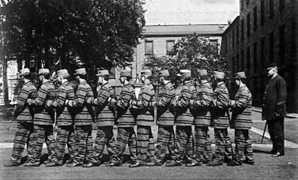
The American Prison in 1931: High Ideals, Harsh Realities

As part of my ongoing review of the work of the Wickersham Commission, I am reading the body’s 1931 Report on Penal Institutions, Probation, and Parole.  I’m much struck by the Commission’s ringing statement about the purpose of prison:

The function of the penal institutions is protection of society.  To this end all efforts must be bent and all administrative methods be adapted.  All judgment upon the functioning of our prison system, or any unit within in, must be in terms of protection of society.  This raises the question of how penal institutions can best contribute to this objective.  There seems but one answer possible — by the reformation of the criminal.  Nearly all prisoners, even within the longterm institutions, are ultimately released. . . . Unless these prisoners are so readjusted before release that they are more likely to be law-abiding citizens than before they were arrested and sentenced, then the prison has not served its purpose.  If the prison experience not merely fails to improve the character of the inmate but actually contributes to his deterioration; if, as is charged, our prisons turn the less hardened into more hardened criminals, then the prison has not only failed in its duty to protect society but has in turn become a contributor to the increase of crime within the community.  Stated positively, it is the function of the prison to find the means so to reshape the interests, attitudes, habits, the total character of the individual so as to release him both competent and willing to find a way of adjusting himself to the community without further law violations.  (6-7)

This passage interests me for two reasons.  First, viewed from a contemporary perspective, it seems a remarkably limited and arguably very naive view of the prison’s function.

Continue ReadingThe American Prison in 1931: High Ideals, Harsh Realities