
Prof. Merrill’s Hallows Lecture on How Implicit Legal Ideas Have Deformed the Constitution
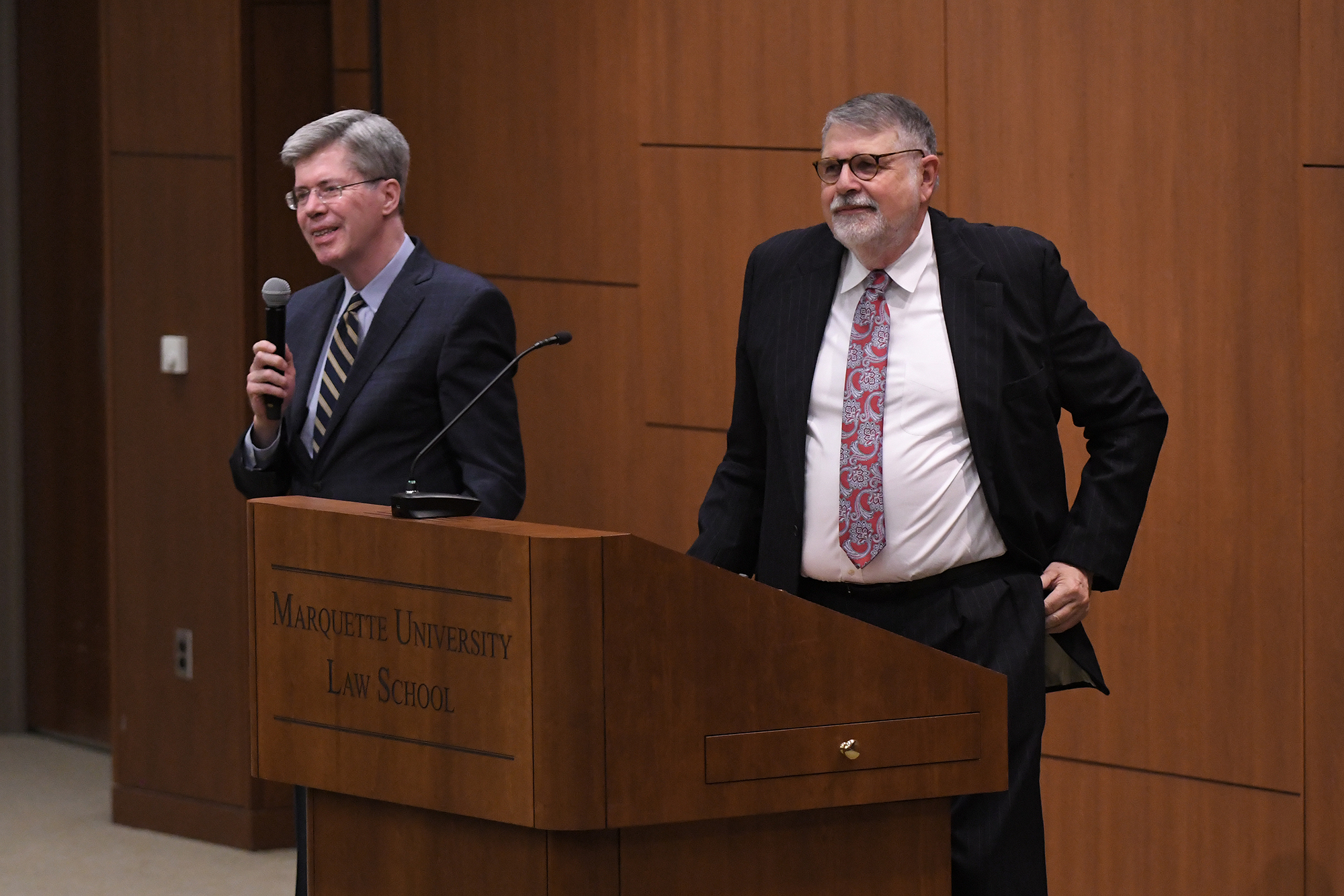
Thomas W. Merrill amd Joe Kearney at a podium.
Dean Kearney (left) welcomes a question for Prof. Merrill after the Hallows Lecture.

The Law School had the privilege earlier this week to present our annual Hallows Lecture. The occasion remembers E. Harold Hallows, a Milwaukee lawyer who taught part-time at Marquette Law School during 1930–1958 and then served on the Wisconsin Supreme Court from 1958 until his death in 1974, the last six years as chief justice. For the lecture, we welcomed Thomas W. Merrill, the Charles Evans Hughes Professor of Law at Columbia University, one of the nation’s most widely respected legal scholars.

Prof. Merrill’s Hallows Lecture, delivered on March 2 in the Lubar Center before 200 people (we counted), was rather a tour de force. Here were the title and advance description:

“Unstated”: How Three Implicit Legal Ideas Have Sidelined Congress and Empowered the President and the Courts

Why has Congress, the constitutional keystone of the federal government, become so ineffective, relative to the president and the federal judiciary? While many explanations have been offered, one important but unappreciated reason is legal ideas—not just widely discussed concepts such as the unitary executive and originalist interpretation of the Constitution but also, and perhaps even more importantly, unstated ideas that have taken hold without much explicit discussion or acknowledgment. This lecture will identify and discuss three largely unquestioned ideas that have combined to deform our constitutional regime. Their result has been that the president wields immense power in the guise of issuing orders and binding regulations and the courts exercise great power in the guise of interpreting the Constitution and laws, while Congress stands largely out of the picture. While there is no magic incantation for restoring a proper constitutional balance, an important first step is to recognize the role that unstated ideas have played in the transformation, so that they can be unmasked and debated in the open.

Even in advance of its publication this coming fall in the Marquette Law Review and Marquette Lawyer, Professor Merrill serialized the lecture this week for a national audience on the Volokh Conspiracy blog. Following an introductory post by Professor Eugene Volokh, the blog featured the following posts the past four days, March 2–5:

  1. How Unstated Legal Ideas Have Deformed the Constitution
  2. The “Unitary Executive” Theory’s Contribution to the Deformation of the Constitution
  3. The Role of Delegation Theories in Deforming the Constitution
  4. How the Supreme Court’s Conception of Its Role Contributes to the Deformation of the Constitution

The text of the entire lecture as prepared for presentation can be read here, and a video of the lecture is available to view here.
Continue ReadingProf. Merrill’s Hallows Lecture on How Implicit Legal Ideas Have Deformed the Constitution

Is it Time for More Than Just “Thoughts and Prayers”?

This semester in Professor Lisa Mazzie’s Advanced Legal Writing: Writing for Law Practice seminar, students are required to write one blog post on a law- or law school-related topic of their choice. Writing blog posts as a lawyer is a great way to practice writing skills, and to do so in a way that allows the writer a little more freedom to showcase his or her own voice, and—eventually for these students—a great way to maintain visibility as a legal professional. Here is the first of those blog posts, this one written by 2L Michael Van Kleunen.

Since the high school shooting in Parkside, Florida, we have seen an arguably unprecedented response from citizens and politicians speaking out on the topic of gun control and the extent to which a policy should be implemented. However, the National Rifle Association (NRA) and other gun rights groups have maintained a strong stance against policies that limit the proliferation of guns in the United States, basing their argument on the Second Amendment.

These groups have profoundly affected political rhetoric and the subsequent legislative landscape for decades. Recent polls have shown a majority of Americans would like to see Congress pass some kind of gun control legislation. But why has it taken so long for such policies to move forward? One key reason is the amount of campaign contributions issued to politicians who occupy vital positions that, inherent in their position, facilitate the creation and passing of legislation.

Continue ReadingIs it Time for More Than Just “Thoughts and Prayers”?

Marquette Law Review Article Featured in Prescription Painkiller Exposé

In cooperation with 60 Minutes, the Washington Post has published a fascinating new story about the behind-the-scenes efforts of actors in the pharmaceuticals business to soften regulatory enforcement at the just the time that the nation’s opioid problems were reaching epidemic proportions. The story would be an engaging read for anyone, but Marquette folks may note a particular point of interest: the Post prominently quotes a forthcoming article in the Marquette Law Review.

According to the Post story, the federal Drug Enforcement Administration has long had authority to block suspiciously large shipments of prescription painkillers that pose an imminent danger to the community. In the late years of the Bush Administration and early years of the Obama Administration, the DEA became increasingly aggressive in using this authority to target businesses that were involved in questionable ways with the distribution of opioids. The Post reports that these businesses pushed back, initially finding some success through lobbying the Department of Justice. However, they seemingly had their greatest success when Congress passed, and President Obama signed into law, changes to the DEA’s enforcement standards and procedures.

This legislation is the subject of the Marquette Law Review piece, authored by John Mulrooney and Katherine Legel. Mulrooney is an administrative law judge with the DEA. Legel, a graduate of Marquette Law School, was a judicial law clerk with the DEA. Of the 2016 law, they write, “If it had been the intent of Congress to completely eliminate the DEA’s ability to ever impose an immediate suspension on distributors or manufacturers, it would be difficult to conceive of a more effective vehicle for achieving that goal.” This and other aspects of the law review article are noted in the Post’s reporting. Student-editors who have been working on the article should feel gratified to see the piece playing such a prominent role in the ongoing efforts of journalists, policymakers, and academics to better understand the multitude of factors that may be contributing to the current opioid crisis.

Continue ReadingMarquette Law Review Article Featured in Prescription Painkiller Exposé