 United States Supreme Court Justice Antonia Scalia’s appearance as the keynote speaker at the dedication of Eckstein Hall this past September was a great honor for both Marquette University and the Law School.
However, it was by no means the first visit of a United States Supreme Court justice to the law school. In fact, it was not even Justice Scalia’s first visit. In 1997, he delivered the annual Hallows Lecture, that year entitled,”A Matter of Interpretation: Federal Courts and the Law.”
The record is not entirely clear when a Supreme Court Justice first visited the law school.
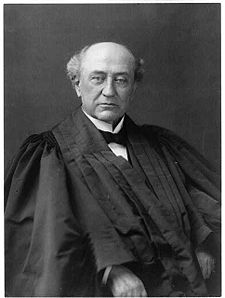
In August of 1909, Justice David Brewer (pictured at the top) came to Milwaukee to address the annual meeting of the Northwestern Life Insurance Company, and while here Brewer almost certainly visited his friend James Jenkins. The two men had known each other as fellow federal judges for many years, and they had served together on the American Bar Association special committee that drafted the original Canons of Ethics which were promulgated in 1908. In 1909, Jenkins was, of course, the dean of the Marquette Law School.
On the other hand, in August 1909, the law school was in summer recess—the last classes had been held on June 24, and the 1909-1910 academic year did not begin until September 13. Moreover, there was no separate law school building in 1909. The Mackie Mansion would be taken over by the law school in 1910, but prior to that classes were held in Johnston Hall. So it is hard to know if Brewer actually visited the “law school” and if he did, it would have been while classes were not in session.
In August 1912, Marquette sponsored a reception for the Association of American Law Schools which was meeting in Milwaukee in conjunction with the American Bar Association. Present at the meeting was future Supreme Court Chief Justice Harlan Fiske Stone. Stone was then the dean of the Columbia Law School, so it seems likely that he would have attended the reception and may have visited the law school as well. (Future Supreme Court Justice George Sutherland was also a speaker at the 1912 ABA meeting in Milwaukee.)
Later that year President (and future Supreme Court Justice) William Howard Taft visited the Marquette campus during his reelection campaign and likely visited the law school as well. (At the time the law school was in the Mackie Mansion which was on the site now occupied by Sensenbrenner Hall.)
The first documented visit by a sitting Supreme Court justice to the law school came in 1958 when Justice Tom Clark delivered an address in honor of the law school’s 50th Anniversary. Clark’s address was entitled, “The Supreme Court as the Protecter [sic] of Liberty Under Law.” This visit occurred during the deanship of Reynolds Seitz.
Clark was the first of three Warren Court justices to visit the law school between 1958 and 1968. In 1965, William Brennan was the speaker at the annual Law Review banquet, and three years later, William O. Douglas appeared at the ceremony marking the opening of the new law library.
More recently, Chief Justice William Rehnquist was the 1988 Marquette University Commencement speaker. As mentioned above, Justice Scalia delivered the 1997 Hallows Lecture, and in 2008, retired Justice Sandra Day O’Connor appeared at law school for a Mike Gousha interview.
For now, that appears to be the complete list of Supreme Court justice visits, although it seems possible that other justices may have visited law school between 1912 and 1958, but that records of those visits have not yet surfaced.
For example, Justice Pierce Butler, who was Roman Catholic and who served on the Supreme Court in the 1920’s and 1930’s, regularly passed through Milwaukee on his way from Washington to his home in Minneapolis. It would be no great surprise to learn that somewhere along the line Justice Butler paid a visit to the law school.
The remarks delivered by several justices on the occasion of their visits to Marquette have been published in the Marquette Law Review. These include:
Justice Clark (43 Marq. L. Rev. 11)
Justice Brennan (48 Marq. L. Rev. 437)
Chief Justice Rehnquist (72 Marq. L. Rev. 145)
I owe a special debt of thanks to our alumnus Daniel Suhr for the idea for this post and for his assistance in collecting this information.