 The way that the media reports on the Supreme Court, one gets the impression that the Court is divided into two intractable four-justice blocs, with Justice Anthony Kennedy deciding most of the cases by swaying back and forth between the two blocs.
(Under this interpretation, the conservative block is made up of Chief Justice John Roberts, as well as Justices Alito, Scalia and Thomas, while the liberal bloc includes Justices Breyer, Ginsburg, Kagan, and Sotomayor.)
Using data compiled from the SCOTUS blog regarding the Court’s 5-4 decisions since the appointment of Chief Justice Roberts, the Court actually divides into three three-justice blocs:
An all-female, “liberal” bloc including Justices Ginsburg, Kagan, and Sotomayor, who agree with each other virtually all the time; an all-male, three judge “conservative” bloc made up of Justices Roberts, Alito, and Thomas, who agree with each other in the vast majority of cases, but without quite the same degree of uniformity as their liberal counterparts. This leaves a three justice bloc in the middle, composed of Justices Breyer, Kennedy, and Scalia, who are less likely to agree with the members of the other two blocs.
In the first bloc, Justices Ginsburg and Kagan have never disagreed with each other in regard to the result in a case that was decided by a 5-4 margin. Justice Sotomayor, in contrast, has agreed with both Ginsburg and Kagan a mere 95% of the time.
In the second block, Justices Roberts and Alito have reached the same result 95% of the time in 5-4 decisions. Thomas and Alito have agreed 91% of the time, while the figure for Thomas and Roberts is 87%.
The justices in the middle group are, in many ways the most interesting. They are grouped together not because they agree with each other (which they do not), but because their voting patterns often fail to align with either of the other two groups. Justices Kennedy and Breyer have reached the same result in 43% of the cases, while Kennedy and Scalia have been together 52% of the time. Perhaps the most remarkable statistic, however, is that Scalia and Breyer have voted with each other in only 4% of the court’s 5-4 decisions since 2006.
As the following table indicates, Justice Breyer votes much more frequently with the “liberal” first group, while both Kennedy and Scalia side with the “conservative” second group approximately two-thirds and three-fourths of the time, respectively.
| Voting with |
Ginsburg |
Kagan |
Sotomayor |
Thomas |
Roberts |
Alito |
| BREYER |
78% |
78% |
73% |
26% |
26% |
23% |
| KENNEDY |
30% |
30% |
36% |
61% |
65% |
73% |
| SCALIA |
26% |
265 |
23% |
74% |
78% |
73% |
|
|
|
|
|
|
|
The pairings least likely to vote together in 5-4 cases are Alito-Ginsburg; Alito-Kagan; and Roberts-Sotomayor. The two justices in those pairings have never voted with each other in a 5-4 decision. Also normally disagreeing are Breyer-Scalia (4% agreement, discussed above); Alito-Sotomayor (5%); Thomas-Ginsburg (9%); Thomas-Kagan (9%); and Thomas-Sotomayor (14%).

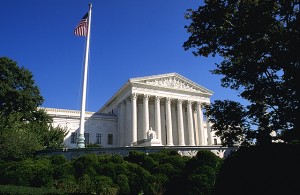 OK, hold onto your seats for some flat-out ERISA law excitement. This morning, the United States Supreme Court heard oral argument in Heimeshoff v. Hartford Life & Accidental Insurance Co. [Briefs at SCOTUSblog], concerning statute of limitation accrual issues for benefit claims under Section 502(a)(1)(B) of ERISA.