The Law and Pastries
 In law school, we learn to “think like a lawyer.” As the fictional Professor Kingsfield put it, we develop “the ability to analyze that vast complex of facts that constitute the relationships of members within a given society.” We learn the rules under which those relationships operate, and the theory and reasons behind how we handle things when those relationships go sour. We begin to see the world around us in a different light – the light of the law.
Torts got me first. I was seeing standards of care, the illusive reasonable man, and potential negligence wherever I went – except at my house, where we always behave reasonably and prudently. Contracts are no longer something I quickly sign and shove back across the counter. Don’t get me wrong, I only read them for entertainment value before signing. After all, I want my iPhone, and there is a reason they’re called adhesion contracts. Property’s spell struck when I encountered a private driveway, which crossed a county bike trail, which ran along a We-Energies right of way. I’ll leave constitutional law and criminal law to your imaginations, but I will say that I haven’t had to invoke any of my rights, nor has anyone had to read them to me. Finally, although I didn’t encounter it in real life, civil procedure did haunt my dreams for a while. Fortunately, new areas of the law from my summer session courses have started to edge out the 1L voices in my head.
One course, intellectual property, has me seeing trademarks and copyright disputes all over the place. Like everyone else, I had been seeing trademarks everywhere for my whole life, I just didn’t know what a trademark was. As I learned trademark law, I remembered a story from my hometown’s recent past. It was big news at the time, but it is likely unfamiliar to people who are not from Racine, Wisconsin. (For those of you not familiar with Racine, it is a lovely city located about 30 minutes south of Milwaukee. Among other things, Racine features an award-winning beach, excellent local government, and kringle.) I’ll have more on the local government in a future posting. For now, I want to talk about pastries.
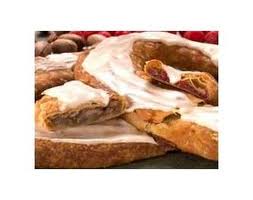
The story begins long ago, when a wave of Danish immigrants settled in Racine. Like other immigrant waves throughout our history, the Danes brought their food here. In this case, they brought kringle, a large, tasty, pretzel-shaped pastry. At some point, Racine bakers swapped the pretzel shape for an oval shape and the Racine kringle was born. For decades, Larsen’s, Lehmann’s, O & H, and Bendtsen’s bakeries prepared and sold delicious Racine kringles. There was plenty of room in the market for all of the competitors to do well, and the good people of Racine, and many lucky visitors, ate their fill of these tasty treats. All was well in kringle-land.
Then, in the 1990’s, as the rise of online sales was taking kringle beyond our borders, a new player emerged on the scene: Racine Danish Kringles (RDK).
 I recently came across an interesting cluster of similar statements from copyright decisions in the late 1950s and early 1960s, which struck me as significant: