Supreme Court Roundup Part Two: King v. Burwell

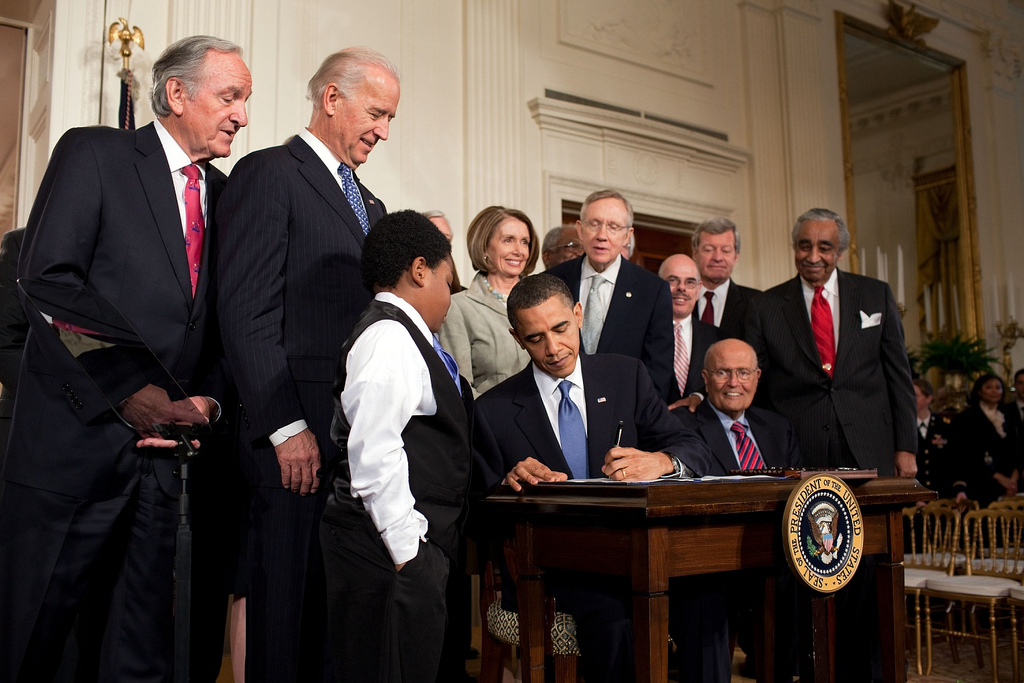
Obama_signs_health_care-20100323On October 5, I participated in an event at the Marquette University Law School entitled “Supreme Court Roundup” with Cato Institute Scholar Ilya Shapiro.  The event was sponsored by the Law School Chapters of the Federalist Society and the American Constitution Society.  A previous post contained my remarks on Obergefell v. Hodges (the “Gay Marriage case”).  What follows are my prepared remarks on King v. Burwell (the “Obamacare case”).

The issue in this case was whether the Affordable Care Act’s tax credits are available in States that have a federal health insurance exchange rather than a state exchange. In Section 36A, the Affordable Care Act (commonly known as “Obamacare”) states that tax credits “shall be allowed” for any “applicable taxpayer.” Then, in Section 36B, the Act provides that the amount of the tax credit depends in part on whether the taxpayer has enrolled in an insurance plan through “an Exchange established by the State.” (emphasis added).

In King v. Burwell, the U.S. Supreme Court, in an opinion written by Chief Justice John Roberts, held that Section 36B allows tax credits to be used for insurance purchased on any exchange created under the Act, including insurance purchased on a federal exchange.

I want to be clear.  I make the following statement with the intent to be as objective and non-partisan as possible.  This litigation was nothing more than a post hoc attack on the Affordable Care Act, using one isolated provision of the law read out of context in order to arrive at a nonsensical meaning, which then used a manufactured theory of legislative intent – a theory without a shred of contemporaneous support in the legislative history – in a desperate attempt to prop up the nonsensical meaning.

The background of how this case arose is illuminating.

Continue ReadingSupreme Court Roundup Part Two: King v. Burwell

Supreme Court Roundup Part One: Obergefell v. Hodges

b599a34c0d512e42e3f5277e172bbebcd745dd98Today marks the beginning of the United States Supreme Court’s 2015-2016 Term, and coincidentally it also marked my participation in an annual event at the Marquette University Law School entitled “Supreme Court Roundup.”  Along with Cato Institute Scholar and Supreme Court expert Ilya Shapiro, I was invited by the Law School Chapters of the Federalist Society and the American Constitution Society to share my perspective on three cases from the Supreme Court’s docket last year.  The cases we discussed included Obergefell v. Hodges (the “Gay Marriage case”), King v. Burwell (the “Obamacare case”) and Yates v. United States (the “fish case”).  Thanks to the law students for the invitation and a special thank you to Mr. Shapiro for his participation.  What follows are my prepared remarks on the Obergefell case.

I call this case “Thurgood Marshall’s Revenge.”

In Obergefell v. Hodges, the Supreme Court held that state laws denying marriage licenses to same sex couples violated the Equal Protection Clause of the United States Constitution.

Justice Kennedy’s majority opinion in Obergefell is notable for what it does not talk about. The majority opinion does not rely upon the theory that marriage is a fundamental right and that therefore state laws infringing upon the right to marriage must be subjected to strict scrutiny. Nor does the majority opinion rely upon the theory that homosexuals are a suspect class, thereby subjecting state laws that treat homosexuals different than heterosexuals to strict scrutiny under the Equal Protection Clause.

The methods by which the Court has traditionally determined whether to apply heightened standards of review to legislative acts – strict scrutiny, intermediate scrutiny, heightened rational review – are what are known as “heuristic devices.” These are artificial aids to problem solving. The Constitution does not use the phrases “strict scrutiny” or “suspect class,” but by creating artificial rules that group cases under these headings, the Supreme Court has developed a methodology for defining the outer boundaries of state policing over individual freedom.

Instead of using the Obergefell case as an opportunity to develop and clarify how the concepts of strict scrutiny and suspect class inform the Court’s interpretation of the Constitution, the majority opinion simply ignores these heuristic devices altogether. In doing so, the majority seems to be belatedly embracing the view of Justice Thurgood Marshall in a 1973 dissenting opinion.

Continue ReadingSupreme Court Roundup Part One: Obergefell v. Hodges

Access to Justice in a Civil Context

ATJ-reportIndigent defendants in criminal cases, and select civil matters (i.e., child in need of protective services petitions, termination of parental rights petitions, Chapter 51 petitions, and Chapter 980 petitions), are entitled to the appointment of counsel when they cannot afford representation. Either the state public defender’s office represents the individual, or an attorney is appointed by the county. It is imperative that individuals facing some form of deprivation of their individual liberty and freedom, as in the aforementioned scenarios, be represented.

But, what happens in other types of civil matters, where there is no right to counsel? What happens when a person or family faces a legal issue that will affect their rights, health, safety, economic security, and overall well-being? All people, regardless of socioeconomic status, should have access to the justice system. While some individuals may be able to handle a matter pro se, meaningful legal assistance or full representation is often needed to assist individuals in asserting and defending their rights.

The Wisconsin Access to Justice Commission (WATJC) is one entity working toward “improving the administration of justice by supporting civil legal services to those who cannot afford them”. In 2011, Wisconsin became one of only four states nationally, and the only state in the Midwest, that failed to provide any state funding for civil legal services. The 2015-2017 budget appropriates $500,000 per year of the biennium for civil legal aid service to abuse victims. This sum is well below the other neighboring states. Minnesota, for example, appropriated over 12 million dollars per year of its biennium for civil legal services. According to WATJC, the average budget for indigent civil legal services in other Midwestern states is $7.6 million. While Wisconsin falls well below that average, it is at least an improvement that the current state budget appropriates some funding, albeit for a very specific class of litigants.

There are a variety of agencies that offer legal assistance and full-representation to indigent clients in civil matters. From my experience working at Centro Legal, I am aware that many more people were in need of assistance than that organization had the capacity to handle. While I cannot speak for other agencies, my best guess is that they also have more work than they can take on, and that as a result many people are turned away because there just isn’t the capacity to represent them. There are notable efforts to coordinate volunteer attorneys and to help people be matched with an attorney that would be willing to take on a case for a reduced rate. With low levels of funding from the state to support agencies already offering civil representation, the difference must be made up somehow. Whether it is volunteering to represent someone, participating as a volunteer at one of the several clinics offering brief legal advice, offering a reduced rate in certain circumstances, or offering support to practitioners that incorporate as a non-profit and offer reduced rates for indigent or modest means clients, all lawyers have a role to play in ensuring that access to justice and the legal system is not limited by one’s socioeconomic status. We all have a stake in improving access to civil legal service for people who cannot afford an attorney.

Continue ReadingAccess to Justice in a Civil Context